


Page 75 - 2024-bfw-MyersAP4e-TE
P. 75
Module 1.4b

                    The brainstem is also a crossover point, where most nerves
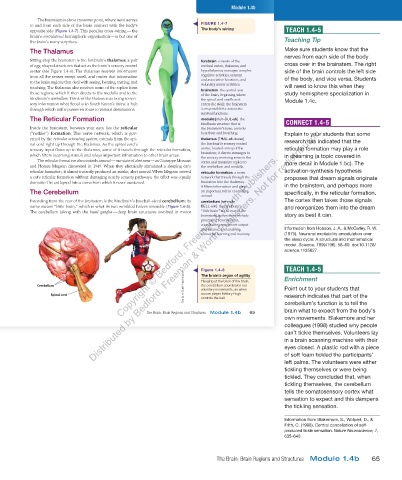
                 to and from each side of the brain connect with the body’s   FIGURE 1.4-7
                 opposite side (Figure 1.4-7). This peculiar cross- wiring — the   The body’s wiring  TEACH 1.4-5
                 brain’s contralateral hemispheric organization — is but one of
                 the brain’s many surprises.                                                         Teaching Tip
                 The Thalamus                                                                        Make sure students know that the
                                                                                                     nerves from each side of the body
                 Sitting atop the brainstem is the forebrain’s thalamus, a pair   forebrain  consists of the
                 of egg-shaped structures that act as the brain’s sensory control   cerebral cortex, thalamus, and   cross over in the brainstem. The right
                 center (see Figure 1.4-6). The thalamus receives information   hypothalamus; manages complex   side of the brain controls the left side
                 from all the senses except smell, and routes that information   cognitive activities, sensory   of the body, and vice versa. Students
                 to the brain regions that deal with seeing, hearing, tasting, and   and associative functions, and
                                                                         voluntary motor activities.
                 touching. The thalamus also receives some of the replies from   brainstem  the central core   will need to know this when they
                 those regions, which it then directs to the medulla and to the   of the brain, beginning where   study hemisphere specialization in
                 hindbrain’s cerebellum. Think of the thalamus as being to sen-  the spinal cord swells as it   Module 1.4c.
                 sory information what Seoul is to South Korea’s trains: a hub   enters the skull; the brainstem
                 through which traffic passes en route to various destinations.  is responsible for automatic
                                                                         survival functions.
                 The Reticular Formation                                 medulla [muh-DUL-uh]  the
                                                                         hindbrain structure that is   CONNECT 1.4-5
                                      Distributed by Bedford, Freeman & Worth Publishers. Not for redistribution.
                 Inside the brainstem, between your ears, lies the reticular     the brainstem’s base; controls
                 (“netlike”)  formation. This nerve network, which is gov-  heartbeat and breathing.  Explain to your students that some
                 erned by the reticular activating system, extends from the spi-  thalamus [THAL-uh-muss]     research has indicated that the
                 nal cord right up through the thalamus. As the spinal cord’s   the forebrain’s sensory control
                 sensory input flows up to the thalamus, some of it travels through the reticular formation,   center, located on top of the     reticular formation may play a role
                                                                         brainstem; it directs messages to
                                               Copyright © Bedford, Freeman & Worth Publishers.
                 which filters incoming stimuli and relays important information to other brain areas.  the sensory receiving areas in the   in dreaming (a topic covered in
                    The reticular formation also controls arousal — our state of alertness — as Giuseppe  Moruzzi   cortex and transmits replies to   more detail in Module 1.5c). The
                 and Horace Magoun discovered in 1949. When they electrically stimulated a sleeping cat’s   the cerebellum and medulla.
                   reticular formation, it almost instantly produced an awake, alert animal. When Magoun severed   reticular formation  a nerve    activation-synthesis hypothesis
                 a cat’s reticular formation without damaging nearby sensory pathways, the effect was equally   network that travels through the   proposes that dream signals originate
                 dramatic: The cat lapsed into a coma from which it never awakened.  brainstem into the thalamus;
                                                                         it filters information and plays   in the brainstem, and perhaps more
                 The Cerebellum                                          an important role in controlling   specifically, in the reticular formation.
                                                                         arousal.
                 Extending from the rear of the brainstem is the hindbrain’s baseball-sized cerebellum; its   cerebellum [sehr-uh-   The cortex then takes those signals
                 name means “little brain,” which is what its two wrinkled halves resemble (Figure 1.4-8).     BELL-um]  the hindbrain’s   and reorganizes them into the dream
                 The cerebellum  (along with  the  basal  ganglia — deep brain  structures involved  in motor   “little brain” at the rear of the
                                                                         brainstem; its functions include   story as best it can.
                                                                         processing sensory input,
                                                                         coordinating movement output
                                                                         and balance, and enabling   Information from Hobson, J. A., & McCarley, R. W.
                                                                         nonverbal learning and memory.  (1975). Neuronal excitability amodulation over
                                                                                                     the sleep cycle: A structural and mathematical
                                                                                                     model. Science, 189(4196), 58–60. doi:10.1126/
                                                                                                     science.1135627
                                                                         Figure 1.4-8                TEACH 1.4-5
                                                                    Tony Quinn/ZUMA Press/Newscom  voluntary movements, as when   Point out to your students that
                                                                         The brain’s organ of agility
                                                                         the cerebellum coordinates our
                    Cerebellum                                           Hanging at the back of the brain,   Enrichment
                        Spinal cord                                      soccer player Mallory Pugh   research indicates that part of the
                                                                         controls the ball.
                                                                                                     cerebellum’s function is to tell the
                                                                                                     brain what to expect from the body’s
                                                        The Brain: Brain Regions and Structures  Module 1.4b   65
                                                                                                     own movements. Blakemore and her
                                                                                                     colleagues (1998) studied why people
                                                                                                     can’t tickle themselves. Volunteers lay
                                                                                                     in a brain scanning machine with their
         03_myersAPpsychology4e_28116_ch01_002_163.indd   65                              15/12/23   9:23 AM
                                                                                                     eyes closed. A plastic rod with a piece
                                                                                                     of soft foam tickled the participants’
                                                                                                     left palms. The volunteers were either
                                                                                                     tickling themselves or were being
                                                                                                     tickled. They concluded that, when
                                                                                                     tickling themselves, the cerebellum
                                                                                                     tells the somatosensory cortex what
                                                                                                     sensation to expect and this dampens
                                                                                                     the tickling sensation.

                                                                                                     Information from Blakemore, S., Wolpert, D., &
                                                                                                     Frith, C. (1998). Central cancellation of self-
                                                                                                     produced tickle sensation. Nature Neuroscience, 1,
                                                                                                     635–640.


                                                                              The Brain: Brain Regions and Structures Module 1.4b   65


          03_HammerTE4e_47547_ch01_2a_163_4pp.indd   65                                                                         07/02/24   5:22 PM

