


Page 71 - 2024-bfw-MyersAP4e-TE
P. 71
Module 1.4a

                 One neuroscience team scanned 129 people’s brains as they did eight different mental
                 tasks (such as reading, gambling, or rhyming). Later, they were able, with 80 percent accu-
                 racy, to identify which of these mental activities the study participants had been doing
                 (Poldrack et al., 2018).
                    You’ve undoubtedly seen pictures of colorful “lit-up” brain regions with accompanying
                 headlines, such as “your brain on music.” Although brain areas don’t actually light up, vivid
                 brain scan images seem impressive. In fact, people have rated scientific explanations as more     PRACTICE
                 believable and interesting when they contain neuroscience (Fernandez-Duque et al., 2015;
                 Im et al., 2017). But “neuroskeptics” caution against overblown claims about any ability to
                 predict customer preferences, to detect lies, and to foretell crime based on neuroscience   Research Methods & Design
                 (Schwartz et al., 2016). Neuromarketing, neuroleadership, neurolaw, and neuropolitics are   (SP 2)
                 often neurohype. Imaging techniques illuminate brain structure and activity, and sometimes
                 they can help us test different theories of behavior (Mather et al., 2013). But given that all   (5 minutes) Explain to your
                 human experience is brain based, it’s no surprise that different brain areas become active     students that researchers are quick
                 when one listens to a lecture or lusts for a lover.                                  to acknowledge the limits of their
                    Today’s techniques for peering into the thinking, feeling brain are doing for
                   psychology what the microscope did for biology and the telescope did for astronomy.   methodology. For example, Eric
                 European researchers have undertaken a $1 billion Human Brain Project (Salles et al.,   Kandel of Columbia University
                 2019). Another project is exploring brain aging from age 3 to 96 (Pomponio et al., 2020).   College of Physicians and Surgeons
                 These massive undertakings harness
                                      Distributed by Bedford, Freeman & Worth Publishers. Not for redistribution.
                 the collective power of hundreds of                                                  states, “If a number of areas show
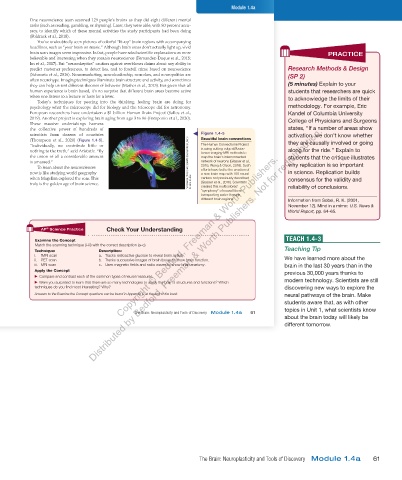
                 scientists from dozens of countries                     Figure 1.4-5                 activation, we don’t know whether
                 (Thompson et al., 2020) (Figure 1.4-5).                 Beautiful brain connections  they are causally involved or going
                 “Individually, we contribute little or                  The Human Connectome Project
                                                                         is using cutting-edge diffusion
                 nothing to the truth,” said Aristotle. “By              tensor imaging MRI methods to   along for the ride.”  Explain to
                 the union of all a considerable amount                  map the brain’s interconnected   students that the critique illustrates
                 is amassed.”                                        Tom Barrick, Chris Clark, SGHMS/Science Photo Library/  network of neurons (Glasser et al.,   why replication is so important
                    To learn about the neurosciences                     2016; Wang & Olson, 2018). Such
                                                                         efforts have led to the creation of
                 now is like studying world geography                    a new brain map with 100 neural   in science. Replication builds
                 when Magellan explored the seas. This                   centers not previously described     consensus for the validity and
                 truly is the golden age of brain science.            Science Source  (Glasser et al., 2016). Scientists   reliability of conclusions.
                                                                         created this multicolored
                                                                         “symphony” of neural fibers
                                                                         transporting water through
                                                                         different brain regions.     Information from Sobel, R. K. (2001,
                                                                                                      November 12). Mind in a mirror. U.S. News &
                                                                                                      World Report, pp. 64–65.
                       ®
                     AP  Science Practice  Check Your Understanding
                   Examine the Concept         Copyright © Bedford, Freeman & Worth Publishers.      TEACH 1.4-3
                   Match the scanning technique (i–iii) with the correct description (a–c).
                   Technique:           Description:                                                 Teaching Tip
                   i.   fMRI scan       a.  Tracks radioactive glucose to reveal brain activity.
                   ii.   PET scan       b.  Tracks successive images of brain tissue to show brain function.  We have learned more about the
                   iii.  MRI scan       c.  Uses magnetic fields and radio waves to show brain anatomy.  brain in the last 30 years than in the
                   Apply the Concept                                                                 previous 30,000 years thanks to
                   ▶ ▶Compare and contrast each of the common types of neural measures.
                   ▶ ▶Were you surprised to learn that there are so many technologies to study the brain’s structures and functions? Which   modern technology. Scientists are still
                   techniques do you find most interesting? Why?                                     discovering new ways to explore the
                   Answers to the Examine the Concept questions can be found in Appendix C at the end of the book.  neural pathways of the brain. Make
                                                                                                     students aware that, as with other
                                                                                                     topics in Unit 1, what scientists know
                                                    The Brain: Neuroplasticity and Tools of Discovery  Module 1.4a   61
                                                                                                     about the brain today will likely be
                                                                                                     different tomorrow.

         03_myersAPpsychology4e_28116_ch01_002_163.indd   61                              15/12/23   9:22 AM


                                                                         The Brain: Neuroplasticity and Tools of Discovery Module 1.4a   61


          03_HammerTE4e_47547_ch01_2a_163_4pp.indd   61                                                                         07/02/24   5:21 PM

