


Page 69 - 2024-bfw-MyersAP4e-TE
P. 69
Module 1.4a

                    Newer neuroimaging techniques give us a superhero-like ability to see inside the
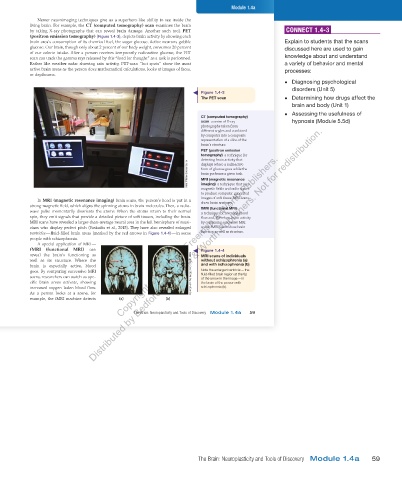
                 living brain. For example, the CT (computed tomography) scan examines the brain
                 by taking X-ray photographs that can reveal brain damage.  Another such tool,  PET   CONNECT 1.4-3
                   (positron emission tomography) (Figure 1.4-3), depicts brain activity by showing each
                 brain area’s consumption of its chemical fuel, the sugar glucose. Active neurons gobble   Explain to students that the scans
                 glucose. Our brain, though only about 2 percent of our body weight, consumes 20 percent   discussed here are used to gain
                 of our calorie intake. After a person receives temporarily radioactive glucose, the PET
                 scan can track the gamma rays released by this “food for thought” as a task is performed.   knowledge about and understand
                 Rather like weather radar showing rain activity, PET-scan “hot spots” show the most   a variety of behavior and mental
                 active brain areas as the person does mathematical calculations, looks at images of faces,   processes:
                 or daydreams.
                                                                                                     •  Diagnosing psychological
                                                                                                       disorders (Unit 5)
                                                                         Figure 1.4-3
                                                                         The PET scan                •  Determining how drugs affect the
                                                                                                       brain and body (Unit 1)
                                                                                                     •  Assessing the usefulness of
                                                                         CT (computed tomography)
                                                                         scan  a series of X-ray       hypnosis (Module 5.5d)
                                                                         photographs taken from
                                      Distributed by Bedford, Freeman & Worth Publishers. Not for redistribution.
                                                                         different angles and combined
                                                                         by computer into a composite
                                                                         representation of a slice of the
                                                                         brain’s structure.
                                                                         PET (positron emission
                                               Copyright © Bedford, Freeman & Worth Publishers.
                                                                         tomography)  a technique for
                                                                         detecting brain activity that
                                                                     Voisin/Phanie/Science Source  form of glucose goes while the
                                                                         displays where a radioactive
                                                                         brain performs a given task.
                                                                         MRI (magnetic resonance
                                                                         imaging)  a technique that uses
                                                                         magnetic fields and radio waves
                                                                         to produce computer-generated
                                                                         images of soft tissue. MRI scans
                    In MRI (magnetic resonance imaging) brain scans, the person’s head is put in a   show brain anatomy.
                 strong magnetic field, which aligns the spinning atoms in brain molecules. Then, a radio-  fMRI (functional MRI)
                 wave pulse momentarily disorients the atoms. When the atoms return to their normal   a technique for revealing blood
                 spin, they emit signals that provide a detailed picture of soft tissues, including the brain.   flow and, therefore, brain activity
                 MRI scans have revealed a larger-than-average neural area in the left hemisphere of musi-  by comparing successive MRI
                 cians who display perfect pitch (Yuskaitis et al., 2015). They have also revealed enlarged   scans. fMRI scans show brain
                   ventricles — fluid-filled brain areas (marked by the red arrows in Figure 1.4-4) — in some   function as well as structure.
                 people with schizophrenia.
                    A special application of MRI —
                 fMRI  (functional  MRI) — can                           Figure 1.4-4
                 reveal the brain’s functioning as                       MRI scans of individuals
                 well as its structure.  Where the                       without schizophrenia (a)
                 brain is especially active, blood                       and with schizophrenia (b)
                 goes. By comparing successive MRI                    From Daniel R Weinberger, M.D., CBDB, NIMH  Note the enlarged ventricle — the
                                                                         fluid-filled brain region at the tip
                 scans, researchers can watch as spe-                    of the arrow in the image — in
                 cific brain areas activate, showing                     the brain of the person with
                 increased oxygen-laden blood flow.                      schizophrenia (b).
                 As a person looks at a scene, for
                 example, the fMRI machine detects   (a)      (b)
                                                   The Brain: Neuroplasticity and Tools of Discovery  Module 1.4a   59


         03_myersAPpsychology4e_28116_ch01_002_163.indd   59                              15/12/23   9:22 AM


                                                                        The Brain: Neuroplasticity and Tools of Discovery Module 1.4a   59


          03_HammerTE4e_47547_ch01_2a_163_4pp.indd   59                                                                         07/02/24   5:21 PM

