


Page 74 - 2024-bfw-MyersAP4e-TE
P. 74
®
                                                           AP  Exam Tip      the forebrain; it also controls some movement and transmits information that enables
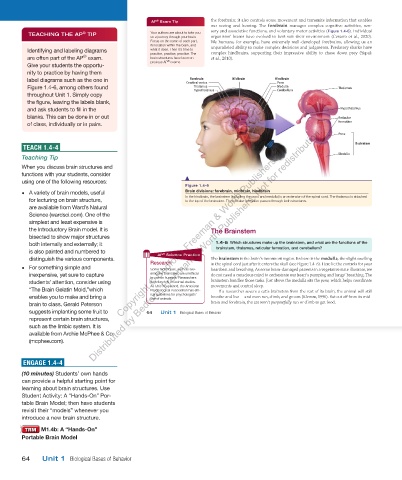
                                                                             our seeing and hearing.  The    forebrain   manages complex cognitive activities, sen-


                                   ®
                 TEACHING THE AP  TIP                      Your authors are about to take you   sory and associative functions, and voluntary motor activities  (  F igure  1.4-6 ) . Individual
                                                         on a journey through your brain.   organisms’ brains have evolved to best suit their environment ( Cesario et al., 2020 ).
                                                         Focus on the name of each part,   We humans, for example, have extremely well-developed forebrains, allowing us an
                                                         its location within the brain, and
                 Identifying and labeling diagrams       what it does. Then it’s time to   unparalleled ability to make complex decisions and judgments. Predatory sharks have
                                                                             complex hindbrains, supporting their impressive ability to chase down prey ( Yopak
                                                         practice, practice, practice. The
                                   ®
                 are often part of the AP  exam.         brain structures have been on   et al., 2010 ).
                                                                ®
                 Give your students the opportu-         previous AP    exams.
                 nity to practice by having them
                 label diagrams such as the one in                      Cerebral cortex  Midbrain  Hindbrain
                                                                      Forebrain
                                                                                                    Pons
                 Figure 1.4-6, among others found                          Thalamus                 Medulla           Thalamus
                                                                           Hypothalamus
                                                                                                    Cerebellum
                 throughout Unit 1. Simply copy
                 the figure, leaving the labels blank,
                 and ask students to fill in the                                                                       Hypothalamus
                 blanks. This can be done in or out                                                                   Reticular
                 of class, individually or in pairs.                                                                  formation
                                      Distributed by Bedford, Freeman & Worth Publishers. Not for redistribution.
                                                                                                                      Pons
                                                                                                                            Brainstem
               TEACH 1.4-4
                                                                                                                      Medulla
               Teaching Tip
               When you discuss brain structures and
               functions with your students, consider
               using one of the following resources:
                                                                              Figure   1.4-6
               •  A variety of brain models, useful                   Brain divisions: forebrain, midbrain, hindbrain
                 for lecturing on brain structure,                  In the hindbrain, the brainstem (including the pons and medulla) is an extension of the spinal cord. The thalamus is attached
                                                                    to the top of the brainstem. The reticular formation passes through both structures.

                 are available from Ward’s Natural
                 Science (wardsci.com). One of the
                 simplest and least expensive is
                 the Introductory Brain model. It is                                             The Brainstem
                 bisected to show major structures  Copyright © Bedford, Freeman & Worth Publishers.


                                                                                          1.4-5   Which structures make up the brainstem, and what are the functions of the

                 both internally and externally; it                                       1.4-5   Which structur es make up the brainstem, and what ar e the functions of the
                                                                              brainstem, thalamus, reticular formation, and cerebellum?
                 is also painted and numbered to           AP  Science Practice  brainstem, thalamus, reticular formation, and cerebellum?
                                                             ®
                 distinguish the various components.           Research        The   brainstem  is the brain’s innermost region. Its base is the   medulla   the slight swelling
                                                                                                                      ,


               •  For something simple and                 Some techniques, such as sev-  in the spinal cord just after it enters the skull (see  Figure  1.4-6 ). Here lie the controls for your
                                                                             heartbeat and breathing. As some brain-damaged patients in a vegetative state illustrate, we
                 inexpensive, yet sure to capture        ering the brainstem, are unethical   do not need a conscious mind to orchestrate our heart’s pumping and lungs’ breathing. The
                                                         to use on humans. Researchers
                 students’ attention, consider using     therefore rely on animal studies.   brainstem handles those tasks. Just above the medulla sits the  pons,  which helps coordinate
                 “The Brain Gelatin Mold,” which         As  Unit 0  explained, the American   movements and control sleep.
                                                         Psychological Association has eth-
                                                                                 If a researcher severs a cat’s brainstem from the rest of its brain, the animal will still
                 enables you to make and bring a         ical guidelines for psychologists’   breathe and live — and even run, climb, and groom ( Klemm, 1990 ). But cut off from its mid-
                                                         use of animals.

                 brain to class. Gerald Peterson                             brain and forebrain, the cat won’t  purposefully  run or climb to get food.
                 suggests implanting some fruit to      64   Unit 1  Biological Bases of Behavior
                 represent certain brain structures,
                 such as the limbic system. It is
                 available from Archie McPhee & Co.
                                                  03_myersAPpsychology4e_28116_ch01_002_163.indd   64                               15/12/23   9:22 AM
                 (mcphee.com).
               ENGAGE 1.4-4
               (10 minutes) Students’ own hands
               can provide a helpful starting point for
               learning about brain structures. Use
               Student Activity: A “Hands-On” Por-
               table Brain Model; then have students
               revisit their “models” whenever you
               introduce a new brain structure.
                     M1.4b: A “Hands-On”
               Portable Brain Model
               64   Unit 1  Biological Bases of Behavior


          03_HammerTE4e_47547_ch01_2a_163_4pp.indd   64                                                                         07/02/24   5:21 PM

