


Page 78 - 2024-bfw-MyersAP4e-TE
P. 78
Later experiments located other “pleasure centers” (Olds, 1958). (What the rats actually
                                                                             experience only they know, and they aren’t telling. Rather than attribute human feelings to rats,
               CONNECT 1.4-6                                                 today’s scientists refer to reward centers.) Just how rewarding are these reward centers? Enough
                                                                             to cause rats to self-stimulate these brain regions more than 1000 times per hour. In other spe-
               Tell your students that the neurotrans-                       cies, including dolphins and monkeys, researchers later discovered other limbic system reward
               mitters that work in reward centers are                       centers, such as the nucleus accumbens in front of the hypothalamus (Hamid et al., 2016).
                                                                               Animal research has also revealed both a general dopamine-related reward system and
               similar to drugs like cocaine and LSD,                        specific centers associated with the pleasures of eating, drinking, and sex. Animals, it seems,
               a topic that is covered in more detail                        come equipped with built-in systems that reward activities essential to survival. As neuro-
               in Module 1.3b. These drugs activate                          scientist Candice Pert (1986) observed, “If you were designing a robot vehicle to walk into
               the reward centers, leading to the                            the future and survive, . . . you’d wire it up so that behavior that ensured the survival of the
                                                                             self or the species — like sex and eating — would be naturally reinforcing.”
               desire to take the drugs again.

                                                             ®
                                                           AP  Science Practice      Data Interpretation
               TEACH 1.4-6
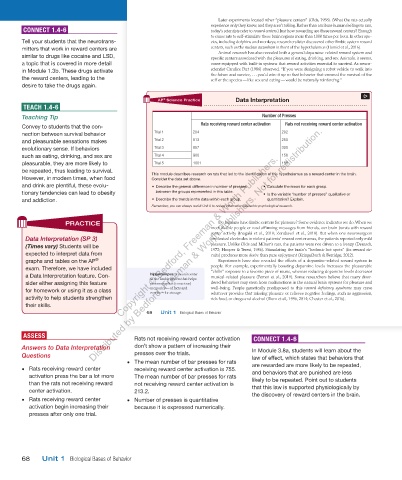
               Teaching Tip                                                                  Number of Presses
               Convey to students that the con-                          Rats receiving reward center activation  Rats not receiving reward center activation
                                      Distributed by Bedford, Freeman & Worth Publishers. Not for redistribution.
               nection between survival behavior          Trial 1      204                          202
               and pleasurable sensations makes           Trial 2      813                          250
               evolutionary sense. If behaviors           Trial 3      857                          300
                                               Copyright © Bedford, Freeman & Worth Publishers.
               such as eating, drinking, and sex are      Trial 4      900                          156
               pleasurable, they are more likely to       Trial 5      1001                         158
               be repeated, thus leading to survival.    This module describes research on rats that led to the identification of the hypothalamus as a reward center in the brain.
               However, in modern times, when food       Consider the data set above.
               and drink are plentiful, these evolu-     •  Describe the general difference in number of presses   •  Calculate the mean for each group.
               tionary tendencies can lead to obesity      between the groups represented in this table.  •  Is the variable “number of presses” qualitative or
               and addiction.                            •  Describe the trends in the data within each group.  quantitative? Explain.
                                                         Remember, you can always revisit Unit 0 to review information related to psychological research.

                             PRACTICE                                          Do humans have limbic centers for pleasure? Some evidence indicates we do. When we
                                                                             meet likable people or read affirming messages from friends, our brain bursts with reward
                                                                             center activity (Inagaki et al., 2019; Zerubavel et al., 2018). But when one neurosurgeon
                Data Interpretation (SP 3)                                   implanted electrodes in violent patients’ reward center areas, the patients reported only mild
                (Times vary) Students will be                                pleasure. Unlike Olds and Milner’s rats, the patients were not driven to a frenzy (Deutsch,
                expected to interpret data from                              1972; Hooper & Teresi, 1986). Stimulating the brain’s “hedonic hot spots” (its reward cir-
                                                                             cuits) produces more desire than pure enjoyment (Kringelbach & Berridge, 2012).
                graphs and tables on the AP ®                                  Experiments have also revealed the effects of a dopamine-related reward system in
                exam. Therefore, we have included                            people. For example, experimentally boosting dopamine levels increases the pleasurable
                                                                             “chills” response to a favorite piece of music, whereas reducing dopamine levels decreases
                a Data Interpretation feature. Con-      hippocampus  a neural center   musical-related pleasure (Ferreri et al., 2019). Some researchers believe that many disor-
                                                         in the limbic system that helps
                sider either assigning this feature      process explicit (conscious)   dered behaviors may stem from malfunctions in the natural brain systems for pleasure and
                for homework or using it as a class      memories — of facts and   well-being. People  genetically  predisposed to  this  reward  deficiency syndrome may crave
                                                                             whatever provides that missing pleasure or relieves negative feelings, such as aggression,
                                                         events — for storage.
                activity to help students strengthen                         rich food, or drugs and alcohol (Blum et al., 1996, 2014; Chester et al., 2016).
                their skills.
                                                        68   Unit 1  Biological Bases of Behavior


               ASSESS                             03_myersAPpsychology4e_28116_ch01_002_163.indd   68  CONNECT 1.4-6                15/12/23   9:23 AM
                                                    Rats not receiving reward center activation
               Answers to Data Interpretation       don’t show a pattern of increasing their   In Module 3.8a, students will learn about the
               Questions                            presses over the trials.              law of effect, which states that behaviors that
                                                 •  The mean number of bar presses for rats   are rewarded are more likely to be repeated,
               •  Rats receiving reward center      receiving reward center activation is 755.   and behaviors that are punished are less
                 activation press the bar a lot more   The mean number of bar presses for rats   likely to be repeated. Point out to students
                 than the rats not receiving reward   not receiving reward center activation is   that this law is supported physiologically by
                 center activation.                 213.2.                                the discovery of reward centers in the brain.
               •  Rats receiving reward center   •  Number of presses is quantitative
                 activation begin increasing their   because it is expressed numerically.
                 presses after only one trial.


               68   Unit 1  Biological Bases of Behavior


          03_HammerTE4e_47547_ch01_2a_163_4pp.indd   68                                                                         07/02/24   5:22 PM

