


Page 76 - 2024-bfw-MyersAP4e-TE
P. 76
movement) enables nonverbal and skill (or procedural) learning. With assistance from the
                                                                             pons, it also coordi nates voluntary movement. When a soccer player masterfully controls
               TEACH 1.4-5                                                   the ball, give their cerebellum some credit. Under alcohol’s influence, coordination suffers.
                                                                             And if you injured your cerebellum, you would have difficulty walking, keeping your bal-
               Active Learning                                               ance, or texting a friend. Your movements would be jerky and exaggerated. Gone would be
               (15 minutes) Before moving on to                              any dreams of being a dancer or guitarist.
                                                                                     This little brain — which actually contains more than half your brain’s neurons —
               the limbic system, allow students to                          operates just outside your awareness. Quickly answer these questions: How long have you
               practice describing what each part                            been reading this text? Do your clothes feel loose or tight? How’s your mood? You probably
               of the brain is responsible for. First,                       answered easily, thanks to your cerebellum.
               ask them to list the parts of the brain                                                  * * *
               covered up to this point (that is, all the                    Note: The brain functions we’ve discussed so far all occur without any conscious effort.

               ones in Learning Target 1.4-5). Then,                         This illustrates another of our recurring themes:  Our brain processes most information outside

                                                                             of our awareness. We are aware of the  results  of our brain’s labor — say, our current visual
               give them a scenario (for example,                            experience — but not  how  we construct the visual image. Likewise, whether we are asleep
               playing in a soccer game or playing                           or awake, our brainstem manages its life-sustaining functions, freeing our conscious brain
               a video game), and ask them to note                           regions to think, talk, dream, or savor a memory.
               what each part of the brain does
                                      Distributed by Bedford, Freeman & Worth Publishers. Not for redistribution.
               during that scenario. Students can          AP  Science Practice        Check Your Understanding
                                                             ®
               work in pairs or individually, in class or
               for homework. Remember: Take time               Examine the Concept              Apply the Concept
               to address any misinformation that        ▶  Explain some brain functions that happen without any   ▶  Are you surprised to learn about all the information
                                               Copyright © Bedford, Freeman & Worth Publishers.
                                                         conscious effort.
                                                                                             processing that happens automatically, without your knowledge?
               comes up in this activity.                ▶  The  ____________  is a crossover point where nerves from   Why or why not?


                                                         the left side of the brain are mostly linked to the right side of the   ▶  In which brain region would damage be most likely to (a) disrupt
                                                         body, and vice versa.               your ability to jump rope? (b) disrupt your ability to hear? (c) leave
                                                                                             you in a coma? (d) cut off the very breath and heartbeat of life?


                                                             Answers to the Examine the Concept questions can be found in  Appendix C  at the end of the book.
                                                               limbic system       neural         The Limbic System
                                                         system located mostly in the
                                                         forebrain — below the cerebral
                                                                                          1.4-6   What are the limbic system’s structures and functions? es and functions?
                                                         hemispheres — that includes               1.4-6         What ar e the limbic system’s structur
               TEACH 1.4-6                               the  amygdala, hypothalamus,
                                                         hippocampus, thalamus, and                   A  skeleton  walks  into  a  café.  “What  would  you
               Teaching Tip                              pituitary gland;  associated with
                                                         emotions and drives.                       like?” asks the barista. The skeleton replies, “I’ll
               As you begin your discussion of the          amygdala      [uh-MIG-duh-la]  Thalamus  take a latte and a mop.”
                                                                                                        We can thank our    limbic  system   for that
               limbic system, remind students that       two lima-bean–sized neural
                                                         clusters in the limbic system;             wonderful emotion when we enjoy a joke. This
               sections of the brainstem govern          linked to emotion.                         system, which is associated with emotions, drives,
               basic functions such as heartbeat and                                                and memory formation, contains the  amygdala,
                                                                                                    hypothalamus,   hippocampus, thalamus, and pituitary
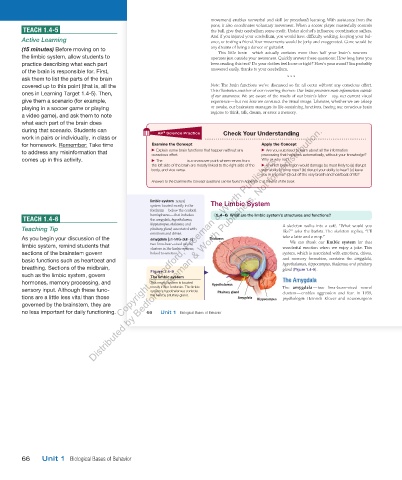
               breathing. Sections of the midbrain,                Figure   1.4-9                   gland  (   Figure 1.4-9 ).


               such as the limbic system, govern           The limbic system
               hormones, memory processing, and          This neural system is located   Hypothalamus     The Amygdala
                                                         mostly in the forebrain. The limbic          The   amygdala — two lima-bean–sized neural
               sensory input. Although these func-       system’s hypothalamus controls   Pituitary gland  clusters — enables aggression and fear. In 1939,
               tions are a little less vital than those   the nearby pituitary gland.     Amygdala  Hippocampus  psychologist Heinrich Klüver and neurosurgeon
               governed by the brainstem, they are
               no less important for daily functioning.  66   Unit 1  Biological Bases of Behavior
                                                  03_myersAPpsychology4e_28116_ch01_002_163.indd   66                               15/12/23   9:23 AM


               66   Unit 1  Biological Bases of Behavior


          03_HammerTE4e_47547_ch01_2a_163_4pp.indd   66                                                                         07/02/24   5:22 PM

