


Page 81 - 2024-bfw-MyersAP4e-TE
P. 81
Module 1.4b

                 Structure of the Cortex
                 If you opened a human skull, exposing the brain, you would see a wrinkled organ, shaped   TEACH 1.4-7
                 somewhat like an oversized walnut. Without these wrinkles, a flattened cerebral cortex
                 would require triple the area — roughly that of a large pizza. The brain’s left and right hemi-  Teaching Tip
                 spheres are filled mainly with axons connecting the cortex to the brain’s other regions. The
                 cerebral cortex — that thin surface layer — contains some 20 to 23 billion of the brain’s nerve   To help students remember the loca-
                 cells and 300 trillion synaptic connections (de Courten-Myers, 2005). Being human takes a   tion and function of the four lobes of
                 lot of nerve.                                                                       the cortex, use the following:
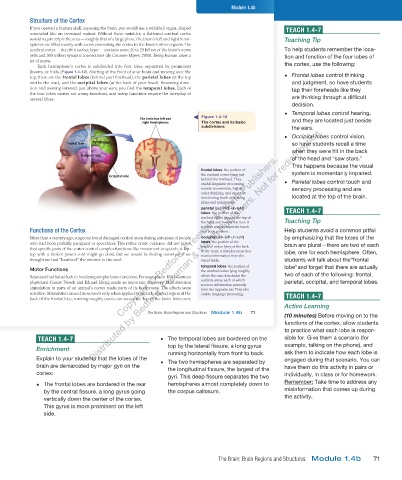
                    Each hemisphere’s cortex is subdivided into four  lobes, separated by prominent
                   fissures, or folds (Figure 1.4-12). Starting at the front of your brain and moving over the
                 top, there are the frontal lobes (behind your forehead), the parietal lobes (at the top   •  Frontal lobes control thinking
                 and to the rear), and the occipital lobes (at the back of your head). Reversing direc-  and judgment, so have students
                 tion and moving forward, just above your ears, you find the temporal lobes. Each of   tap their foreheads like they
                 the four lobes carries out many functions, and many functions require the interplay of
                 several lobes.                                                                        are thinking through a difficult
                                                                                                       decision.
                                                                                                     •  Temporal lobes control hearing,
                                                                         Figure 1.4-12
                                                     The brain has left and                            and they are located just beside
                                                      right hemispheres  The cortex and its basic
                                                                         subdivisions                  the ears.
                                      Distributed by Bedford, Freeman & Worth Publishers. Not for redistribution.
                                                                                                     •  Occipital lobes control vision,
                              Frontal lobe  Parietal lobe                                              so have students recall a time
                                                                                                       when they were hit in the back
                                               Copyright © Bedford, Freeman & Worth Publishers.
                                  Temporal lobe
                                                                                                       of the head and “saw stars.”
                                                                                                       This happens because the visual
                                                                         frontal lobes  the portion of
                                           Occipital lobe                the cerebral cortex lying just   system is momentarily impaired.
                                                                         behind the forehead. They
                                                                         enable linguistic processing,   •  Parietal lobes control touch and
                                                                         muscle movements, higher-     sensory processing and are
                                                                         order thinking, and executive
                                                                         functioning (such as making   located at the top of the brain.
                                                                         plans and judgments).
                                                                         parietal [puh-RYE-uh-tuhl]
                                                                         lobes  the portion of the   TEACH 1.4-7
                                                                         cerebral cortex lying at the top of
                                                                         the head and toward the rear; it   Teaching Tip
                                                                         receives sensory input for touch
                 Functions of the Cortex                                 and body position.          Help students avoid a common pitfall
                 More than a century ago, surgeons found damaged cortical areas during autopsies of people   occipital [ahk-SIP-uh-tuhl]   by emphasizing that the lobes of the
                 who had been partially paralyzed or speechless. This rather crude evidence did not prove   lobes  the portion of the   brain are plural—there are two of each
                 that specific parts of the cortex control complex functions like movement or speech. A lap-  cerebral cortex lying at the back
                                                                         of the head; it includes areas that
                 top with a broken power cord might go dead, but we would be fooling ourselves if we   receive information from the   lobe, one for each hemisphere. Often,
                 thought we had “localized” the internet in the cord.    visual fields.              students will talk about the “frontal
                                                                         temporal lobes  the portion of   lobe” and forget that there are actually
                 Motor Functions                                         the cerebral cortex lying roughly
                 Scientists had better luck in localizing simpler brain functions. For example, in 1870,  German   above the ears; it includes the   two of each of the following: frontal,
                 physicians Gustav Fritsch and Eduard Hitzig made an important discovery: Mild electrical   auditory areas, each of which   parietal, occipital, and temporal lobes.
                                                                         receives information primarily
                 stimulation to parts of an animal’s cortex made parts of its body move. The effects were   from the opposite ear. They also
                 selective: Stimulation caused movement only when applied to an arch-shaped region at the   enable language processing.  TEACH 1.4-7
                 back of the frontal lobe, running roughly ear-to-ear across the top of the brain. Moreover,
                                                                                                     Active Learning
                                                        The Brain: Brain Regions and Structures  Module 1.4b   71
                                                                                                     (10 minutes) Before moving on to the
                                                                                                     functions of the cortex, allow students
                                                                                                     to practice what each lobe is respon-
                    TEACH 1.4-7
                                                                                          15/12/23   9:23 AM
         03_myersAPpsychology4e_28116_ch01_002_163.indd   71  •  The temporal lobes are bordered on the   sible for. Give them a scenario (for
                    Enrichment                                 top by the lateral fissure, a long gyrus   example, talking on the phone), and
                                                               running horizontally from front to back.  ask them to indicate how each lobe is
                    Explain to your students that the lobes of the   •  The two hemispheres are separated by   engaged during that scenario. You can
                    brain are demarcated by major gyri on the   the longitudinal fissure, the largest of the   have them do this activity in pairs or
                    cortex:                                                                          individually, in class or for homework.
                                                               gyri. This deep fissure separates the two
                    •  The frontal lobes are bordered in the rear   hemispheres almost completely down to   Remember: Take time to address any
                      by the central fissure, a long gyrus going   the corpus callosum.              misinformation that comes up during
                      vertically down the center of the cortex.                                      the activity.
                      This gyrus is more prominent on the left
                      side.


                                                                               The Brain: Brain Regions and Structures Module 1.4b   71


          03_HammerTE4e_47547_ch01_2a_163_4pp.indd   71                                                                         07/02/24   5:22 PM

