


Page 84 - 2024-bfw-MyersAP4e-TE
P. 84
Sensory Functions
                                                                             If the motor cortex sends messages out to the body, where does the cortex receive incoming
                                                                             messages? Penfield identified a cortical area — at the front of the parietal lobes, parallel to
                                                                             and just behind the motor cortex — that specializes in receiving information from the skin
                                                                             senses, such as touch and temperature, and from the movement of body parts. We now call
                                                                             this area the somatosensory cortex. Stimulate a point on the top of this band of tissue and
                                                                             a person may report being touched on the shoulder; stimulate some point on the side and
                                                                             the person may feel something on the face.
                                                                               The more sensitive the body region, the larger the somatosensory cortex area devoted
                                                                             to it (see Figure 1.4-13). Your supersensitive lips project to a larger brain area than do your
                                                                             toes, which is one reason we kiss rather than touch toes. Rats have a large area of the brain
                                                                             devoted to their whisker sensations, and owls to their hearing sensations.
                                                                               Scientists have identified additional areas where the cortex receives input from
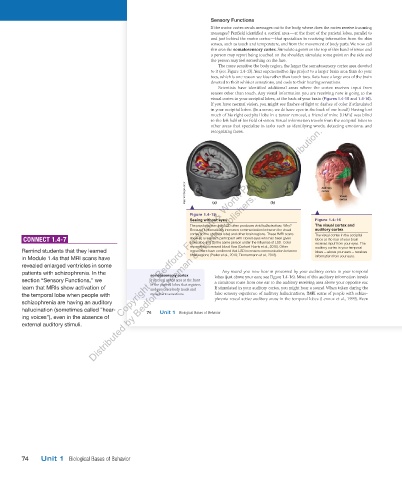
                                                                             senses other than touch. Any visual information you are receiving now is going to the
                                                                             visual cortex in your occipital lobes, at the back of your brain (Figures 1.4-15 and 1.4-16).
                                                                             If you have normal vision, you might see flashes of light or dashes of color if stimulated
                                                                             in your occipital lobes. (In a sense, we do have eyes in the back of our head!) Having lost
                                                                             much of his right occipital lobe in a tumor removal, a friend of mine [DM’s] was blind
                                                                             to the left half of his field of vision. Visual information travels from the occipital lobes to
                                                                             other areas that specialize in tasks such as identifying words, detecting emotions, and
                                      Distributed by Bedford, Freeman & Worth Publishers. Not for redistribution.
                                                                             recognizing faces.


                                               Copyright © Bedford, Freeman & Worth Publishers.


                                                                    Imperial College London  (a)  (b)            Auditory  Visual
                                                                                                                 cortex
                                                                                                                       cortex

                                                                      Figure 1.4-15
                                                                      Seeing without eyes                      Figure 1.4-16
                                                                      The psychoactive drug LSD often produces vivid hallucinations. Why?   The visual cortex and
                                                                      Because it dramatically increases communication between the visual   auditory cortex
                                                                      cortex (in the occipital lobe) and other brain regions. These fMRI scans   The visual cortex in the occipital
               CONNECT 1.4-7                                          show (a) a research participant with closed eyes who has been given   lobes at the rear of your brain
                                                                      a placebo and (b) the same person under the influence of LSD. Color   receives input from your eyes. The
                                                                      represents increased blood flow (Carhart-Harris et al., 2016). Other   auditory cortex in your temporal
               Remind students that they learned                      researchers have confirmed that LSD increases communication between   lobes — above your ears — receives
                                                                      brain regions (Preller et al., 2019; Timmermann et al., 2018).  information from your ears.
               in Module 1.4a that MRI scans have
               revealed enlarged ventricles in some
               patients with schizophrenia. In the                              Any sound you now hear is processed by your auditory cortex in your temporal
                                                         somatosensory cortex     lobes (just above your ears; see Figure 1.4-16). Most of this auditory information travels
               section “Sensory Functions,” we           a cerebral cortex area at the front
                                                         of the parietal lobes that registers   a circuitous route from one ear to the auditory receiving area above your opposite ear.
               learn that MRIs show activation of        and processes body touch and   If stimulated in your auditory cortex, you might hear a sound. When taken during the
               the temporal lobe when people with        movement sensations.  false sensory experience of auditory hallucinations, fMRI scans of people with schizo-
               schizophrenia are having an auditory                           phrenia reveal active auditory areas in the temporal lobes (Lennox et al., 1999). Even
               hallucination (sometimes called “hear-   74   Unit 1  Biological Bases of Behavior
               ing voices”), even in the absence of
               external auditory stimuli.

                                                  03_myersAPpsychology4e_28116_ch01_002_163.indd   74                               15/12/23   9:23 AM


               74   Unit 1  Biological Bases of Behavior


          03_HammerTE4e_47547_ch01_2a_163_4pp.indd   74                                                                         07/02/24   5:22 PM

