


Page 83 - 2024-bfw-MyersAP4e-TE
P. 83
Module 1.4b

                 moving red target, the researchers matched the brain signals with the arm movements. Then
                 they programmed a computer to monitor the signals and operate the joystick. When a mon-
                 key merely thought about a move, the mind-reading computer moved the cursor with nearly   ENGAGE 1.4-7
                 the same proficiency as had the reward-seeking monkey. Monkey think, computer do.
                    Clinical trials of such cognitive neural prosthetics have been under way with people who   (15 minutes) Many computer-
                 have severe paralysis or have lost a limb (Andersen et al., 2010; Rajangam et al., 2016).   assistive technologies exist to help
                 The first patient, a 25-year-old man with paralysis, was able to mentally control a TV, draw   people with motor difficulties perform
                 shapes on a computer screen, and play video games — all thanks to an aspirin-sized chip
                 with 100 microelectrodes recording activity in his motor cortex (Hochberg et al., 2006).   everyday tasks. To illustrate this fact,
                 Other people with paralysis who have received implants have learned to direct robotic arms   have students search the internet to
                 with their thoughts (Clausen et al., 2017).                                         see what kinds of technologies are
                    And then there is Ian Burkhart, who lost the use of
                 his arms and legs at age 19. Ohio State University brain                            available to help people with motor
                 researchers implanted recording electrodes in his motor                             disabilities communicate and interact
                 cortex (Schwemmer et al., 2018). Imagine the process:                               with the world. (Hint: Tell students
                 Researchers instruct Burkhart to stare at a screen that
                 shows a moving hand. Next, Burkhart imagines moving                                 to use a broad search term such as
                 his own hand. Brain signals from his motor cortex feed                              “assistive computer technology for
                 into a computer, which gets the message that he wants
                 to move his arm and thus stimulates those muscles.                                  persons with motor disabilities.”) After
                                      Distributed by Bedford, Freeman & Worth Publishers. Not for redistribution.
                 The result? Burkhart, with his very own paralyzed arm,                              10 minutes of searching, have  students
                 grasps a bottle, dumps out its contents, and picks up a                             report the most interesting technology
                 stick. He can even play the video game Guitar Hero. By
                 learning Burkhart’s unique brain response patterns, the                             they found. Tie their examples back
                 computer can predict his brain activity to help him make                   Andrew Spear/Redux Pictures  into a discussion of the cortex.
                                               Copyright © Bedford, Freeman & Worth Publishers.
                 these movements. “It’s really restored a lot of the hope I
                 have for the future to know that a device like this will be
                 possible to use in everyday life,” Burkhart says, “for me
                 and for many other people” (Wood, 2018). (See tinyurl
                 .com/ControlMotorCortex.)
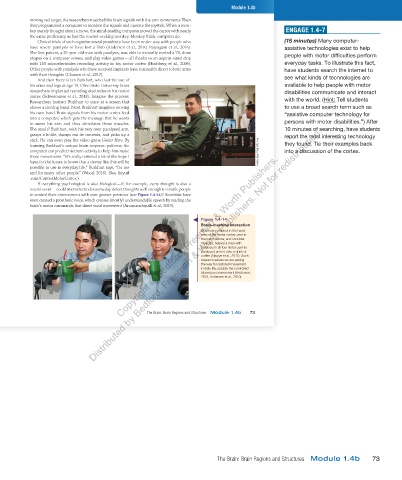
                    If everything psychological is also biological — if, for example, every thought is also a
                   neural event — could microelectrodes someday detect thoughts well enough to enable people
                 to control their environment with ever-greater precision (see Figure 1.4-14)? Scientists have
                 even created a prosthetic voice, which creates (mostly) understandable speech by reading the
                 brain’s motor commands that direct vocal movement (Anumanchipalli et al., 2019).
                                                                         Figure 1.4-14
                                                                         Brain–machine interaction
                                                                         Electrodes planted in the hand
                                                                         area of the motor cortex, and in
                                                                         the hand, elbow, and shoulder
                                                                         muscles, helped a man with
                                                                         paralysis in all four limbs use his
                                                                         paralyzed arm to take a drink of
                                                                         coffee (Ajiboye et al., 2017). Such
                                                                         research advances are paving
                                                                         the way for restored movement
                                                                         in daily life, outside the controlled
                                                                         laboratory environment (Andersen,
                                                                         2019; Andersen et al., 2010).


                                                        The Brain: Brain Regions and Structures  Module 1.4b   73


         03_myersAPpsychology4e_28116_ch01_002_163.indd   73                              15/12/23   9:23 AM


                                                                               The Brain: Brain Regions and Structures Module 1.4b   73


          03_HammerTE4e_47547_ch01_2a_163_4pp.indd   73                                                                         07/02/24   5:22 PM

