


Page 86 - 2024-bfw-MyersAP4e-TE
P. 86
(MacPherson et al., 2016). And if responsible for the absence of birthday cake, they may feel
                                                                             no regret (Bault et al., 2019).
                                                                               Frontal lobe damage also can alter personality and remove a person’s inhibitions. Con-
                             PRACTICE                                        sider the classic case of railroad worker Phineas Gage. One afternoon in 1848, Gage, then
                                                                             25 years old, was using a tamping iron to pack gunpowder into a rock. A spark ignited the
                Research Methods & Design                                    gunpowder, shooting the rod up through his left cheek and out the top of his skull, leaving
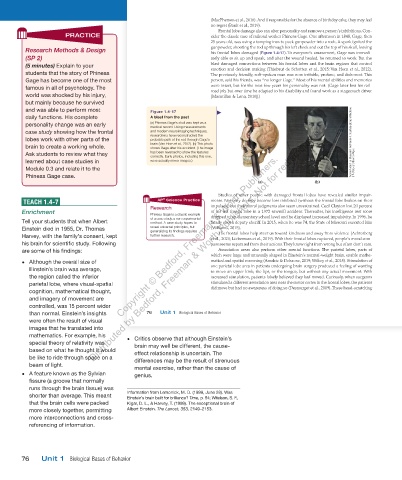
                                                                             his frontal lobes damaged (Figure 1.4-17). To everyone’s amazement, Gage was immedi-
                (SP 2)                                                       ately able to sit up and speak, and after the wound healed, he returned to work. But the
                (5 minutes) Explain to your                                  blast damaged connections between his frontal lobes and the brain regions that control
                                                                             emotion and decision making (Thiebaut de Schotten et al., 2015; Van Horn et al., 2012).
                students that the story of Phineas                           The previously friendly, soft-spoken man was now irritable, profane, and dishonest. This
                Gage has become one of the most                              person, said his friends, was “no longer Gage.” Most of his mental abilities and memories
                famous in all of psychology. The                             were intact, but for the next few years his personality was not. (Gage later lost his rail-
                                                                             road job, but over time he adapted to his disability and found work as a stagecoach driver
                world was shocked by his injury,                               [Macmillan & Lena, 2010].)
                but mainly because he survived
                and was able to perform most             Figure 1.4-17
                daily functions. His complete            A blast from the past
                personality change was an early          (a) Phineas Gage’s skull was kept as a
                                      Distributed by Bedford, Freeman & Worth Publishers. Not for redistribution.
                                                         medical record. Using measurements
                case study showing how the frontal       and modern neuroimaging techniques,
                                                         researchers have reconstructed the
                lobes work with other parts of the       probable path of the rod through Gage’s                          Warren Anatomical Museum in the Francis A. Countway Library of Medicine.
                brain to create a working whole.         brain (Van Horn et al., 2012). (b) This photo
                                                         shows Gage after his accident. (The image
                Ask students to review what they         has been reversed to show the features
                                                         correctly. Early photos, including this one,
                learned about case studies in            were actually mirror images.)                                     Gift of Jack and Beverly Wilgus
                Module 0.3 and relate it to the
                Phineas Gage case.
                                                                                            (a)               (b)
                                                                               Studies of other people with damaged frontal lobes have revealed similar impair-
                                                             ®
               TEACH 1.4-7                                 AP  Science Practice  ments. Not only do they become less inhibited (without the frontal lobe brakes on their
                                                         Research            impulses), but their moral judgments also seem unrestrained. Cecil Clayton lost 20 percent
               Enrichment                                Phineas Gage is a classic  example   of his left frontal lobe in a 1972 sawmill accident. Thereafter, his intelligence test score
               Tell your students that when Albert       of a case study, a non- experimental   dropped to an elementary school level and he displayed increased impulsivity. In 1996, he
                                                                             fatally shot a deputy sheriff. In 2015, when he was 74, the State of Missouri executed him
                                                         method. A case study hopes to
               Einstein died in 1955, Dr. Thomas         reveal universal principles, but   (Williams, 2015).
                                                         generalizing its findings requires
                                                                               The frontal lobes help steer us toward kindness and away from violence (Achterberg
               Harvey, with the family’s consent, kept  Copyright © Bedford, Freeman & Worth Publishers.
                                                         further research.
                                                                             et al., 2020; Lieberman et al., 2019). With their frontal lobes ruptured, people’s moral com-
               his brain for scientific study. Following                     pass seems separated from their actions. They know right from wrong but often don’t care.
               are some of his findings:                                       Association areas also perform other mental functions. The parietal lobes, parts of
                                                                             which were large and unusually shaped in Einstein’s normal-weight brain, enable mathe-
               •  Although the overall size of                               matical and spatial reasoning (Amalric & Dehaene, 2019; Wilkey et al., 2018). Stimulation of
                 Einstein’s brain was average,                               one parietal lobe area in patients undergoing brain surgery produced a feeling of wanting
                                                                             to move an upper limb, the lips, or the tongue, but without any actual movement. With
                 the region called the inferior                              increased stimulation, patients falsely believed they had moved. Curiously, when surgeons
                 parietal lobe, where visual-spatial                         stimulated a different association area near the motor cortex in the frontal lobes, the patients
                 cognition, mathematical thought,                            did move but had no awareness of doing so (Desmurget et al., 2009). These head-scratching
                 and imagery of movement are
                 controlled, was 15 percent wider
                 than normal. Einstein’s insights       76   Unit 1  Biological Bases of Behavior
                 were often the result of visual
                 images that he translated into
                 mathematics. For example, his   •  Critics observe that although Einstein’s                                        15/12/23   9:23 AM
                                                  03_myersAPpsychology4e_28116_ch01_002_163.indd   76
                 special theory of relativity was   brain may well be different, the cause-
                 based on what he thought it would   effect relationship is uncertain. The
                 be like to ride through space on a   differences may be the result of strenuous
                 beam of light.
                                                    mental exercise, rather than the cause of
               •  A feature known as the Sylvian    genius.
                 fissure (a groove that normally
                 runs through the brain tissue) was
                 shorter than average. This meant   Information from Lemonick, M. D. (1999, June 28). Was
                                                 Einstein’s brain built for brilliance? Time, p. 54; Witelson, S. F.,
                 that the brain cells were packed   Kigar, D. L., & Harvey, T. (1999). The exceptional brain of
                 more closely together, permitting   Albert Einstein. The Lancet, 353, 2149–2153.
                 more interconnections and cross-
                 referencing of information.


               76   Unit 1  Biological Bases of Behavior


          03_HammerTE4e_47547_ch01_2a_163_4pp.indd   76                                                                         07/02/24   5:23 PM

