


Page 70 - 2024-bfw-MyersAP4e-TE
P. 70
blood rushing to the back of the brain, which processes visual infor-
                                                                                         mation. Another  tool,  functional near-infrared  spectroscopy (fNIRS),
                                                                                         shines infrared light on blood molecules to identify brain activity.
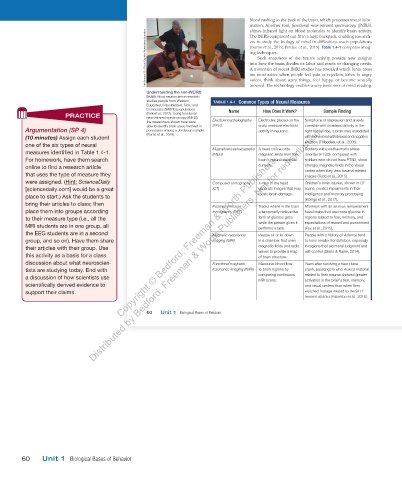
                                                       Mark Straccia/UCLA Social Cognitive Neuroscience Laboratory  (Burns et al., 2019; Perdue et al., 2019). Table 1.4-1 compares imag-
                                                                                         The fNIRS equipment can fit in a large backpack, enabling research-
                                                                                         ers to study the biology of mind in difficult-to-reach populations
                                                                                         ing techniques.
                                                                                            Such snapshots of the brain’s activity provide new insights
                                                                                         into how the brain divides its labor and reacts to changing needs.
                                                                                         A mountain of recent fMRI studies has revealed which brain areas
                                                                                         are most active when people feel pain or rejection, listen to angry
                                                                                         aroused. The technology enables a very basic sort of mind reading.
                                                        Understanding the non-WEIRD      voices, think about scary things, feel happy, or become sexually
                                                        brain  Most neuroscience research
                                                        studies people from Western,   TABLE 1.4-1  Common Types of Neural Measures
                                                        Educated, Industrialized, Rich, and
                                                        Democratic (WEIRD) populations   Name  How Does It Work?  Sample Finding
                             PRACTICE                   (Falk et al., 2013). Using functional
                                                        near-infrared spectroscopy (fNIRS),
                                                        the researchers shown here were   Electroencephalography   Electrodes placed on the   Symptoms of depression and anxiety
                                                        able to identify brain areas involved in   (EEG)  scalp measure electrical   correlate with increased activity in the
                                      Distributed by Bedford, Freeman & Worth Publishers. Not for redistribution.
                Argumentation (SP 4)                    persuasion among a Jordanian sample   activity in neurons.  right frontal lobe, a brain area associated
                (10 minutes) Assign each  student       (Burns et al., 2019).                              with behavioral withdrawal and negative
                one of the six types of neural                                                             emotion (Thibodeau et al., 2006).
                measures identified in Table 1.4-1.                          Magnetoencephalography  A head coil records   Soldiers with posttraumatic stress
                                                                                                           disorder (PTSD), compared with
                                                                                            magnetic fields from the
                                                                             (MEG)
                For homework, have them search                                              brain’s natural electrical   soldiers who do not have PTSD, show
                online to find a research article                                           currents.      stronger magnetic fields in the visual
                that uses the type of measure they                                                         cortex when they view trauma-related
                                                                                                           images (Todd et al., 2015).
                were assigned. (Hint: ScienceDaily                           Computed tomography   X-rays of the head   Children’s brain injuries, shown in CT
                [sciencedaily.com] would be a great                          (CT)           generate images that may  scans, predict impairments in their
                place to start.) Ask the students to                                        locate brain damage.  intelligence and memory processing
                                                                                                           (Königs et al., 2017).
                bring their articles to class; then                          Positron emission   Tracks where in the brain   Monkeys with an anxious temperament
                place them into groups according                             tomography (PET)  a temporarily radioactive   have brains that use more glucose in
                to their measure type (i.e., all the                                        form of glucose goes   regions related to fear, memory, and
                MRI students are in one group, all                                          while the person given it   expectations of reward and punishment
                                                                                                           (Fox et al., 2015).
                                                                                            performs a task.
                the EEG students are in a second  Copyright © Bedford, Freeman & Worth Publishers.         People with a history of violence tend
                                                                                            People sit or lie down
                                                                             Magnetic resonance
                group, and so on). Have them share                           imaging (MRI)  in a chamber that uses   to have smaller frontal lobes, especially
                their articles with their group. Use                                        magnetic fields and radio   in regions that aid moral judgment and
                                                                                                           self-control (Glenn & Raine, 2014).
                                                                                            waves to provide a map
                this activity as a basis for a class                                        of brain structure.
                discussion about what neuroscien-                            Functional magnetic   Measures blood flow   Years after surviving a near plane
                tists are studying today. End with                           resonance imaging (fMRI)  to brain regions by   crash, passengers who viewed material
                a discussion of how scientists use                                          comparing continuous   related to their trauma showed greater
                                                                                            MRI scans.
                                                                                                           activation in the brain’s fear, memory,
                scientifically derived evidence to                                                         and visual centers than when they
                support their claims.                                                                      watched footage related to the 9/11
                                                                                                           terrorist attacks (Palombo et al., 2015).
                                                        60   Unit 1  Biological Bases of Behavior

                                                  03_myersAPpsychology4e_28116_ch01_002_163.indd   60                              29/12/23   12:14 PM


               60   Unit 1  Biological Bases of Behavior


          03_HammerTE4e_47547_ch01_2a_163_4pp.indd   60                                                                         07/02/24   5:21 PM

