


Page 65 - 2024-bfw-MyersAP4e-TE
P. 65
Module 1.4a

                       Module 1.4a          The Brain: Neuroplasticity                               INTRODUCE THE MODULE


                                          and Tools of Discovery                                     Make It Meaningful
                                                                                                      (10 minutes) Ask students if
                         LEARNING TARGETS                                                             they have ever had, or someone
                        1.4-1         Explain why psychologists are concerned with human biology.      they know has ever had, an
                       1.4-2         Explain how biology and experience together enable neuroplasticity.      MRI (for example, on their
                       1.4-3          Compare and contrast several techniques for studying the brain’s   knee). Ask students who are
                         connections to behavior and mind.                                            comfortable doing so to share their
                                                                                                      experiences. Use their examples to
                                                                                                      start a discussion of tools to study

                       Why ar

                               1.4-1
                               1.4-1   Why are psychologists concerned with human biology?                   the brain.

                                          ned with human biology?
                            e psychologists concer
                 Our understanding of how the brain gives birth to the mind has come a long way. The ancient   AP  Science Practice
                                                                              ®
                 Greek physician Hippocrates correctly located the mind in the brain. His contemporary, the
                                      Distributed by Bedford, Freeman & Worth Publishers. Not for redistribution.
                 philosopher Aristotle, believed the mind was sited in the heart, which pumps warmth and       Research    INTRODUCE THE MODULE
                 vitality to the body. The heart remains our symbol for love, but science has long since over-    Unlike phrenologists, psycholog-
                                                                          ical scientists take an  empirical,
                 taken philosophy on this issue: It’s your brain, not your heart, that falls in love.   or scientifically derived approach   Activate Prior Knowledge
                      In the early 1800s, German physician Franz Gall proposed that  phrenology,   studying   to studying the brain. As  Unit 0
                                               Copyright © Bedford, Freeman & Worth Publishers.


                 bumps on the skull, could reveal a person’s mental abilities and character traits  (  Figure 1.4-1 ) .   explained, they use an evidence-   (10 minutes) Begin class with

                                                                          based method that draws on
                 At one point, Britain was home to 29 phrenological societies. Phrenologists also traveled North   observation and experimentation.
                 America to give skull readings ( Dean, 2012 ;  Hunt, 1993 ). Using a false name, humorist Mark   this activity, which asks students
                 Twain put one famous phrenologist to the test. “He found a cavity [and] startled me by saying   to decide if statements are
                 that that cavity represented the total absence of the sense of humor!” Three months later, Twain         biological psychology       the   true or false. The statements
                 sat for a second reading, this time identifying himself. Now “the cavity was gone, and in its   scientific study of the links
                 place was . . . the loftiest bump of humor he had ever encountered in his life-long  experience!”   between biological (genetic,   tap into common beliefs and
                                                                         neural, hormonal) and
                 ( Lopez, 2002 ). Today, the “science” of phrenology reminds us of our need to engage in critical   psychological processes.   misconceptions about psychology.
                 thinking and scientific analysis. Phrenology did at least succeed in focusing attention on the   Some biological psychologists   This activity will benefit students’
                 localization of function — the idea that various brain regions have particular functions.   call themselves  behavioral

                      Today, we are living in a time Gall could only dream about.    Biological psychologists   neuroscientists, neuropsychologists,   understanding of Module 1.4a as
                 use advanced technologies to study the links between biological (genetic, neural, hormonal)   behavior geneticists, physiological   they read.
                                                                         psychologists,  or  biopsychologists.
                                                                                                            M1.4a: Fact or Falsehood?
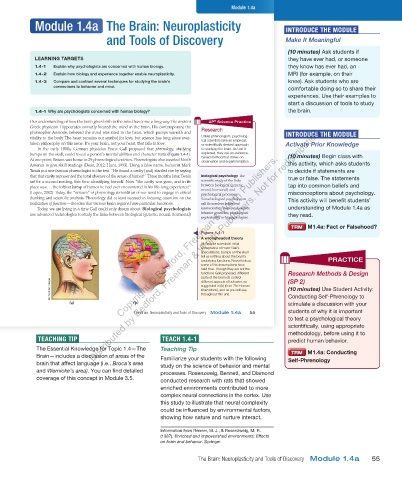
                                                                                   Figure   1.4-1
                                                  Movement                 A wrongheaded theory
                                                      Planning
                                                        Thinking
                                                 Spatial                 (a) Despite scientists’ initial
                                                awareness  Touch  Judging  acceptance of Franz Gall’s
                                                       Speech  Feeling
                                                Comprehension  Sound  Taste  speculations, bumps on the skull
                                               Visual
                                              processing  Emotion  Smell  tell us nothing about the brain’s
                                                 Recognition  Memory                                               PRACTICE
                                               Vision                    underlying functions. Nevertheless,
                                                                         some of his assumptions have
                                                Coordination
                                                                         held true. Though they are not the
                                                   Arousal               functions Gall proposed, different   Research Methods & Design
                                                                         parts of the brain do control   (SP 2)
                        Bettmann/Getty Images                            suggested in (b) (from  The Human   (10 minutes) Use Student Activity:
                                                                         different aspects of behavior, as
                                                                         Brain Book , and as you will see
                                                                               )
                                                                         throughout this unit.
                                                                                                      Conducting Self-Phrenology to
                              (a)                  (b)                                                stimulate a discussion with your
                                                    The Brain: Neuroplasticity and Tools of Discovery  Module 1.4a   55  students of why it is important
                                                                                                      to test a psychological theory
                                                                                                      scientifically, using appropriate
                                                                                                      methodology, before using it to
                    TEACHING TIP                             TEACH 1.4-1                              predict human behavior.
         03_myersAPpsychology4e_28116_ch01_002_163.indd   55                              15/12/23   9:22 AM
                    The Essential Knowledge for Topic 1.4—The   Teaching Tip                                M1.4a: Conducting
                    Brain—includes a discussion of areas of the   Familiarize your students with the following
                    brain that affect language (i.e., Broca’s area   study on the science of behavior and mental   Self-Phrenology
                    and Wernicke’s area). You can find detailed   processes. Rosenzweig, Bennett, and Diamond
                    coverage of this concept in Module 3.5.  conducted research with rats that showed
                                                            enriched environments contributed to more
                                                            complex neural connections in the cortex. Use
                                                            this study to illustrate that neural complexity
                                                            could be influenced by environmental factors,
                                                            showing how nature and nurture interact.
                                                            Information from Renner, M. J., & Rosenzweig, M. R.
                                                            (1987). Enriched and impoverished environments: Effects
                                                            on brain and behavior. Springer.
                                                                        The Brain: Neuroplasticity and Tools of Discovery Module 1.4a   55
          03_HammerTE4e_47547_ch01_2a_163_4pp.indd   55                                                                         07/02/24   5:21 PM

