


Page 60 - 2024-bfw-MyersAP4e-TE
P. 60
For 3 or 4 hours, they experience high energy, emotional elevation, and (given a social
context) connectedness with those around them (“I love everyone”). Octopuses became
TEACH 1.3-7 similarly sociable when researchers gave them MDMA ( Edsinger et al., 2018 ). Eight
arms and MDMA = a lot of reaching out.
Active Learning Ecstasy’s popularity first soared globally in the late 1990s as a “club drug” taken at
(Out of class) Ask students to write nightclubs and all-night dance parties ( Landry, 2002 ). But there are good reasons not to
be ecstatic about Ecstasy. One is its dehydrating effect, which — when combined with pro-
a compare-and-contrast essay for longed dancing — can lead to severe overheating, increased blood pressure, and death.
the four stimulants (nicotine, cocaine, Another is that repeated leaching of brain serotonin can damage serotonin-producing neu-
methamphetamine, and Ecstasy). Be rons, leading to decreased output and increased risk of permanently depressed mood ( Croft
et al., 2001 ; McCann et al., 2001 ; Roiser et al., 2005 ). Ecstasy also suppresses the immune
sure they include what these stimu- system, impairs memory, slows thought, and disrupts sleep by interfering with serotonin’s
lants have in common and how they control of the circadian clock ( Laws & Kokkalis, 2007 ; Schilt et al., 2007 ; Wagner et al., 2012 ).
are different. Remember: Take time Ecstasy delights for the night but dispirits the morrow.
to address any misinformation that Hallucinogens
comes up in this activity.
What ar
What ar
1.3-8
1.3-8 What are hallucinogens, and what are their effects?
What ar
and what ar
hallucinogens,
fects?
e their ef
hallucinogens,
e
e
e
Hallucinogens distort perceptions and evoke sensory images in the absence of sensory
Distributed by Bedford, Freeman & Worth Publishers. Not for redistribution.
input (which is why these drugs are also called psychedelics, meaning “mind-manifesting”).
Some, such as LSD and MDMA (Ecstasy), are synthetic. Others, including psilocybin, aya-
huasca, and the mild hallucinogen marijuana, are natural substances.
Whether provoked to hallucinate by drugs, loss of oxygen, or extreme sensory
deprivation, the brain hallucinates in basically the same way ( Martial et al., 2019 ; Siegel,
Copyright © Bedford, Freeman & Worth Publishers.
hallucinogens psychedelic
(“mind-manifesting”) drugs that 1982 ). The experience typically begins with simple geometric forms, such as a spiral.
distort perceptions and evoke Then come more meaningful images, which may be superimposed on a tunnel; others
sensory images in the absence of may be replays of past emotional experiences. Brain scans of people on an LSD trip
sensory input. reveal that their visual cortex becomes hypersensitive and strongly connected to their
near-death experience an brain’s emotion centers ( Carhart-Harris et al., 2016 ). As the hallucination peaks, peo-
altered state of consciousness ple frequently feel separated from their body and experience dreamlike scenes. Their
reported after a close brush with sense of self dissolves, as does the border between themselves and the external world
death (such as cardiac arrest);
often similar to drug-induced ( Lebedev et al., 2015 ).
,
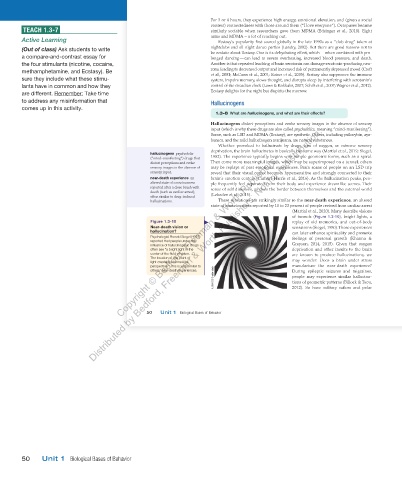
hallucinations. These sensations are strikingly similar to the near-death experience an altered
state of consciousness reported by 10 to 23 percent of people revived from cardiac arrest
( Martial et al., 2020 ). Many describe visions
of tunnels ( Figure 1.3-10 ), bright lights, a
Figure 1.3-10 replay of old memories, and out-of-body
Near-death vision or sensations ( Siegel, 1980 ). These experiences
hallucination? can later enhance spirituality and promote
Psychologist Ronald Siegel (1977) feelings of personal growth ( Khanna &
reported that people under the
influence of hallucinogenic drugs Greyson , 2014 , 2015 ). Given that oxygen
often see “a bright light in the deprivation and other insults to the brain
center of the field of vision. . . . are known to produce hallucinations, we
The location of this point of
light create[s] a tunnel-like may wonder: Does a brain under stress
perspective.” This is very similar to manufacture the near-death experience?
NUMAX3D/Shutterstock people may experience similar hallucina-
others’ near-death experiences. During epileptic seizures and migraines,
tions of geometric patterns ( Billock & Tsou,
2012 ). So have solitary sailors and polar
50 Unit 1 Biological Bases of Behavior
03_myersAPpsychology4e_28116_ch01_002_163.indd 50 15/12/23 9:22 AM
50 Unit 1 Biological Bases of Behavior
03_HammerTE4e_47547_ch01_2a_163_4pp.indd 50 07/02/24 5:20 PM

