


Page 58 - 2024-bfw-MyersAP4e-TE
P. 58
®
               TEACH 1.3-7                                 AP  Science Practice  Check Your Understanding
               Teaching Tip                              Examine the Concept                 Apply the Concept
                                                         ▶ ▶Explain how a stimulant affects behavior.  ▶ ▶Think of a friend or family member who is addicted to
               Reinforce students’ study of              ▶ ▶Explain the physiological effects of nicotine.  nicotine. What do you think would be most effective to say to
               neurotransmitters and action              ▶ ▶Explain the withdrawal symptoms someone should expect   that person to convince them to try to quit?
               potentials with Figure 1.3-9, which       when quitting smoking.
               shows how drugs affect the action         Answers to the Examine the Concept questions can be found in Appendix C at the end of the book.
               at the synapse. By discussing this
               figure, you will find out whether
               students learned the material covered     AP  Exam Tip        Cocaine
                                                           ®
               in Module 1.3a. If students understand                        Cocaine is a powerfully addictive stimulant derived from the coca plant. The recipe for
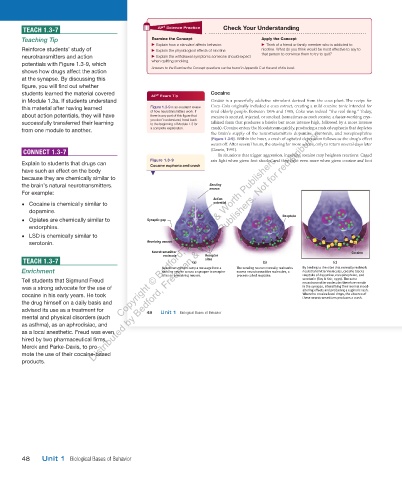
               this material after having learned        Figure 1.3-9 is an excellent review   Coca-Cola originally included a coca extract, creating a mild cocaine tonic intended for
                                                                             tired elderly people. Between 1896 and 1905, Coke was indeed “the real thing.” Today,
                                                         of how neurotransmitters work. If
               about action potentials, they will have   there is any part of this figure that   cocaine is snorted, injected, or smoked (sometimes as crack cocaine, a faster-working crys-
               successfully transferred their learning   you don’t understand, head back   tallized form that produces a briefer but more intense high, followed by a more intense
                                                         to the beginning of Module 1.3 for
               from one module to another.               a complete explanation.  crash). Cocaine enters the bloodstream quickly, producing a rush of euphoria that depletes
                                                                             the brain’s supply of the neurotransmitters dopamine, serotonin, and norepinephrine
                                                                             (Figure 1.3-9). Within the hour, a crash of agitated depression follows as the drug’s effect
                                                                             wears off. After several hours, the craving for more wanes, only to return several days later
               CONNECT 1.3-7                                                 (Gawin, 1991).
                                                                               In situations that trigger aggression, ingesting cocaine may heighten reactions. Caged
               Explain to students that drugs can        Figure 1.3-9        rats fight when given foot shocks, and they fight even more when given cocaine and foot
                                                         Cocaine euphoria and crash
               have such an effect on the body
               because they are chemically similar to
               the brain’s natural neurotransmitters.                       Sending
                                                                            neuron
               For example:
                                                                             Action
               •  Cocaine is chemically similar to                           potential
                 dopamine.
                                                                                                    Reuptake
               •  Opiates are chemically similar to     Synaptic gap
                 endorphins.
               •  LSD is chemically similar to  Copyright © Bedford, Freeman & Worth Publishers.
                 serotonin.           Distributed by Bedford, Freeman & Worth Publishers. Not for redistribution.
                                                        Receiving neuron
                                                         Neurotransmitter                                                  Cocaine
                                                             molecule      Receptor
               TEACH 1.3-7                                             (a)  sites             (b)                    (c)
               Enrichment                                    Neurotransmitters carry a message from a   The sending neuron normally reabsorbs   By binding to the sites that normally reabsorb
                                                                                                           neurotransmitter molecules, cocaine blocks
                                                             sending neuron across a synapse to receptor
                                                                                     excess neurotransmitter molecules, a
                                                             sites on a receiving neuron.  process called reuptake.  reuptake of dopamine, norepinephrine, and
               Tell students that Sigmund Freud                                                            serotonin (Ray & Ksir, 1990). The extra
                                                                                                           neurotransmitter molecules therefore remain
               was a strong advocate for the use of                                                        in the synapse, intensifying their normal mood-
                                                                                                           altering effects and producing a euphoric rush.
               cocaine in his early years. He took                                                         When the cocaine level drops, the absence of
                                                                                                           these neurotransmitters produces a crash.
               the drug himself on a daily basis and
               advised its use as a treatment for       48   Unit 1  Biological Bases of Behavior
               mental and physical disorders (such
               as asthma), as an aphrodisiac, and
               as a local anesthetic. Freud was even
               hired by two pharmaceutical firms,   03_myersAPpsychology4e_28116_ch01_002_163.indd   48                             15/12/23   9:22 AM
               Merck and Parke-Davis, to pro-
               mote the use of their cocaine-based
               products.


               48   Unit 1  Biological Bases of Behavior


          03_HammerTE4e_47547_ch01_2a_163_4pp.indd   48                                                                         07/02/24   5:20 PM

