


Page 53 - 2024-bfw-MyersAP4e-TE
P. 53
Module 1.3b


                 death ( Kendler et al., 2016 ;  Mackey et al., 2019 ;  WHO, 2018b ;   Figure 1.3-7 ) .
                 Girls and young women (who have less of a stomach enzyme that digests
                   alcohol) can become addicted to alcohol more quickly than boys and young          ENGAGE 1.3-6
                 men do, and they are at risk for lung, brain, and liver damage at lower con-  Daniel Hommer, NIAAA, NIH, HHS
                 sumption levels ( CASA, 2003 ). With increased heavy drinking among women,          (Out of class) The text describes
                 these gender differences can have life-or-death consequences: Between 2001          some gender differences in the impact
                 and 2017, Canadian women’s risk for alcohol-related death increased at five   Scan of woman with   Scan of woman without  of alcohol consumption. Ask students
                 times the rate for men ( Tam, 2018 ).          alcohol use disorder  alcohol use disorder
                                                                     (a)           (b)               whether there should be different
                       Slowed  Neural  Processing       Alcohol slows sympathetic nervous system     blood alcohol limits for men and
                 activity. Larger doses cause reactions to slow, speech to slur, and skilled performance to dete-
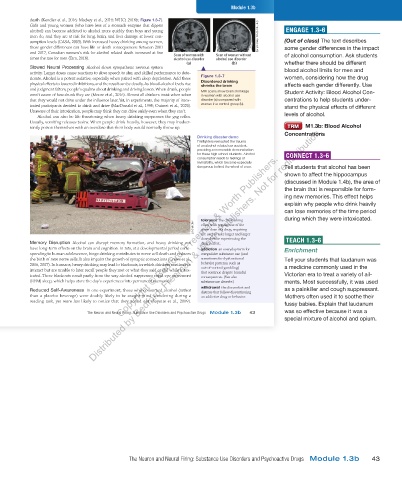
                 riorate. Alcohol is a potent sedative, especially when paired with sleep deprivation. Add these             Figure   1.3-7    women, considering how the drug
                 physical effects to lowered inhibitions, and the result can be deadly. As blood-alcohol levels rise    Disordered drinking   affects each gender differently. Use
                                                                         shrinks the brain
                 and judgment falters, people’s qualms about drinking and driving lessen. When drunk, people   MRI scans show brain shrinkage   Student Activity: Blood Alcohol Con-
                 aren’t aware of  how  drunk they are ( Moore et al., 2016 ). Almost all drinkers insist when sober   in women with alcohol use
                 that they would not drive under the influence later. Yet, in experiments, the majority of intox-  disorder (a) compared with   centrations to help students under-
                 icated participants decided to drink and drive ( MacDonald et al., 1995 ;  Ouimet et al., 2020 ).   women in a control group (b).       stand the physical effects of different
                 Unaware of their intoxication, people may think they can drive safely even when they can’t.   levels of alcohol.
                      Alcohol can also be life threatening when heavy drinking suppresses the gag reflex.
                 Usually, vomiting releases toxins. When people drink heavily, however, they may inadver-
                 tently poison themselves with an overdose that their body would normally throw up.              M1.3b: Blood Alcohol
                                      Distributed by Bedford, Freeman & Worth Publishers. Not for redistribution.
                                                                                                     Concentrations
                                                                        Drinking disaster demo
                                                                        Firefighters reenacted the trauma
                                                                        of an alcohol-related car accident,
                                                                        providing a memorable demonstration
                                               Copyright © Bedford, Freeman & Worth Publishers.
                                                                        for these high school students. Alcohol   CONNECT 1.3-6
                                                                        consumption leads to feelings of
                                                                        invincibility, which become especially
                                                                        dangerous behind the wheel of a car.       Tell students that alcohol has been
                                                                                                     shown to affect the hippocampus
                                                                                                     (discussed in Module 1.4b), the area of
                                                                                                     the brain that is responsible for form-
                                                                                                     ing new memories. This effect helps
                                                                                                     explain why people who drink heavily
                                                                                                     can lose memories of the time period
                                                                                                     during which they were intoxicated.
                                                                         tolerance  the diminishing
                                                                         Lon Clark Diehl  effect with regular use of the
                                                                         same dose of a drug, requiring
                                                                         the user to take larger and larger
                                                                         doses before experiencing the   TEACH 1.3-6
                             Memory  Disruption       Alcohol can disrupt memory formation, and heavy drinking can   drug’s effect.
                 have long-term effects on the brain and cognition. In rats, at a developmental period corre-  addiction  an everyday term for   Enrichment
                 sponding to human adolescence, binge drinking contributes to nerve cell death and reduces   compulsive substance use (and
                 the birth of new nerve cells. It also impairs the growth of synaptic connections ( Crews et al.   ,  sometimes for dysfunctional   Tell your students that laudanum was
                    ,
                   2006   2007 ). In humans, heavy drinking may lead to blackouts, in which drinkers continue to   behavior patterns, such as   a medicine commonly used in the
                 interact but are unable to later recall people they met or what they said or did while intox-  out-of-control gambling)
                                                                         that continue despite harmful
                 icated. These blackouts result partly from the way alcohol suppresses rapid eye movement   consequences. (See also   Victorian era to treat a variety of ail-
                 (REM) sleep, which helps store the day’s experiences into permanent memories.     substance use disorder.)  ments. Most successfully, it was used
                                                                         withdrawal  the discomfort and   as a painkiller and cough suppressant.
                       Reduced Self-Awareness       In one experiment, those who consumed alcohol (rather   distress that follow discontinuing
                 than a placebo beverage) were doubly likely to be caught mind-wandering during a   an addictive drug or behavior.  Mothers often used it to soothe their
                 reading task, yet were  less  likely to notice that they zoned out ( Sayette et al., 2009 ).
                                                                                                     fussy babies. Explain that laudanum
                                    The Neuron and Neural Firing: Substance Use Disorders and Psychoactive Drugs  Module 1.3b   43  was so effective because it was a
                                                                                                     special mixture of alcohol and opium.
         03_myersAPpsychology4e_28116_ch01_002_163.indd   43                              15/12/23   9:22 AM


                                                  The Neuron and Neural Firing: Substance Use Disorders and Psychoactive Drugs Module 1.3b   43


          03_HammerTE4e_47547_ch01_2a_163_4pp.indd   43                                                                         07/02/24   5:19 PM

