


Page 57 - 2024-bfw-MyersAP4e-TE
P. 57
Module 1.3b


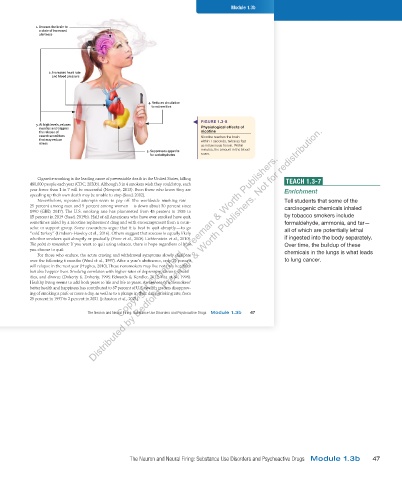
                   1. Arouses the brain to
                    a state of increased
                    alertness


                        2. Increases heart rate
                         and blood pressure


                                                        4. Reduces circulation
                                                         to extremities
                                                                         FIGURE 1.3-8
                   3. At high levels, relaxes
                                      Distributed by Bedford, Freeman & Worth Publishers. Not for redistribution.
                    muscles and triggers                                 Physiological effects of
                    the release of                                       nicotine
                    neurotransmitters                                    Nicotine reaches the brain
                    that may reduce                                      within 7 seconds, twice as fast
                    stress
                                                                         as intravenous heroin. Within
                                                        5. Suppresses appetite   minutes, the amount in the blood
                                               Copyright © Bedford, Freeman & Worth Publishers.
                                                         for carbohydrates  soars.
                    Cigarette smoking is the leading cause of preventable death in the United States, killing   TEACH 1.3-7
                 480,000 people each year (CDC, 2020b). Although 3 in 4 smokers wish they could stop, each
                 year fewer than 1 in 7 will be successful (Newport, 2013). Even those who know they are   Enrichment
                 speeding up their own death may be unable to stop (Saad, 2002).
                    Nevertheless, repeated attempts seem to pay off. The worldwide smoking rate —     Tell students that some of the
                 25 percent among men and 5 percent among women — is down about 30 percent since       carcinogenic chemicals inhaled
                 1990 (GBD, 2017). The U.S. smoking rate has plummeted from 45 percent in 1955 to
                 15 percent in 2019 (Saad, 2019b). Half of all Americans who have ever smoked have quit,   by tobacco smokers include
                 sometimes aided by a nicotine replacement drug and with encouragement from a coun-  formaldehyde, ammonia, and tar—
                 selor or support group. Some researchers argue that it is best to quit abruptly — to go   all of which are potentially lethal
                 “cold turkey” (Lindson-Hawley et al., 2016). Others suggest that success is equally likely
                 whether smokers quit abruptly or gradually (Fiore et al., 2008; Lichtenstein et al., 2010).   if ingested into the body separately.
                 The point to remember: If you want to quit using tobacco, there is hope regardless of how   Over time, the buildup of these
                 you choose to quit.                                                                 chemicals in the lungs is what leads
                    For those who endure, the acute craving and withdrawal symptoms slowly dissipate
                 over the following 6 months (Ward et al., 1997). After a year’s abstinence, only 10 percent   to lung cancer.
                 will relapse in the next year (Hughes, 2010). These nonsmokers may live not only healthier
                 but also happier lives. Smoking correlates with higher rates of depression, chronic disabil-
                 ities, and divorce (Doherty & Doherty, 1998; Edwards & Kendler, 2012; Vita et al., 1998).
                 Healthy living seems to add both years to life and life to years. Awareness of nonsmokers’
                 better health and happiness has contributed to 87 percent of U.S. twelfth graders disapprov-
                 ing of smoking a pack or more a day, as well as to a plunge in their daily smoking rate, from
                 25 percent in 1997 to 2 percent in 2021 (Johnston et al., 2021).

                                    The Neuron and Neural Firing: Substance Use Disorders and Psychoactive Drugs  Module 1.3b   47


         03_myersAPpsychology4e_28116_ch01_002_163.indd   47                              15/12/23   9:22 AM


                                                  The Neuron and Neural Firing: Substance Use Disorders and Psychoactive Drugs Module 1.3b   47


          03_HammerTE4e_47547_ch01_2a_163_4pp.indd   47                                                                         07/02/24   5:20 PM

