


Page 52 - 2024-bfw-MyersAP4e-TE
P. 52
®
CONNECT 1.3-6 AP Science Practice Developing Arguments
Tolerance and Addiction
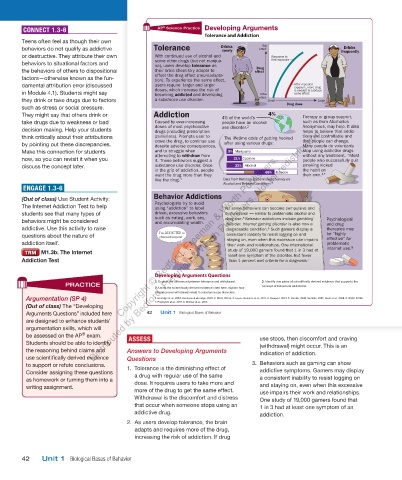
Teens often feel as though their own
Big
Drinks
behaviors do not qualify as addictive Tolerance Drinks effect frequently
rarely
or destructive. They attribute their own With continued use of alcohol and Response to
behaviors to situational factors and some other drugs (but not marijua- rst exposure
na), users develop tolerance as
Drug
the behaviors of others to dispositional their brain chemistry adapts to effect
factors—otherwise known as the fun- offset the drug effect (neuroadapta-
tion). To experience the same effect,
damental attribution error (discussed users require larger and larger After repeated
exposure, more drug
in Module 4.1). Students might say doses, which increase the risk of Little is needed to produce
becoming addicted and developing
same effect
they drink or take drugs due to factors a substance use disorder. effect Small Large
such as stress or social pressure. Drug dose
They might say that others drink or Addiction 4% of the world’s 4% Therapy or group support,
take drugs due to weakness or bad Caused by ever-increasing people have an alcohol such as from Alcoholics
decision making. Help your students doses of most psychoactive use disorder. 2 Anonymous, may help. It also
helps to believe that addic-
drugs (including prescription
think critically about their attributions painkillers). Prompts user to The lifetime odds of getting hooked tions are controllable and
by pointing out these discrepancies. crave the drug, to continue use after using various drugs: that people can change.
Many people do voluntarily
despite adverse consequences,
Make this connection for students and to struggle when 9% Marijuana stop using addictive drugs
now, so you can revisit it when you attempting to withdraw from 21% Cocaine without any treatment. “Most
people who successfully quit
it. These behaviors suggest a
discuss the concept later. substance use disorder. Once 23% Alcohol smoking kicked
in the grip of addiction, people 68% Tobacco the habit on
want the drug more than they their own. 4 ”
like the drug. 1 Data from National Epidemiologic Survey on
Alcohol and Related Conditions 3
ENGAGE 1.3-6
(Out of class) Use Student Activity: Behavior Addictions
The Internet Addiction Test to help Psychologists try to avoid Yet some behaviors can become compulsive and
using “addiction” to label
students see that many types of driven, excessive behaviors dysfunctional — similar to problematic alcohol and
5
behaviors might be considered such as eating, work, sex, drug use. Behavior addictions include gambling Psychological
and accumulating wealth.
disorder. Internet gaming disorder is also now a
and drug
addictive. Use this activity to raise diagnosable condition. Such gamers display a therapies may
6
I'm ADDICTED to
questions about the nature of Copyright © Bedford, Freeman & Worth Publishers. be “highly
consistent inability to resist logging on and
cheeseburgers!
effective” for
staying on, even when this excessive use impairs
addiction itself. Distributed by Bedford, Freeman & Worth Publishers. Not for redistribution. problematic
their work and relationships. One international
M1.3b: The Internet study of 19,000 gamers found that 1 in 3 had at internet use. 8
least one symptom of the disorder. But fewer
Addiction Test than 1 percent met criteria for a diagnosis. 7
Developing Arguments Questions
1. Berridge et al., 2009; Robinson & Berridge, 2003. 2. WHO, 2014b. 3. Lopez-Quintero et al., 2011. 4. Newport, 2013. 5. Gentile, 2009;
Grif ths, 2001; Hoeft et al., 2008. 6. WHO, 2018b. 7. Przybylski et al., 2017. 8. Winkler et al., 2013.
1. Explain the difference between tolerance and withdrawal.
3. Identify one piece of scientifically derived evidence that supports the
PRACTICE concept of behavioral addictions.
2. Using the scientifically derived evidence cited here, explain how
tolerance and withdrawal relate to substance use disorders.
Argumentation (SP 4) 1. Berridge et al., 2009; Robinson & Berridge, 2003. 2. WHO, 2014b. 3. Lopez-Quintero et al., 2011. 4. Newport, 2013. 5. Gentile, 2009; Griffiths, 2001; Hoeft et al., 2008. 6. WHO, 2018b.
7. Przybylski et al., 2017. 8. Winkler et al., 2013.
(Out of class) The “Developing
Arguments Questions” included here 42 Unit 1 Biological Bases of Behavior
are designed to enhance students’
argumentation skills, which will
®
be assessed on the AP exam. ASSESS use stops, then discomfort and craving 15/12/23 9:22 AM
03_myersAPpsychology4e_28116_ch01_002_163.indd 42
Students should be able to identify (withdrawal) might occur. This is an
the reasoning behind claims and Answers to Developing Arguments indication of addiction.
use scientifically derived evidence Questions
to support or refute conclusions. 1. Tolerance is the diminishing effect of 3. Behaviors such as gaming can show
Consider assigning these questions a drug with regular use of the same addictive symptoms. Gamers may display
as homework or turning them into a dose. It requires users to take more and a consistent inability to resist logging on
writing assignment. and staying on, even when this excessive
more of the drug to get the same effect. use impairs their work and relationships.
Withdrawal is the discomfort and distress One study of 19,000 gamers found that
that occur when someone stops using an 1 in 3 had at least one symptom of an
addictive drug. addiction.
2. As users develop tolerance, the brain
adapts and requires more of the drug,
increasing the risk of addiction. If drug
42 Unit 1 Biological Bases of Behavior
03_HammerTE4e_47547_ch01_2a_163_4pp.indd 42 07/02/24 5:19 PM

