


Page 56 - 2024-bfw-MyersAP4e-TE
P. 56
The lost lives from these dynamite-loaded cigarettes approximate those from today’s
                                                                             actual cigarettes. A teen-to-the-grave smoker has a 50 percent chance of dying from the
               CONNECT 1.3-7                                                 habit, and each year, tobacco kills nearly 7 million people worldwide, with another 1.2 million
                                                                             people killed due to exposure to second-hand smoke (WHO, 2020b). By 2030, annual
               Help students see that operant                                tobacco deaths are expected to increase to 8 million. That means that 1 billion people this
               conditioning (covered in Module 3.8a)                         century may be killed by tobacco (WHO, 2012a).
                                                                               Tobacco products include cigarettes, cigars, chewing tobacco, pipe tobacco, snuff,
               is a factor in nicotine and other drug                        and — most recently — e-cigarettes. Inhaling e-cigarette vapor (vaping) gives users a jolt of
               addictions. Explain that the faster the                       nicotine without cigarettes’ cancer-causing tar. Thanks to vaping’s rapid increase — the fast-
               high occurs, the more reinforcing the                         est drug use increase on record — U.S. high school students in 2021 daily used e-cigarettes
               drug-taking behavior is. For many                             at 2.7 times the rate of traditional cigarettes (Johnston et al., 2021).
                                                                               In one survey of regular e-cigarette users from the United States, England, Canada,
               drug users, the cycle of taking drugs                         and Australia, 85 percent reported they vaped because they believed it would help them
               and withdrawal from them is a                                 cut down on smoking traditional cigarettes (Yong et al., 2019). Experts debate whether
               negatively reinforcing system. Once                           e-cigarettes can really help smokers quit smoking (Hajek et al., 2019; HHS, 2020a). But they
                                                                             agree that cigarettes are addictive nicotine dispensers that introduce nonsmokers to smok-
               the drug’s effects start to wane,                             ing (Prochaska, 2019). In a British study, nonsmoking teens who started vaping became four
               painful withdrawal symptoms occur.                            times more likely to move on to cigarette smoking (Miech et al., 2017).
                                                                               Teen use has prompted legal restrictions as well as investigations, including one by the
               Taking more of the drug eliminates the                        U.S. Food and Drug Administration on whether e-cigarette companies target teenage users
                                      Distributed by Bedford, Freeman & Worth Publishers. Not for redistribution.
               negative symptoms, reinforcing the                            (Richtel & Kaplan, 2018). Fruity flavors, for example, increase teen use (Buckell & Sindelar,
               drug-taking behavior even more.                               2019; O’Connor et al., 2019). These troubling trends prompted U.S. Surgeon General Jerome
                                                                             Adams to “officially declar[e] e-cigarette use among youth an epidemic” (Stein, 2018).
                                                                                                            Smoke a cigarette and nature will
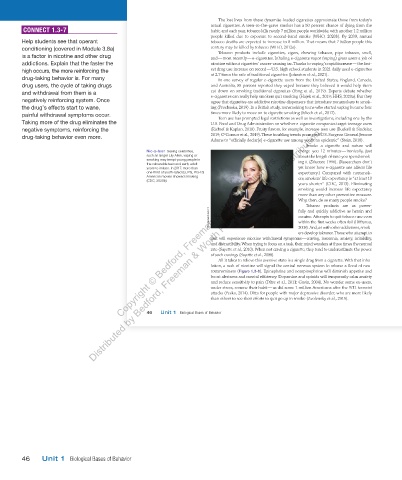
                                                        Nic-a-teen  Seeing celebrities,                  charge you 12 minutes — ironically, just
                                               Copyright © Bedford, Freeman & Worth Publishers.
                                                        such as singer Lily Allen, vaping or             about the length of time you spend smok-
                                                        smoking may tempt young people in
                                                        the vulnerable teen and early-adult              ing it (Discover, 1996). (Researchers don’t
                                                        years to imitate. In 2017, more than             yet know how e-cigarette use affects life
                                                        one-third of youth-rated (G, PG, PG-13)          expectancy.) Compared with nonsmok-
                                                        American movies showed smoking                   ers, smokers’ life expectancy is “at least 10
                                                        (CDC, 2020b).
                                                                                                         years shorter” (CDC, 2013). Eliminating
                                                                                                         smoking  would increase life  expectancy
                                                                                                         more than any other preventive measure.
                                                                                                         Why, then, do so many people smoke?
                                                                                                            Tobacco products are as  power-
                                                                            VYPe/MeGA/Newscom            cocaine. Attempts to quit tobacco use even
                                                                                                         fully and quickly addictive as heroin and
                                                                                                         within the first weeks often fail (DiFranza,
                                                                                                         2008). And, as with other addictions, smok-
                                                                                                         ers develop tolerance. Those who attempt to
                                                                             quit will experience nicotine withdrawal symptoms — craving, insomnia, anxiety, irritability,
                                                                             and distractibility. When trying to focus on a task, their mind wanders at three times the normal
                                                                             rate (Sayette et al., 2010). When not craving a cigarette, they tend to underestimate the power
                                                                             of such cravings (Sayette et al., 2008).
                                                                               All it takes to relieve this aversive state is a single drag from a cigarette. With that inha-
                                                                             lation, a rush of nicotine will signal the central nervous system to release a flood of neu-
                                                                             rotransmitters (Figure 1.3-8). Epinephrine and norepinephrine will diminish appetite and
                                                                             boost alertness and mental efficiency. Dopamine and opioids will temporarily calm anxiety
                                                                             and reduce sensitivity to pain (Ditre et al., 2011; Gavin, 2004). No wonder some ex-users,
                                                                             under stress, resume their habit — as did some 1 million Americans after the 9/11 terrorist
                                                                             attacks (Pesko, 2014). Ditto for people with major depressive disorder, who are more likely
                                                                             than others to see their efforts to quit go up in smoke (Zvolensky et al., 2015).
                                                        46   Unit 1  Biological Bases of Behavior


                                                  03_myersAPpsychology4e_28116_ch01_002_163.indd   46                               15/12/23   9:22 AM


               46   Unit 1  Biological Bases of Behavior


          03_HammerTE4e_47547_ch01_2a_163_4pp.indd   46                                                                         07/02/24   5:20 PM

