


Page 59 - 2024-bfw-MyersAP4e-TE
P. 59
Module 1.3b

                 shocks. Likewise, humans who voluntarily ingest high doses of cocaine in laboratory exper-
                                                                              ®
                 iments impose higher shock levels on a presumed opponent than do those receiving a   AP  Science Practice
                 placebo (Licata et al., 1993). Cocaine use may also lead to emotional disturbances, suspi-  Research
                 ciousness, convulsions, cardiac arrest, or respiratory failure.  Placebos are important in experi-
                    Cocaine powerfully stimulates the brain’s reward pathways (Keramati et al., 2017;   mentation. They allow researchers
                 Walker et al., 2018). Its psychological effects vary with the dosage and form consumed, but   to uncover effects on behavior
                 the situation and the user’s expectations and personality also play a role. Given a placebo,   caused by the administration of
                 cocaine users who thought they were taking cocaine often had a cocaine-like experience   an inert substance or condition,
                                                                         which the recipient assumes is
                 (Van Dyke & Byck, 1982).                                an active agent — such as the
                    In national surveys, 1 percent of American twelfth graders and 6 percent of British     cocaine in this study.
                 18- to 24-year-olds reported having tried cocaine during the past year (ACMD, 2009;
                   Johnston et al., 2021).
                 Methamphetamine                                                                     CONNECT 1.3-7
                 Amphetamines stimulate neural activity. As body functions speed up, the
                 user’s energy rises and mood soars. Amphetamines are the parent drug                Link amphetamines to neurotransmitters
                 for the highly addictive  methamphetamine, which is chemically similar but          (discussed in Module 1.3a) by pointing
                 has stronger effects (NIDA, 2002, 2005). Methamphetamine triggers the
                 release of the neurotransmitter dopamine, which  stimulates brain cells that        out to your students that research has
                 enhance energy and mood, leading to 8 hours or so of heightened energy     Multnomah County Sheriff’s Office  shown that former methamphetamine
                                      Distributed by Bedford, Freeman & Worth Publishers. Not for redistribution.
                 and euphoria. Its aftereffects may include irritability, insomnia, hyperten-        users often lose some key dopamine
                 sion, seizures, social isolation, depression, and occasional violent outbursts
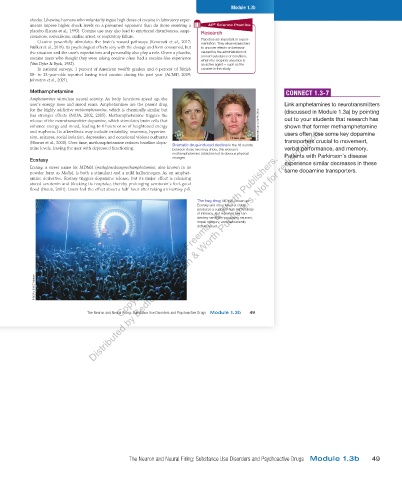
                 (Homer et al., 2008). Over time, methamphetamine reduces baseline dopa-  Dramatic drug-induced decline In the 18 months    transporters crucial to movement,
                 mine levels, leaving the user with depressed functioning.  between these two mug shots, this woman’s   verbal performance, and memory.
                                               Copyright © Bedford, Freeman & Worth Publishers.
                                                                methamphetamine addiction led to obvious physical   Patients with Parkinson’s disease
                 Ecstasy                                        changes.                             experience similar decreases in these
                 Ecstasy, a street name for MDMA (methylenedioxymethamphetamine, also known in its
                 powder form as Molly), is both a stimulant and a mild hallucinogen. As an amphet-   same dopamine transporters.
                 amine derivative, Ecstasy triggers dopamine release, but its major effect is releasing
                 stored serotonin and blocking its reuptake, thereby prolonging serotonin’s feel-good
                 flood (Braun, 2001). Users feel the effect about a half-hour after taking an Ecstasy pill.

                                                                        The hug drug  MDMA, known as
                                                                        Ecstasy and often taken at clubs,
                                                                        produces a euphoric high and feelings
                                                                        of intimacy. But repeated use can
                                                                        destroy serotonin-producing neurons,
                                                                        impair memory, and permanently
                                                                        deflate mood.


                   PYMCA/UIG/AGE Fotostock


                                    The Neuron and Neural Firing: Substance Use Disorders and Psychoactive Drugs  Module 1.3b   49


         03_myersAPpsychology4e_28116_ch01_002_163.indd   49                              29/12/23   12:09 PM


                                                  The Neuron and Neural Firing: Substance Use Disorders and Psychoactive Drugs Module 1.3b   49


          03_HammerTE4e_47547_ch01_2a_163_4pp.indd   49                                                                         07/02/24   5:20 PM

