


Page 62 - 2024-bfw-MyersAP4e-TE
P. 62
cognitive impairment (Harvey, 2019). “Nearly 1 in 5 people who begin marijuana use
                                                                             during  adolescence  become  addicted,”  warned  U.S.  Surgeon  General  Jerome Adams
               ENGAGE 1.3-8                                                  (Aubrey, 2019).
                                                                               Attitudes toward marijuana use have changed remarkably — from 12 percent support
               (15 minutes) In pairs, have students                          for legalizing marijuana in 1969 to 66 percent in 2019 (De Pinto, 2019; McCarthy, 2018).
               explore the Substance Abuse and                               Some countries and U.S. states have legalized marijuana possession. Greater legal accep-
               Mental Health Services Administration                         tance may explain why rates of Americans who have tried marijuana rose dramatically
                                                                             between 1969 and 2019, from 4 to 45 percent, with 12 percent saying they now smoke
               website (samhsa.gov). Tell them to                              marijuana (Gallup, 2019b).
               focus on the “Data” tab. After                                                          * * *
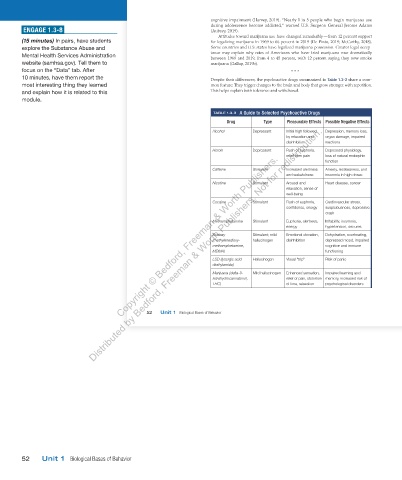
               10 minutes, have them report the                              Despite their differences, the psychoactive drugs summarized in Table 1.3-3 share a com-
               most interesting thing they learned                           mon feature: They trigger changes to the brain and body that grow stronger with repetition.
               and explain how it is related to this                         This helps explain both tolerance and withdrawal.
               module.
                                                                             TABLE 1.3-3  A Guide to Selected Psychoactive Drugs
                                                                                  Drug        Type   Pleasurable Effects Possible Negative Effects
                                      Distributed by Bedford, Freeman & Worth Publishers. Not for redistribution.
                                                                             Alcohol      Depressant  Initial high followed   Depression, memory loss,
                                                                                                     by relaxation and   organ damage, impaired
                                                                                                     disinhibition  reactions
                                                                             Heroin       Depressant  Rush of euphoria,   Depressed physiology,
                                               Copyright © Bedford, Freeman & Worth Publishers.
                                                                                                     relief from pain  loss of natural endorphin
                                                                                                                  function
                                                                             Caffeine     Stimulant  Increased alertness   Anxiety, restlessness, and
                                                                                                     and wakefulness  insomnia in high doses
                                                                             Nicotine     Stimulant  Arousal and   Heart disease, cancer
                                                                                                     relaxation, sense of
                                                                                                     well-being
                                                                             Cocaine      Stimulant  Rush of euphoria,   Cardiovascular stress,
                                                                                                     confidence, energy  suspiciousness, depressive
                                                                                                                  crash
                                                                             Methamphetamine  Stimulant  Euphoria, alertness,   Irritability, insomnia,
                                                                                                     energy       hypertension, seizures
                                                                             Ecstasy      Stimulant; mild   Emotional elevation,   Dehydration, overheating,
                                                                             (methylenedioxy-   hallucinogen  disinhibition  depressed mood, impaired
                                                                             methamphetamine,                     cognitive and immune
                                                                             MDMA)                                functioning
                                                                             LSD (lysergic acid   Hallucinogen  Visual “trip”  Risk of panic
                                                                             diethylamide)
                                                                             Marijuana (delta-9-  Mild hallucinogen  Enhanced sensation,   Impaired learning and
                                                                             tetrahydrocannabinol,   relief of pain, distortion  memory, increased risk of
                                                                             THC)                    of time, relaxation  psychological disorders


                                                        52   Unit 1  Biological Bases of Behavior


                                                  03_myersAPpsychology4e_28116_ch01_002_163.indd   52                               15/12/23   9:22 AM


               52   Unit 1  Biological Bases of Behavior


          03_HammerTE4e_47547_ch01_2a_163_4pp.indd   52                                                                         07/02/24   5:20 PM

