


Page 66 - 2024-bfw-MyersAP4e-TE
P. 66
CULTURAL             and psychological processes. They and other researchers working from a biological perspec-
                                                        AWARENESS            tive are announcing discoveries about the interplay of our biology and our behavior and
                                                          In the biopsychosocial approach,   mind at an exhilarating pace. Within little more than the past century, researchers seeking

                                                        culture — the enduring beliefs, ideas,   to understand the biology of the mind have discovered that:
                                                        attitudes, values, and traditions


                                                        shared by a group — is an important   •   Among the body’s cells are neurons that conduct electricity and “talk” to one another by
                                                        component in understanding human   sending chemical messages across a synapse (see Module 1.3).
                                                        behavior. It plays a role equal to those

                                                        of the biological and psychological   •   Our experiences wire our adaptive brain.
                                                        systems. Can you think of some ways
                                                        your culture influences your behavior?   •   Specific brain systems serve specific functions (though not the functions Gall supposed).

                                                                             •   We integrate information processed in these different brain systems to construct our
                                                           ®
                                   ®
                 TEACHING THE AP  TIP                      AP  Exam Tip        experiences of sights and sounds, meanings and memories, pain and passion.
                                                                                     We have also realized that we are each a system composed of subsystems that are in
                                                           You will see versions of  Figure 1.4-2     turn composed of even smaller subsystems. Tiny cells organize to form body organs. These
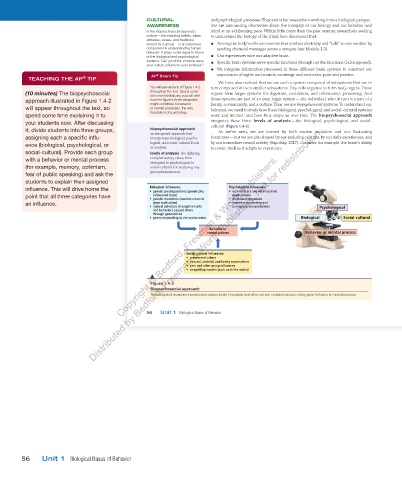
                (10 minutes) The biopsychosocial         throughout the text. Spend some   organs form larger systems for digestion, circulation, and information processing. And
                                                         time now familiarizing yourself with
                approach illustrated in Figure 1.4-2     how the figure’s three viewpoints   those systems are part of an even larger system — the individual, who in turn is a part of a
                                                         might contribute to behavior
                will appear throughout the text, so      or mental processes, the very   family, a community, and a culture. Thus, we are  biopsychosocial  systems. To understand our
                                                                             behavior, we need to study how these biological, psychological, and social- cultural systems
                spend some time explaining it to           foundation of psychology.   work and interact, and how they shape us over time. The    biopsychosocial approach

                your students now. After discussing                          integrates these three   levels  of  analysis  — the biological, psychological, and social-


                                                                             cultural  (   F igure  1.4-2 ) .

                                      Distributed by Bedford, Freeman & Worth Publishers. Not for redistribution.
                it, divide students into three groups,         biopsychosocial approach        As we’ve seen, we are formed by both ancient evolution and our fluctuating
                                                         an integrated approach that
                assigning each a specific influ-         incorporates biological, psycho-    hormones — but we are also shaped by our enduring cultures, by our daily experiences, and
                ence (biological, psychological, or      logical, and social-cultural levels   by our immediate neural activity ( Sapolsky, 2017 ). Consider, for example, the brain’s ability
                                                         of analysis.
                                                                             to rewire itself as it adapts to experience.
                social-cultural). Provide each group        levels of analysis       the differing
                                               Copyright © Bedford, Freeman & Worth Publishers.
                with a behavior or mental process        complementary views, from
                                                         biological to psychological to
                (for example, memory, optimism,          social-cultural, for analyzing any
                fear of public speaking) and ask the     given phenomenon.
                students to explain their assigned
                influence. This will drive home the      Biological influences:    Psychological influences:
                                                         • genetic predispositions (genetically
                                                                                   •  learned fears and other learned
                point that all three categories have       influenced traits)       expectations
                                                                                   •  emotional responses
                                                         • genetic mutations (random errors in
                an influence.                                 gene replication)    •  cognitive processing and
                                                         •  natural selection of adaptive traits    perceptual interpretations  Psychological
                                                           and behaviors passed down
                                                           through generations
                                                         •  genes responding to the environment           Biological    Social-cultural
                                                                            Behavior or
                                                                           mental process                  Behavior or mental process
                                                                     Social-cultural influences:
                                                                     •  presence of others
                                                                     •  cultural, societal, and family expectations
                                                                     •  peer and other group influences
                                                                     •  compelling models (such as in the media)
                                                                   Figure   1.4-2
                                                          Biopsychosocial approach
                                                         This integrated viewpoint incorporates various levels of analysis and offers a more complete picture of any given behavior or mental process.
                                                        56   Unit 1  Biological Bases of Behavior
                                                  03_myersAPpsychology4e_28116_ch01_002_163.indd   56                               15/12/23   9:22 AM


               56   Unit 1  Biological Bases of Behavior


          03_HammerTE4e_47547_ch01_2a_163_4pp.indd   56                                                                         07/02/24   5:21 PM

