


Page 50 - 2024-bfw-MyersAP4e-TE
P. 50
Tolerance and Addiction in Substance Use
               TEACH 1.3-5                                                   Disorders

               Teaching Tip                                                               1.3-5   What are  substance use disorders?

                                                                                   What ar


                                                                                       e

                                                                                   What ar
                                                                                       e
                                                                                         substance use disorders?
                                                                                          1.3-5
                                                                                       e

                                                                                   What ar
                                                                                         substance use disorders?
               If students approach you about a                                Let’s imagine a day in the life of a legal-drug-using adult. The day begins with a couple shots
               substance use–related problem that                            of espresso to feel alert, then an Adderall pill to help focus on a morning meeting. At midday,
               either they have or someone they care                         an energy drink offsets post-lunch drowsiness, and vaping calms anxiety before a presenta-
                                                                             tion. Later, a friend suggests meeting for after-work drinks. It used to take only a drink or two
               about has, help them understand your                          to feel relaxed, but now it’s three or four. Back home, two Advil PMs before bed help induce
               obligations as a teacher. While you                           sleep. The alarm beeps just a few hours later. Then the daily cycle of drug use resumes. Over
               can assure them a certain level of con-                       time, our imagined person — and many actual people — may struggle to keep up with work
                                                                             and family responsibilities, experience strained relationships, and have difficulty limiting their
               fidentiality, you may be obligated to                         substance use. How do we know when substance use becomes a problem?
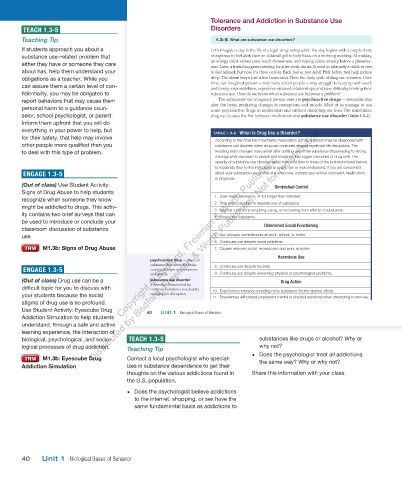
               report behaviors that may cause them                              The substances our imaginary person uses are    psychoactive drugs   — chemicals that
               personal harm to a guidance coun-                             alter the brain, producing changes in perceptions and moods. Most of us manage to use
                                                                             some psychoactive drugs in moderation and without disrupting our lives. But sometimes,
               selor, school psychologist, or parent.                        drug use crosses the line between moderation and    substance use disorder (   Table 1.3-2 ).


               Inform them upfront that you will do
                                      Distributed by Bedford, Freeman & Worth Publishers. Not for redistribution.
               everything in your power to help, but                             TABLE   1.3-2      When Is Drug Use a Disorder?

               for their safety, that help may involve                        According to the American Psychiatric Association (2013), a person may be diagnosed with
               other people more qualified than you                           substance use disorder when drug use continues despite significant life disruptions. The
               to deal with this type of problem.                             resulting brain changes may persist after quitting use of the substance (thus leading to strong
                                                                              cravings when exposed to people and situations that trigger memories of drug use). The
                                                                              severity of substance use disorder varies from mild (two to three of the indicators listed below)
                                                                              to moderate (four to five indicators) to severe (six or more indicators). If you are concerned
               ENGAGE 1.3-5                                                   about your substance use or that of a loved one, contact your school counselor, health clinic,
                                                                              or physician.
               (Out of class) Use Student Activity:                                               Diminished Control
               Signs of Drug Abuse to help students

               recognize when someone they know                                      1.   Uses more substance, or for longer than intended.
               might be addicted to drugs. This activ-                            2.    Tries unsuccessfully to regulate use of substance.

                                                                                     3.   Spends much time acquiring, using, or recovering from effects of substance.
               ity contains two brief surveys that can                            4.    Craves the substance.
               be used to introduce or conclude your
               classroom discussion of substance                                                Diminished Social Functioning
                                                                                     5.   Use disrupts commitments at work, school, or home.

               use.                            Copyright © Bedford, Freeman & Worth Publishers.
                                                                                  6.    Continues use despite social problems.
                      M1.3b: Signs of Drug Abuse                                  7.    Causes reduced social, recreational, and work activities.
                                                                                                   Hazardous Use
                                                               psychoactive drug       a chemical
                                                         substance that alters the brain,           8.    Continues use despite hazards.
               ENGAGE 1.3-5                              causing changes in perceptions
                                                         and moods.               9.    Continues use despite worsening physical or psychological problems.
               (Out of class) Drug use can be a             substance use disorder                  Drug Action
               difficult topic for you to discuss with   a disorder characterized by           10.   Experiences tolerance (needing more substance for the desired effect).
                                                         continued substance use despite

               your students because the social          resulting life disruption.             11.   Experiences withdrawal (unpleasant mental or physical reactions) when attempting to end use.

               stigma of drug use is so profound.
               Use Student Activity: Eyescube Drug      40   Unit 1  Biological Bases of Behavior
               Addiction Simulation to help students
               understand, through a safe and active
               learning experience, the interaction of
               biological, psychological, and socio-  TEACH 1.3-5                           substances like drugs or alcohol? Why or   15/12/23   9:22 AM
                                                  03_myersAPpsychology4e_28116_ch01_002_163.indd   40
               logical processes of drug addiction.  Teaching Tip                           why not?
                                                                                          •  Does the psychologist treat all addictions
                      M1.3b: Eyescube Drug       Contact a local psychologist who special-  the same way? Why or why not?
               Addiction Simulation              izes in substance dependence to get their
                                                 thoughts on the various addictions found in   Share this information with your class.
                                                 the U.S. population.
                                                 •  Does the psychologist believe addictions
                                                    to the internet, shopping, or sex have the
                                                    same fundamental basis as addictions to
               40   Unit 1  Biological Bases of Behavior


          03_HammerTE4e_47547_ch01_2a_163_4pp.indd   40                                                                         07/02/24   5:19 PM

