


Page 108 - 2024-bfw-MyersAP4e-TE
P. 108
Melatonin production suppressed      Melatonin produced
                                                                                   Suprachiasmatic                      Suprachiasmatic
                                                                                   nucleus                              nucleus

                                                                                    Pineal gland                        Pineal gland
                                                           Light
                                                                                   No melatonin                         Melatonin
                                                                                   produced                             produced

                                                                                   Blood vessel                         Blood vessel

                                                                   (a)                                  (b)
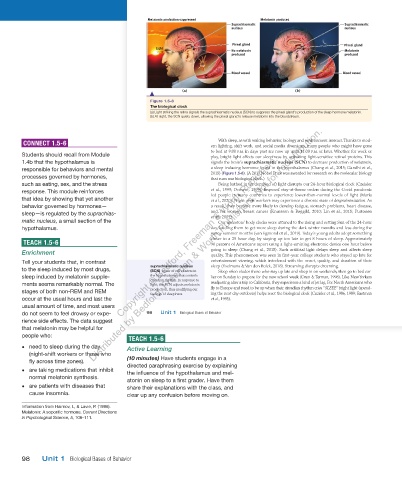
                                                         Figure 1.5-8
                                                         The biological clock
                                                         (a) Light striking the retina signals the suprachiasmatic nucleus (SCN) to suppress the pineal gland’s production of the sleep hormone melatonin.
                                                         (b) At night, the SCN quiets down, allowing the pineal gland to release melatonin into the bloodstream.


                                                                               With sleep, as with waking behavior, biology and environment interact. Thanks to mod-
               CONNECT 1.5-6                                                 ern lighting, shift work, and social media diversions, many people who might have gone
                                                                             to bed at 9:00 p.m. in days past are now up until 11:00 p.m. or later. Whether for work or
                                               Copyright © Bedford, Freeman & Worth Publishers.
               Students should recall from Module                            play, bright light affects our sleepiness by activating light-sensitive retinal proteins. This
               1.4b that the hypothalamus is                                 signals the brain’s suprachiasmatic nucleus (SCN) to decrease production of melatonin,
               responsible for behaviors and mental                          a sleep-inducing hormone found in the hypothalamus (Chang et al., 2015; Gandhi et al.,
               processes governed by hormones,                               2015) (Figure 1.5-8). (A 2017 Nobel Prize was awarded for research on the molecular biology
                                                                             that runs our biological clock.)
               such as eating, sex, and the stress                             Being bathed in (or deprived of) light disrupts our 24-hour biological clock (Czeisler

               response. This module reinforces                              et al., 1999; Dement, 1999). Imposed stay-at-home orders during the Covid pandemic
                                                                             led people in many countries to experience lower-than-normal levels of light (María
               that idea by showing that yet another                         et al., 2020). Night-shift workers may experience a chronic state of desynchronization. As
               behavior governed by hormones—                                a result, they become more likely to develop fatigue, stomach problems, heart disease,
               sleep—is regulated by the suprachias-                         and, for women, breast cancer (Knutsson & Bøggild, 2010; Lin et al., 2015; Puttonen
                                                                             et al., 2009).
               matic nucleus, a small section of the                           Our ancestors’ body clocks were attuned to the rising and setting Sun of the 24-hour
               hypothalamus.                                                 day, leading them to get more sleep during the dark winter months and less during the
                                                                             sunny summer months (van Egmond et al., 2019). Today’s young adults adopt something
                                                                             closer to a 25-hour day, by staying up too late to get 8 hours of sleep. Approximately
               TEACH 1.5-6            Distributed by Bedford, Freeman & Worth Publishers. Not for redistribution.
                                                                             90 percent of Americans report using a light-emitting electronic device one hour before
               Enrichment                                                    going to sleep (Chang et al., 2015). Such artificial light delays sleep and affects sleep
                                                                             quality. This phenomenon was seen in first-year college students who stayed up late for
               Tell your students that, in contrast                          entertainment viewing, which interfered with the onset, quality, and duration of their
               to the sleep induced by most drugs,       suprachiasmatic nucleus   sleep (Exelmans & Van den Bulck, 2018). Streaming disrupts dreaming.
                                                         (SCN)  a pair of cell clusters in
                                                                               Sleep often eludes those who stay up late and sleep in on weekends, then go to bed ear-
               sleep induced by melatonin supple-        the hypothalamus that controls   lier on Sunday to prepare for the new school week (Oren & Terman, 1998). Like New Yorkers
                                                         circadian rhythm. In response to
               ments seems remarkably normal. The        light, the SCN adjusts melatonin   readjusting after a trip to California, they experience a kind of jet lag. For North Americans who
               stages of both non-REM and REM            production, thus modifying our   fly to Europe and need to be up when their circadian rhythm cries “SLEEP,” bright light (spend-
                                                                             ing the next day outdoors) helps reset the biological clock (Czeisler et al., 1986, 1989; Eastman
                                                         feelings of sleepiness.
               occur at the usual hours and last the                         et al., 1995).
               usual amount of time, and most users
               do not seem to feel drowsy or expe-      98   Unit 1  Biological Bases of Behavior
               rience side effects. The data suggest
               that melatonin may be helpful for
               people who:                        TEACH 1.5-6                                                                       15/12/23   9:24 AM
                                                  03_myersAPpsychology4e_28116_ch01_002_163.indd   98
               •  need to sleep during the day   Active Learning
                 (night-shift workers or those who
                 fly across time zones).         (10 minutes) Have students engage in a
                                                 directed paraphrasing exercise by explaining
               •  are taking medications that inhibit   the influence of the hypothalamus and mel-
                 normal melatonin synthesis.     atonin on sleep to a first grader. Have them
               •  are patients with diseases that   share their explanations with the class, and
                 cause insomnia.                 clear up any confusion before moving on.
               Information from Haimov, I., & Lavie, P. (1996).
               Melatonin: A soporific hormone. Current Directions
               in Psychological Science, 5, 106–111.


               98   Unit 1  Biological Bases of Behavior


          03_HammerTE4e_47547_ch01_2a_163_4pp.indd   98                                                                         07/02/24   5:25 PM

