


Page 109 - 2024-bfw-MyersAP4e-TE
P. 109
Module 1.5b


                       ®
                     AP  Science Practice        Check Your Understanding
                         Examine the Concept              Apply the Concept
                   ▶  Explain the differences among the stages of sleep.   ▶  Would you consider yourself a night owl or a morning lark?
                   ▶  Explain the role of the suprachiasmatic nucleus in sleep.   Explain how this relates to your circadian rhythm.
                   ▶  Explain how REM sleep relates to dreaming.

                       Answers to the Examine the Concept questions can be found in  Appendix C  at the end of the book.


                       Why Do We Sleep?
                               1.5-7     What  ar e  sleep’s                                         TEACH 1.5-7

                               1.5-7    What are sleep’s functions?     functions?
                   As we’ve just seen, our sleep patterns differ from person to person and from culture to cul-  Teaching Tip
                 ture. But why do we have this need for sleep? Psychologists offer six possible reasons:
                                                                                                     Point out to your students how

                      1. Sleep protects. When darkness shut down the day’s hunting, gathering, and travel, our   different qualities have evolved in
                    distant ancestors were better off asleep in a cave, out of harm’s way. Those who didn’t
                    wander around dark cliffs were more likely to leave descendants. This fits a broad-  animals and humans due to their sleep
                                      Distributed by Bedford, Freeman & Worth Publishers. Not for redistribution.
                    er principle: A species’ sleep pattern tends to suit its ecological niche ( Siegel, 2009 ).   habits. Nocturnal animals typically
                      Animals with the greatest need to graze and the least ability to hide tend to sleep less.   have better night vision and larger
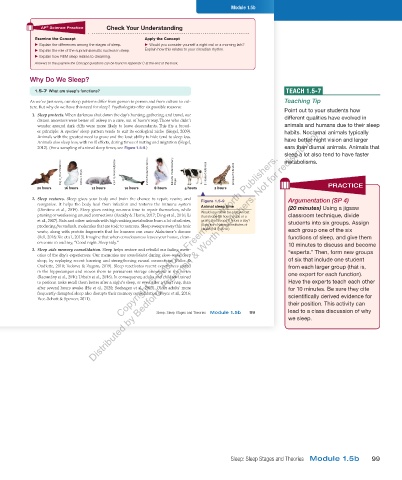
                    Animals also sleep less, with no ill effects, during times of mating and migration ( Siegel,
                    2012 ). (For a sampling of animal sleep times, see  Figure 1.5-9.)               ears than diurnal animals. Animals that


                                               Copyright © Bedford, Freeman & Worth Publishers.
                                                                                                     sleep a lot also tend to have faster
                                                                                                     metabolisms.
                            Kruglov_Orda/Shutterstock  Andrew D. Myers  Utekhina Anna/Shutterstock  Steffen Foerster/Shutterstock  RubberBall Productions/Getty   Eric Isselee/Shutterstock  pandapaw/Shutterstock
                    20 hours  16 hours  12 hours  10 hours  8 hours  Images  4 hours  2 hours                      PRACTICE
                               2.  Sleep  restores.  Sleep gives your body and brain the chance to repair, rewire, and             Figure   1.5-9    Argumentation (SP 4)
                      reorganize. It helps the body heal from infection and restores the immune system     Animal sleep time
                    ( Dimitrov et al., 2019 ). Sleep gives resting neurons time to repair themselves, while   Would you rather be a brown bat   (20 minutes) Using a jigsaw
                    pruning or weakening unused connections ( Ascády & Harris, 2017 ; Ding et al., 2016;  Li   that sleeps 20 hours a day or a   classroom technique, divide
                    et al., 2017 ). Bats and other animals with high waking metabolism burn a lot of calories,   giraffe that sleeps 2 hours a day?   students into six groups. Assign
                    producing  free radicals,  molecules that are toxic to neurons. Sleep sweeps away this toxic   (Data from National Institutes of
                                                                         Health [ NIH], 2010 .)
                    waste, along with protein fragments that for humans can cause Alzheimer’s disease   each group one of the six
                    ( Beil, 2018 ;  Xie et al., 2013 ). Imagine that when consciousness leaves your house, clean-  functions of sleep, and give them
                    ers come in and say, “Good night. Sleep tidy.”                                    10 minutes to discuss and become
                     3. Sleep aids memory consolidation.  Sleep helps restore and rebuild our fading mem-  “experts.” Then, form new groups
                    ories of the day’s experiences. Our memories are  consolidated  during slow-wave deep
                    sleep, by replaying recent learning and strengthening neural connections ( Paller &   of six that include one student
                    Oudiette, 2018 ; Todorva & Zugaro, 2019). Sleep reactivates recent experiences stored   from each larger group (that is,
                    in the hippocampus and moves them to permanent storage elsewhere in the cortex    one expert for each function).
                    ( Racsmány et al., 2010 ; Urbain et al., 2016). In consequence, adults and children trained
                    to perform tasks recall them better after a night’s sleep, or even after a short nap, than   Have the experts teach each other
                    after several hours awake ( He et al., 2020 ;  Seehagen et al., 2015 ). Older adults’ more   for 10 minutes. Be sure they cite
                    frequently disrupted sleep also disrupts their memory consolidation ( Boyce et al., 2016 ;   scientifically derived evidence for
                     Pace-Schott & Spencer, 2011 ).
                                                                                                      their position. This activity can
                                                           Sleep: Sleep Stages and Theories  Module 1.5b   99  lead to a class discussion of why
                                                                                                      we sleep.


         03_myersAPpsychology4e_28116_ch01_002_163.indd   99                              15/12/23   9:24 AM


                                                                                   Sleep: Sleep Stages and Theories Module 1.5b   99


          03_HammerTE4e_47547_ch01_2a_163_4pp.indd   99                                                                         07/02/24   5:25 PM

