


Page 121 - 2024-bfw-MyersAP4e-TE
P. 121
Module 1.5c

                 Maquet, 2001). So precise were these activity patterns that scientists could tell where in the
                 maze the rat would be if awake. To sleep, perchance to remember.
                    This is important news for students, many of whom are sleep deprived on weekdays
                 and binge sleep on the weekend (Stickgold, 2000). High school students with high grades           PRACTICE
                 slept about 25 minutes longer each night than their lower-achieving classmates (Wolfson &
                 Carskadon, 1998; see Figure 1.5-12). Sacrificing sleep time to study actually worsens aca-
                 demic performance, by making it harder the next day to understand class material or do well   Data interpretation (SP 3)
                 on a test (Gillen-O’Neel et al., 2013).                                              (20 minutes) In pairs, have stu-
                                                                                                      dents create a scatterplot to
                                                                                                      illustrate the positive correlation
                                                                         Figure 1.5-12
                                                                         A sleeping brain is a        between GPA and hours of sleep.
                                                                         working brain
                                                                                                      Ask them to hypothesize the rea-
                                                                                                      sons why individuals with higher
                                                                                                      GPAs may get more sleep than
                                                                                                      those with lower GPAs. Bonus: You
                                                                                                      can also review research methods
                                                                                                      in this activity by asking students
                      (a) Learning.  (b) Sleep consolidates our   (c) Learning is retained.
                                    learning into long-term                                           to identify the design (correlational)
                                    memory.                                                           and the variables (GPA and hours of
                                                                                                      sleep per night).
                                               Copyright © Bedford, Freeman & Worth Publishers.
                    To develop and preserve neural pathways. Perhaps dreams, or the brain activity associ-
                 ated with REM sleep, serve a physiological function, providing the sleeping brain with periodic
                 stimulation. This theory makes developmental sense. As you will see in Module 3.2, stimulating
                 experiences preserve and expand the brain’s neural pathways. Infants, whose neural networks
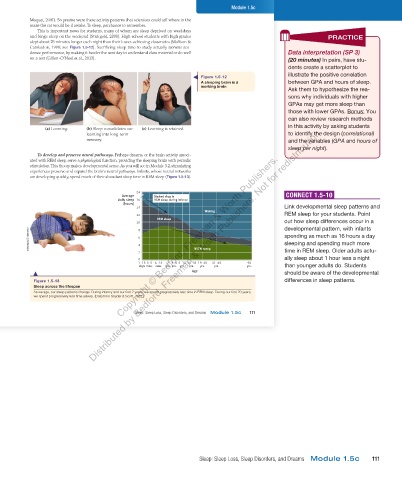
                 are developing quickly, spend much of their abundant sleep time in REM sleep (Figure 1.5-13).

                                                    24
                                                Average   Marked drop in                             CONNECT 1.5-10
                                              daily sleep  16  REM sleep during infancy
                                                (hours)
                                                    14                                               Link developmental sleep patterns and
                                                                           Waking
                                                    12                                               REM sleep for your students. Point
                                                           REM sleep
                                                    10 8                                             out how sleep differences occur in a
                                                                                                     developmental pattern, with infants
                 swissmacky/Shutterstock  Distributed by Bedford, Freeman & Worth Publishers. Not for redistribution.
                                                                                                     spending as much as 16 hours a day
                                                     6
                                                                                                     sleeping and spending much more
                                                     4
                                                     2                 NREM sleep                    time in REM sleep. Older adults actu-
                                                     0                                               ally sleep about 1 hour less a night
                                                     1–15 3–5 6–23  2 3–4  5–13  14–18 19–30  31–45  90
                                                     days mos. mos.  yrs. yrs.  yrs.  yrs.  yrs.  yrs.  yrs.  than younger adults do. Students
                                                                      Age                            should be aware of the developmental
                   Figure 1.5-13                                                                     differences in sleep patterns.
                   Sleep across the lifespan
                   As we age, our sleep patterns change. During infancy and our first 2 years, we spend progressively less time in REM sleep. During our first 20 years,
                   we spend progressively less time asleep. (Data from Snyder & Scott, 1972.)
                                                    Sleep: Sleep Loss, Sleep Disorders, and Dreams  Module 1.5c   111


         03_myersAPpsychology4e_28116_ch01_002_163.indd   111                             15/12/23   9:24 AM


                                                                         Sleep: Sleep Loss, Sleep Disorders, and Dreams Module 1.5c   111


          03_HammerTE4e_47547_ch01_2a_163_4pp.indd   111                                                                        07/02/24   5:26 PM

