


Page 138 - 2024-bfw-MyersAP4e-TE
P. 138
Unlike cones, rods congregate in the retina’s outer regions. Rods remain sensitive in
                                                                             dim light, and they enable black-and-white vision. Rods have no hotline to the brain. If
               ENGAGE 1.6-5                                                  cones are soloists, rods perform as a chorus. Several rods pool their faint energy output and
                                                                             funnel it onto a single bipolar cell, which sends the combined message to your brain.
               (5 minutes) Because cones detect                                Cones and rods each provide a special sensitivity — cones to detail and color, and
               color and rods do not, students might                         rods to faint light and peripheral motion. Stop for a minute and experience this rod–cone
               not realize that their peripheral vision                      difference. Pick a word in this sentence and stare directly at it, focusing its image on the
                                                                             cones in your fovea. Notice that words distant from it appear blurred? Their image is strik-
               is very poor at judging color. Have a                         ing your retina’s outer regions, where rods predominate. Thus, when you drive or bike,
               student sit in a chair and fixate on a                        rods help you detect a car in your peripheral vision well before you perceive its details.
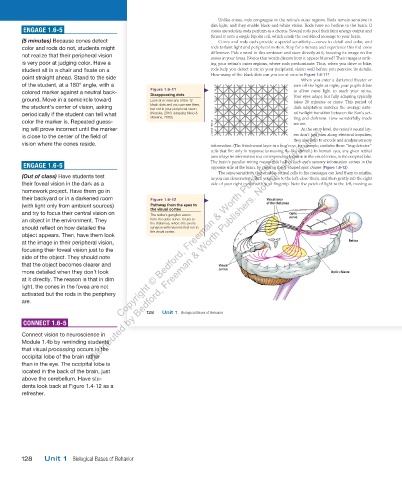
               point straight ahead. Stand to the side                       How many of the black dots can you see at once in Figure 1.6-11?
                                                                                                          When you enter a darkened theater or
               of the student, at a 180° angle, with a                                                  turn off the light at night, your pupils dilate
               colored marker against a neutral back-    Figure 1.6-11                                  to allow more light to reach your retina.
                                                         Disappearing dots
               ground. Move in a semicircle toward       Look at or near any of the 12                  Your eyes adapt, but fully adapting typically
                                                                                                        takes 20 minutes or more.  This period of
               the student’s center of vision, asking    black dots and you can see them,               dark adaptation matches the average natu-
                                                         but not in your peripheral vision
               periodically if the student can tell what   (Kitaoka, 2016, adapting Ninio &             ral twilight transition between the Sun’s set-
                                                         Stevens, 2000).
               color the marker is. Repeated guess-                                                     ting and darkness. How wonderfully made
                                                                                                        we are.
                                      Distributed by Bedford, Freeman & Worth Publishers. Not for redistribution.
               ing will prove incorrect until the marker                     Akiyoshi Kitaoka             At the entry level, the retina’s neural lay-
               is close to the center of the field of                                                   ers don’t just pass along electrical impulses;
                                                                                                        they also help to encode and analyze sensory
               vision where the cones reside.                                information. (The third neural layer in a frog’s eye, for example, contains those “bug detector”
                                                                             cells that fire only in response to moving fly-like stimuli.) In human eyes, any given retinal
                                                                             area relays its information to a corresponding location in the visual cortex, in the occipital lobe.
               ENGAGE 1.6-5                                                  The brain’s peculiar wiring means that half of each eye’s sensory information arrives in the
                                                                             opposite side of the brain, by crossing the X-shaped optic chiasm (Figure 1.6-12).
                                                                               The same sensitivity that enables retinal cells to fire messages can lead them to misfire,
               (Out of class) Have students test                             as you can demonstrate. Turn your eyes to the left, close them, and then gently rub the right
               their foveal vision in the dark as a                          side of your right eyelid with your fingertip. Note the patch of light to the left, moving as
               homework project. Have them go in
               their backyard or in a darkened room      Figure 1.6-12                         Visual area
               (with light only from ambient sources)    Pathway from the eyes to              of the thalamus
               and try to focus their central vision on   the visual cortex                           Optic
                                                         The retina’s ganglion axons
               an object in the environment. They        form the optic nerve. It runs to             nerve
                                                         the thalamus, where the axons
               should reflect on how detailed the        synapse with neurons that run to
                                                         the visual cortex.
               object appears. Then, have them look  Copyright © Bedford, Freeman & Worth Publishers.
               at the image in their peripheral vision,                                                                   Retina
               focusing their foveal vision just to the
               side of the object. They should note
               that the object becomes clearer and                             Visual
               more detailed when they don’t look                              cortex                               Optic chiasm
               at it directly. The reason is that in dim
               light, the cones in the fovea are not
               activated but the rods in the periphery
               are.
                                                        128   Unit 1  Biological Bases of Behavior
               CONNECT 1.6-5

               Connect vision to neuroscience in
                                                  03_myersAPpsychology4e_28116_ch01_002_163.indd   128                              15/12/23   9:25 AM
               Module 1.4b by reminding students
               that visual processing occurs in the
               occipital lobe of the brain rather
               than in the eye. The occipital lobe is
               located in the back of the brain, just
               above the cerebellum. Have stu-
               dents look back at Figure 1.4-12 as a
               refresher.


               128   Unit 1  Biological Bases of Behavior


          03_HammerTE4e_47547_ch01_2a_163_4pp.indd   128                                                                        07/02/24   5:27 PM

