


Page 140 - 2024-bfw-MyersAP4e-TE
P. 140
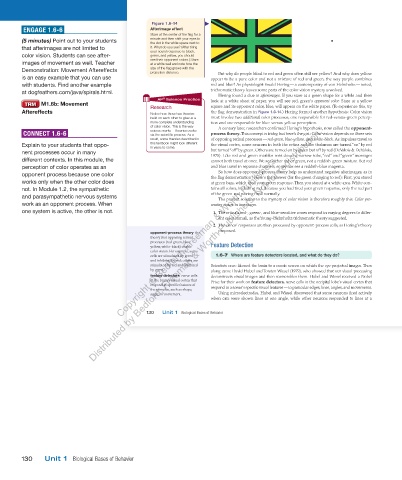
Figure   1.6-14
               ENGAGE 1.6-6                               Afterimage effect
                                                         Stare at the center of the flag for a
               (5 minutes) Point out to your students    minute and then shift your eyes to
                                                         the dot in the white space next to
               that afterimages are not limited to       it. What do you see? (After tiring
                                                         your neural response to black,
               color vision. Students can see after-     green, and yellow, you should
               images of movement as well. Teacher       see their opponent colors.) Stare
                                                         at a white wall and note how the
               Demonstration: Movement Aftereffects      size of the flag grows with the     But why do people blind to red and green often still see yellow? And why does yellow
                                                         projection distance.
               is an easy example that you can use                           appear to be a pure color and not a mixture of red and green, the way purple combines
               with students. Find another example                           red and blue? As physiologist Ewald Hering — a contemporary of von Helmholtz — noted,
               at dogfeathers.com/java/spirals.html.                         trichromatic theory leaves some parts of the color vision mystery unsolved.
                                                                                 Hering found a clue in  afterimages.  If you stare at a green shape for a while and then
                                                             ®
                                                           AP  Science Practice  look at a white sheet of paper, you will see red, green’s  opponent color. Stare at a yellow

                     M1.6b: Movement                               Research    square and its opponent color, blue, will appear on the white paper. (To experience this, try
               Aftereffects                                Notice how these two theories   the flag demonstration in   Figure 1.6-14. ) Hering formed another hypothesis: Color vision

                                                         build on each other to give us a   must involve two  additional  color processes, one responsible for red-versus-green percep-
                                                         more complete understanding   tion and one responsible for blue-versus-yellow perception.
                                                         of color vision. This is the way         A century later, researchers confirmed Hering’s hypothesis, now called the    opponent-
                                      Distributed by Bedford, Freeman & Worth Publishers. Not for redistribution.

               CONNECT 1.6-6                             science works — theories evolve   process theory  . This concept is tricky, but here’s the gist: Color vision depends on three sets

                                                         via the scientific process. As a

                                                         result, some theories described in   of opposing retinal processes —  red-green, blue-yellow,  and   white-black. As impulses travel to
               Explain to your students that oppo-       this textbook might look different   the visual cortex, some neurons in both the retina and the thalamus are turned “on” by red
                                                         in years to come.

               nent processes occur in many                                  but turned “off” by green. Others are turned on by green but off by red ( DeValois & DeValois,
                                               Copyright © Bedford, Freeman & Worth Publishers.
                                                                             1975 ). Like red and green marbles sent down a narrow tube, “red” and “green” messages
               different contexts. In this module, the                       cannot both travel at once. We see either red or green, not a reddish-green mixture. But red
               perception of color operates as an                            and blue travel in separate channels, so we  can  see a reddish-blue magenta.
                                                                                     So how does opponent-process theory help us understand negative afterimages, as in
               opponent process because one color                            the flag demonstration? Here’s the answer (for the green changing to red): First, you stared
               works only when the other color does                          at green bars, which tired your green response. Then you stared at a white area. White con-
               not. In Module 1.2, the sympathetic                           tains all colors, including red. Because you had tired your green response, only the red part
               and parasympathetic nervous systems                           of the green-red pairing fired normally.
                                                                                 The present solution to the mystery of color vision is therefore roughly this:  Color pro-
               work as an opponent process. When                             cessing occurs in two stages.
               one system is active, the other is not.                            1. The retina’s red-, green-, and blue-sensitive cones respond in varying degrees to differ-


                                                                               ent color stimuli, as the Young–Helmholtz trichromatic theory suggested.


                                                                                 2. The cones’ responses are then processed by opponent-process cells, as Hering’s theory
                                                                               proposed.
                                                               opponent-process theory       the
                                                         theory that opposing retinal
                                                         processes (red-green, blue-
                                                         yellow, white-black) enable      Feature Detection
                                                         color vision. For example, some


                                                                                          1.6-7    Where are feature detectors located, and what do they do?
                                                         cells are stimulated by green               1.6-7     Wher e ar e featur e detectors located, and what do they do?
                                                         and inhibited by red; others are
                                                         stimulated by red and inhibited     Scientists once likened the brain to a movie screen on which the eye projected images. Then
                                                         by green.           along came David Hubel and Torsten Wiesel (1979), who showed that our visual processing
                                                            feature detectors       nerve cells   deconstructs visual images and then reassembles them. Hubel and Wiesel received a Nobel
                                                         in the brain’s visual cortex that   Prize for their work on    feature detectors    nerve cells in the occipital lobe’s visual cortex that

                                                                                                    ,
                                                         respond to specific features of
                                                         the stimulus, such as shape,   respond to a scene’s specific visual features — to particular edges, lines, angles, and movements.
                                                         angle, or movement.       Using microelectrodes, Hubel and Wiesel discovered that some neurons fired actively
                                                                             when cats were shown lines at one angle, while other neurons responded to lines at a
                                                        130   Unit 1  Biological Bases of Behavior
                                                  03_myersAPpsychology4e_28116_ch01_002_163.indd   130                              15/12/23   9:25 AM


               130   Unit 1  Biological Bases of Behavior


          03_HammerTE4e_47547_ch01_2a_163_4pp.indd   130                                                                        07/02/24   5:28 PM

