


Page 141 - 2024-bfw-MyersAP4e-TE
P. 141
Module 1.6b

                 different angle. They surmised that these specialized neurons, now known as feature detec-
                 tors, receive information from individual ganglion cells in the retina. Feature detectors
                 pass this specific information to other cortical areas, where teams of cells (supercell clusters)   TEACH 1.6-7
                 respond to more complex patterns.
                    For biologically important objects and events, monkey brains (and surely ours as well)   Enrichment
                 have a “vast visual encyclopedia” distributed in the form of specialized cells (Perrett et al.,   Remind students that the human
                 1990, 1992, 1994). These cells respond to one type of stimulus, such as a specific gaze, head
                 angle, posture, or body movement. Other supercell clusters integrate this information   brain—especially our visual system—
                 and fire only when the cues collectively indicate the direction of someone’s attention and   is uniquely capable of parallel pro-
                 approach. This instant analysis, which aided our ancestors’ survival, also helps a hockey   cessing, as discussed in Module 1.5a.
                 player anticipate where to shoot the puck, and a driver to anticipate a pedestrian’s next
                 movement.                                                                           In fact, London’s police depart-
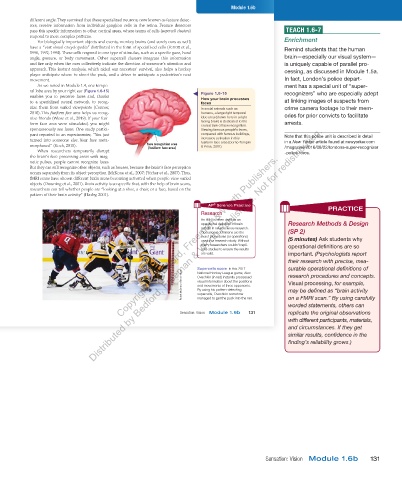
                    As we noted in Module 1.4, one tempo-                                            ment has a special unit of “super-
                 ral lobe area by your right ear (Figure 1.6-15)         Figure 1.6-15               recognizers” who are especially adept
                 enables  you  to  perceive  faces  and, thanks          How your brain processes
                 to a specialized neural network, to recog-              faces                       at linking images of suspects from
                 nize them from varied viewpoints (Connor,               In social animals such as   crime camera footage to their mem-
                 2010). This fusiform face area helps us recog-          humans, a large right temporal   ories for prior convicts to facilitate
                 nize friends (Wiese et al., 2019). If your fusi-        lobe area (shown here in a right-
                 form face area were stimulated, you might               facing brain) is dedicated to the   arrests.
                                                                         crucial task of face recognition.
                                      Distributed by Bedford, Freeman & Worth Publishers. Not for redistribution.
                 spontaneously see faces. One study partici-             Viewing famous people’s faces,
                 pant reported to an experimenter, “You just             compared with famous buildings,   Note that this police unit is described in detail
                 turned  into  someone  else. Your  face  meta-          increases activation in this   in a New Yorker article found at newyorker.com
                                                                         fusiform face area (Gorno-Tempini
                 morphosed” (Koch, 2015).               Face recognition area  & Price, 2001).       /magazine/2016/08/22/londons-super-recognizer
                                                        (fusiform face area)
                    When researchers temporarily disrupt                                             -police-force.
                                               Copyright © Bedford, Freeman & Worth Publishers.
                 the brain’s face-processing areas with mag-
                 netic pulses, people cannot recognize faces.
                 But they can still recognize other objects, such as houses, because the brain’s face  perception
                 occurs separately from its object perception (McKone et al., 2007; Pitcher et al., 2007). Thus,
                 fMRI scans have shown different brain areas becoming activated when people view varied
                 objects (Downing et al., 2001). Brain activity is so specific that, with the help of brain scans,
                 researchers can tell whether people are “looking at a shoe, a chair, or a face, based on the
                 pattern of their brain activity” (Haxby, 2001).
                                                                              ®
                                                                            AP  Science Practice
                                                                                                                   PRACTICE
                                                                         Research
                                                                         An fMRI is often used as an
                                                                           operational definition of brain   Research Methods & Design
                                                                         activity in neuroscience research.
                                                                         Operational definitions are the   (SP 2)
                                                                         exact procedures (or operations)
                                                                         used in a research study. Without   (5 minutes) Ask students why
                                                                         them, researchers couldn’t repli-  operational definitions are so
                                                                         cate studies to ensure the results
                                                                         are valid.                   important. (Psychologists report
                                                                                                      their research with precise, mea-
                                                                        Supercells score  In this 2017   surable operational definitions of
                                                                   Patrick McDermott/Getty Images  Ovechkin (in red) instantly processed   Visual processing, for example,
                                                                        National Hockey League game, Alex
                                                                                                      research procedures and concepts.
                                                                        visual information about the positions
                                                                        and movements of three opponents.
                                                                                                      may be defined as “brain activity
                                                                        By using his pattern-detecting
                                                                        supercells, Ovechkin somehow
                                                                                                      on a FMRI scan.” By using carefully
                                                                        managed to get the puck into the net.
                                                                                                      worded statements, others can
                                                                  Sensation: Vision  Module 1.6b   131  replicate the original observations
                                                                                                      with different participants, materials,
                                                                                                      and circumstances. If they get
                                                                                                      similar results, confidence in the
         03_myersAPpsychology4e_28116_ch01_002_163.indd   131                             15/12/23   9:25 AM
                                                                                                      finding’s reliability grows.)


                                                                                              Sensation: Vision Module 1.6b   131


          03_HammerTE4e_47547_ch01_2a_163_4pp.indd   131                                                                        07/02/24   5:28 PM

