


Page 28 - 2024-bfw-MyersAP4e-TE
P. 28
changed ever so slightly, would produce a cosmos in which life could not exist. Had gravity
                                                                             been a tad stronger or weaker, or had the weight of a carbon proton been a wee bit different,
                                                                             our universe just wouldn’t have worked.
                                                                               What caused this almost-too-good-to-be-true, finely tuned universe?  Why is
                                                                             there something rather than nothing? How did it come to be, in the words of Harvard-
                                                                             Smithsonian astrophysicist Owen Gingerich (1999), “so extraordinarily right, that
                                                                             it  seemed  the  universe  had  been  expressly designed  to  produce intelligent,  sentient
                                                                             beings”? On such matters, a humble, awed, scientific silence is appropriate, suggested
                                                                             philosopher Ludwig  Wittgenstein: “Whereof one cannot speak, thereof one must be
                                                                             silent” (1922, p. 189).
                                                                               Rather than fearing science, we can welcome its enlarging our understanding and
                                                                             awakening our sense of awe. In The Fragile Species, Lewis Thomas (1992) described his
                                                                             utter amazement that Earth in time gave rise to bacteria and eventually to Bach’s Mass
                                                                             in B Minor. In a short 4 billion years, life on Earth has come from nothing to struc-
                                                                             tures as complex as a 6-billion-unit strand of DNA and the incomprehensible intri-
                                                                             cacy of the human brain. Atoms no different from those in a rock somehow formed
                                                                             dynamic   entities that produce extraordinary, self-replicating, information-processing
                                                                             systems — us (Davies, 2007). Although we appear to have been created from dust, over
                                                                             eons of time, the end result is a priceless creature, one rich with potential beyond our
                                                                             imagining.


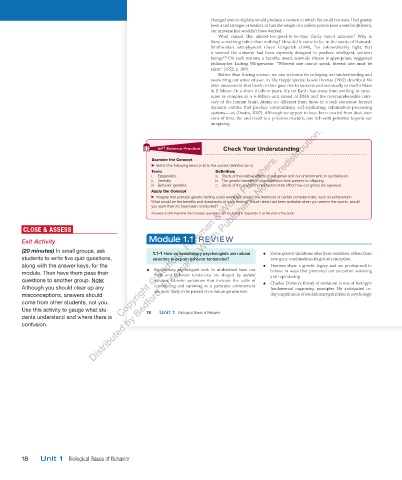
                                                           AP  Science Practice  Check Your Understanding
                                                             ®
                                                                                 Worth Publishers.
                                                         Examine the Concept
                                                         ▶ ▶Match the following terms (i–iii) to the correct definition (a–c).
                                                         Term:                Definition:
                                                         i.   Epigenetics     a.  Study of the relative effects of our genes and our environment on our behavior.
                                                         ii.   Heredity       b.  The genetic transfer of characteristics from parents to offspring.
                                                         iii.  Behavior genetics  c.  Study of the environmental factors that affect how our genes are expressed.
                                                         Apply the Concept & Worth Publishers. Not for redistribution.
                                                         ▶ ▶Imagine that prenatal genetic testing could eventually predict the likelihood of certain complex traits, such as extraversion.
                                                         What would be the benefits and drawbacks of such testing? If such tests had been available when you were in the womb, would
                                                         you want them to have been conducted?
                                                            Bedford, Freeman &
                                                         Answers to the Examine the Concept questions can be found in Appendix C at the end of the book.
               CLOSE & ASSESS

               Exit Activity                            Module 1.1  REVIEW
               (20 minutes) In small groups, ask          1.1-1 How do evolutionary psychologists use natural   •  Some genetic variations arise from mutations, others from
                                      Distributed by Bedford, Freeman
               students to write five quiz questions,     selection to explain behavior tendencies?  new gene combinations forged at conception.
               along with the answer keys, for the                                            •  Humans share a genetic legacy and are predisposed to
               module. Then have them pass their        •  Evolutionary psychologists seek to understand how our   behave in ways that promoted our ancestors’ surviving
                                                          traits and behavior tendencies are shaped by  natural
                                                                                                and reproducing.
               questions to another group. Note:            selection. Genetic variations that increase the odds of   •  Charles Darwin’s theory of evolution is one of biology’s
               Although you should clear up any             reproducing and surviving in a particular environment     fundamental organizing principles. He anticipated to-
               misconceptions, answers should   Copyright ©  are most likely to be passed on to future generations.  day’s application of evolutionary principles in psychology.
               come from other students, not you.
               Use this activity to gauge what stu-     18   Unit 1  Biological Bases of Behavior
               dents understand and where there is
               confusion.                         03_myersAPpsychology4e_28116_ch01_002_163.indd   18                               15/12/23   9:21 AM


               18   Unit 1  Biological Bases of Behavior


          03_HammerTE4e_47547_ch01_2a_163_4pp.indd   18                                                                         07/02/24   5:17 PM

