


Page 24 - 2024-bfw-MyersAP4e-TE
P. 24
Even the impressive data from personality assessments are clouded by the reunion of
                                                                             many of the separated twins some years before they were tested. Moreover, when adoption
               TEACH 1.1-3                                                   agencies are involved, separated twins tend to be placed in similar homes. Despite these
                                                                             criticisms, the striking twin-study results helped shift scientific thinking toward a greater
               Teaching Tip                                                  appreciation of genetic influences.
               You may have students in class who                            Biological Versus Adoptive Relatives
               have been adopted. Be sensitive to                            For behavior geneticists, nature’s second real-life study — adoption — creates two groups:
               their possible feelings and visible                           genetic relatives (biological parents and siblings) and environmental relatives (adoptive par-
               reactions as you discuss research                             ents and siblings). For personality or any other given trait, we can therefore ask whether
               concerning the impact of nature                               adopted children are more like their biological parents, who contributed their genes, or their
                                                                             adoptive parents, who contributed their home environment. And while sharing that home
               and nurture on the development of                             environment, do adopted siblings come to share traits?
               adopted children. Some students                                 The stunning finding from studies of hundreds of adoptive families is that, apart from
               in your class may know, for exam-                             identical twins, people who grow up together — whether biologically related or not — do
                                                                             not much resemble one another in personality (McGue & Bouchard, 1998; Plomin, 2011;
               ple, that their biological parents had                        Rowe, 1990). On personality traits such as extraversion and agreeableness, for example,
               substance abuse problems or other                             people who have been adopted are more similar to their biological parents than to their
               psychological issues. This knowledge                          caregiving adoptive parents.
                                                                               The finding is important enough to bear repeating: The normal range of environments
               may cause concern over whether they                           shared by a family’s children has little discernible impact on their personalities. Two adopted chil-
               will face similar challenges. Emphasize                       dren raised in the same home are no more likely to share personality traits with each other
                                                                             than with the child down the block.
               that although a trait may be heritable,                         Heredity  shapes  other primates’  personalities,  too.  For  example,  macaque  monkeys
               it doesn’t necessarily mean that the                          raised by foster mothers exhibit social behaviors that resemble those of their biological,
                                                                                 Worth Publishers.
               trait will manifest itself.                                   rather than foster, mothers (Maestripieri, 2003).
                                                                               Why are children in the same family so different? Why does a shared family environment
                                                                             have so little effect on children’s personalities? Is it because each sibling experiences unique
               TEACH 1.1-3                                                   peer influences and life events? Because sibling relationships ricochet off each other, ampli-
                                                                             fying their differences? Because siblings — despite sharing half their genes — have very
               Discussion Prompt                                             different combinations of genes and may evoke very different kinds of parenting? Such
                                                                             questions fuel behavior geneticists’ curiosity.
               In her book The Nurture Assumption,                     & Worth Publishers. Not for redistribution.
                                                                               The genetic leash may limit the family environment’s influence on personality, but it
               Judith Rich Harris proposed that                              does not mean that adoptive parenting is a fruitless venture. One study followed more than
               parents do not have as much  influence                        3000 Swedish children with at least one biological parent who had depression. Compared
               on the development of their children                          to their not-adopted siblings, those raised by an adoptive family were about 20 percent less
                                                                             likely to develop depression (Kendler et al., 2020a). As an adoptive parent, I [ND] especially
               as people generally believe. In his                           find it heartening to know that parents do influence their children’s attitudes, values, man-
               book The Blank Slate: The Modern                              ners, politics, education, and faith (Gould et al., 2019; Kandler & Riemann, 2013). This was
               Denial of Human Nature, Steven                                dramatically illustrated during World War II by separated identical twins Jack Yufe, a Jew,
                                                                             and Oskar Stöhr, a member of Germany’s Hitler Youth. After later reuniting, Oskar mused
               Pinker also argues that infants are          Bedford, Freeman &
                                                                             to Jack: “If we had been switched, I would have been the Jew, and you would have been the
               born not blank, but rather come                               Nazi” (Segal, 2005, p. 70). Parenting — and the cultural environments in which parents raise
                                                                             their children — matters!
                                      Distributed by Bedford, Freeman
               equipped with a structure that          Tim Clayton/Corbis/Getty Images  Moreover, child neglect and abuse and even parental divorce are rare in adoptive
                 influences how they behave and think.                       homes. (Adoptive parents are carefully screened; biological parents are not.) One study
               Have students consider the following:                         looked at the parenting of siblings being raised apart — some with their biological mother,
                 that your genes had the greatest  Copyright ©               risk of psychological disorder, most adopted children thrive, especially when adopted as
                                                                             some with an adoptive mother (Natsuaki et al., 2019). Compared with the biological moth-
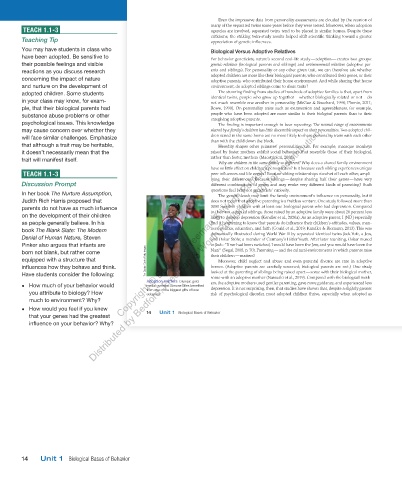
               •  How much of your behavior would       Adoption matters  Olympic gold   ers, the adoptive mothers used gentler parenting, gave more guidance, and experienced less
                                                        medal gymnast Simone Biles benefited
                                                                             depression. It is not surprising, then, that studies have shown that, despite a slightly greater
                                                        from one of the biggest gifts of love:
                 you attribute to biology? How
                                                        adoption.
                 much to environment? Why?
               •  How would you feel if you knew        14   Unit 1  Biological Bases of Behavior
                 influence on your behavior? Why?  03_myersAPpsychology4e_28116_ch01_002_163.indd   14                              15/12/23   9:21 AM


               14   Unit 1  Biological Bases of Behavior


          03_HammerTE4e_47547_ch01_2a_163_4pp.indd   14                                                                         07/02/24   5:16 PM

