


Page 19 - 2024-bfw-MyersAP4e-TE
P. 19
Module 1.1

                    But in important ways, we also are each unique. We are each a one-of-a-kind package
                 of looks, language, personality, interests, and cultural background. What causes our striking
                 diversity? How much is our individuality shaped by our differing genes, and how much
                 by our environment — by every external influence, from maternal nutrition while in the            PRACTICE
                 womb to social support while nearing the tomb? How does our heredity interact with our
                 experiences to create both our universal human nature and our individual and social diver-  Argumentation (SP 4)
                 sity? Such questions intrigue behavior geneticists.
                                                                                                      (Out of class) Students often dis-
                 Genes: Our Codes for Life                                                            count the interaction of genes and
                 Barely more than a century ago, few would have guessed that every cell nucleus in your body   the environment. They especially
                 contains the genetic master code for your entire body. It’s as if every room in Dubai’s Burj
                 Khalifa (the world’s tallest structure) contained a book detailing the architect’s plans for the   don’t believe that a person’s genet-
                 entire structure. The plans for your own book of life run to 46 chapters — 23 donated by your   ics can influence their environment.
                 mother’s egg and 23 by your father’s sperm. Each of these 46 chapters, called a chromosome,   Have students find scientifically
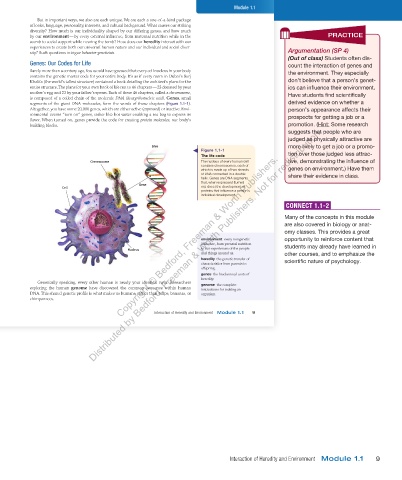
                 is composed of a coiled chain of the molecule DNA (deoxyribonucleic acid). Genes, small
                 segments of the giant DNA molecules, form the words of those chapters (Figure 1.1-1).     derived evidence on whether a
                 Altogether, you have some 20,000 genes, which are either active (expressed) or inactive. Envi-  person’s appearance affects their
                 ronmental events “turn on” genes, rather like hot water enabling a tea bag to express its   prospects for getting a job or a
                 flavor. When turned on, genes provide the code for creating protein molecules, our body’s
                 building blocks.                                                                     promotion. (Hint: Some research
                                                                       & Worth Publishers. Not for redistribution.
                                                                                                      suggests that people who are
                                                                                                      judged as physically attractive are
                                                         DNA                                          more likely to get a job or a promo-
                                                                         Figure 1.1-1
                                                                         The life code                tion over those judged less attrac-
                                     Chromosome                          The nucleus of every human cell   tive, demonstrating the influence of
                                                                         contains chromosomes, each of
                                                                         which is made up of two strands   genes on environment.) Have them
                                                                         of DNA connected in a double   share their evidence in class.
                                                                         helix. Genes are DNA segments
                                                                         that, when expressed (turned
                                                     Gene                        Worth Publishers.
                            Cell                                         on), direct the development of
                                                                         proteins that influence a person’s
                                                                         individual development.     Many of the concepts in this module
                                                                                                     CONNECT 1.1-2
                                                            Bedford, Freeman &                       are also covered in biology or anat-

                                                                                                     omy classes. This provides a great
                                                                                                     opportunity to reinforce content that
                                                                         environment  every nongenetic
                                                                         influence, from prenatal nutrition
                                                                                                     students may already have learned in
                                                 Nucleus                 to our experiences of the people   other courses, and to emphasize the
                                                                         and things around us.
                                      Distributed by Bedford, Freeman
                                                                         heredity  the genetic transfer of
                                                                                                     scientific nature of psychology.
                                                                         characteristics from parents to
                                                                         genes  the biochemical units of
                                                                         heredity.
                    Genetically speaking, every other human is nearly your identical twin.   Researchers   offspring.
                                                                         genome  the complete
                 exploring the human  genome  have  discovered  the  common  sequence  within  human   instructions for making an
                 DNA. This shared genetic profile is what makes us humans, rather than tulips, bananas, or   organism.
                 chimpanzees.                  Copyright ©
                                                          Interaction of Heredity and Environment  Module 1.1   9


         03_myersAPpsychology4e_28116_ch01_002_163.indd   9                               15/12/23   9:21 AM


                                                                                   Interaction of Heredity and Environment Module 1.1   9


          03_HammerTE4e_47547_ch01_2a_163_4pp.indd   9                                                                          07/02/24   5:16 PM

