


Page 16 - 2024-bfw-MyersAP4e-TE
P. 16
®
                                                           AP  Science Practice  Check Your Understanding
                                                         Examine the Concept                 Apply the Concept
                                                         ▶ ▶Explain contemporary psychology’s position on the nature–  ▶ ▶Think of one of your own traits. (For example, are you
                                                         nurture issue.                      a planner or a procrastinator — do you usually complete
                                                                                             assignments on time or late? Are you more of an extravert or an
                                                                                             introvert — do you become energized by social interactions or do
                                                                                             you recharge by spending time alone?) How do you think that
                                                                                             trait was influenced by nature and nurture?
                                                         Answers to the Examine the Concept questions can be found in Appendix C at the end of the book.


                                                                             Evolutionary Psychology: Understanding
                                                           ®
                 TEACHING THE AP  TIP
                 T E A C H I N G T H E A P ® ®  TI P     AP  Exam Tip        Human Nature
                                                         To assist your active learning of
                Many students overlook the               psychology, Learning Targets are   1.1-1 How do evolutionary psychologists use natural selection to explain behavior
                Many students overlook the
                                                         grouped together at the start of
                Learning Target questions such as
                Learning Target questions such as        each module and then framed   tendencies?
                                                         as questions that appear at the
                1.1-1 here. Emphasize that these           beginning of the pertinent section   Evolutionary psychologists focus mostly on what makes us so much alike as humans. They
                1.1-1 here. Emphasize that these
                questions serve as a reading guide.
                questions serve as a reading guide.      of reading. It helps to keep the   use Charles Darwin’s principle of natural selection to understand the roots of behavior and
                                                         question in mind as you read
                If students take note of them, the       through a section to make sure   mental processes. The idea, simplified, is this:
                If students take note of them, the
                                                         that you are following the main
                                                                                 Worth Publishers.
                questions will help them focus on
                questions will help them focus on        point of the discussion.  •  Organisms’ varied offspring compete for survival.
                the main points in each section.
                the main points in each section.                             •  Certain biological and behavioral variations increase organisms’ reproductive and sur-
                                                                               vival chances in their particular environment.
                                                                             •  Offspring that survive are more likely to pass their genes to ensuing generations.
                                                                             •  In this way, over time, population characteristics may change.
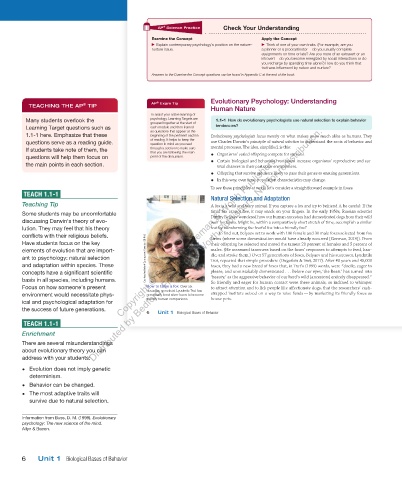
                                                                             To see these principles at work, let’s consider a straightforward example in foxes.
               TEACH 1.1-1                                             & Worth Publishers. Not for redistribution.
                                                                             Natural Selection and Adaptation
               Teaching Tip                                                  A fox is a wild and wary animal. If you capture a fox and try to befriend it, be careful: If the
               Some students may be uncomfortable                            timid fox cannot flee, it may snack on your fingers. In the early 1950s, Russian scientist
                                                                               Dmitry Belyaev wondered how our human ancestors had domesticated dogs from their wild
               discussing Darwin’s theory of evo-                            wolf forebears. Might he, within a comparatively short stretch of time, accomplish a similar
               lution. They may feel that his theory                         feat by transforming the fearful fox into a friendly fox?
                                                                               To find out, Belyaev set to work with 100 female and 30 male foxes selected from fox
               conflicts with their religious beliefs.                       farms (where some domestication would have already occurred [Gorman, 2019]). From
               Have students focus on the key               Bedford, Freeman &
                                                                             their offspring he selected and mated the tamest 20 percent of females and 5 percent of
               elements of evolution that are import-                        males. (He measured tameness based on the foxes’ responses to attempts to feed, han-
               ant to psychology: natural selection    Courtesy Institute of Cytology and Genetics, SB RAS  dle, and stroke them.) Over 57 generations of foxes, Belyaev and his successor, Lyudmila
                                      Distributed by Bedford, Freeman
                                                                             Trut, repeated that simple procedure (Dugatkin & Trut, 2017). After 40 years and 45,000
               and adaptation within species. These                          foxes, they had a new breed of foxes that, in Trut’s (1999) words, were “docile, eager to
               concepts have a significant scientific                        please, and unmistakably domesticated . . . Before our eyes, ‘the Beast’ has turned into
               basis in all species, including humans.                       ‘beauty,’ as the aggressive behavior of our herd’s wild [ancestors] entirely disappeared.”
                                                                             So friendly and eager for human contact were these animals, so inclined to whimper
               Focus on how someone’s present           How to tame a fox  Over six   to attract attention and to lick people like affectionate dogs, that the researchers’ cash-
                                                        decades, geneticist Lyudmila Trut has
               environment would necessitate phys- Copyright ©               strapped institute seized on a way to raise funds — by marketing its friendly foxes as
                                                        genetically bred silver foxes to become
               ical and psychological adaptation for    friendly human companions.  house pets.
               the success of future generations.       6   Unit 1  Biological Bases of Behavior
               TEACH 1.1-1
               Enrichment
               There are several misunderstandings   03_myersAPpsychology4e_28116_ch01_002_163.indd   6                             15/12/23   9:20 AM
               about evolutionary theory you can
               address with your students:
               •  Evolution does not imply genetic
                 determinism.
               •  Behavior can be changed.
               •  The most adaptive traits will
                 survive due to natural selection.

               Information from Buss, D. M. (1999). Evolutionary
               psychology: The new science of the mind.
               Allyn & Bacon.


               6   Unit 1  Biological Bases of Behavior


          03_HammerTE4e_47547_ch01_2a_163_4pp.indd   6                                                                          07/02/24   5:16 PM

