


Page 21 - 2024-bfw-MyersAP4e-TE
P. 21
Module 1.1

                 To better understand these interactions, behavior geneticists conduct studies of genetically
                 related and unrelated people.  Family studies  search for traits and diseases that tend to be
                 shared by family members — for example, among biological siblings, or by a parent and a
                 child.  Twin studies  and  adoption studies,  to which we will now turn, assess in more detail the
                 effects of shared genes and shared environments.


                       ®
                     AP  Science Practice        Check Your Understanding
                         Examine the Concept              Apply the Concept
                   ▶  Explain the difference between heredity and environment.   ▶  Were you surprised to learn how genetically similar we are
                   ▶  Explain some effects of small genetic variations within and   to our chimpanzee cousins? What was your impression before
                   between species.                    reading this section?
                                                       ▶  Come up with one unique research question or topic that
                                                       would be of interest to a behavioral geneticist.
                       Answers to the Examine the Concept questions can be found in  Appendix C  at the end of the book.


                    Twin and Adoption Studies


                               1.1-3   How do twin and adoption studies help us understand the ef fects and inter
                               1.1-3   How do twin and adoption studies help us understand the effects and inter--
                   actions of nature and nurture?
                   actions of nature and nurture?
                                                                              ®
                                                                            AP  Science Practice
                   To scientifically tease apart the influences of environment and heredity, behavior geneticists   PRACTICE
                 could wish for two types of studies. The first would control heredity while varying the home         Research
                                                                                 Worth Publishers.
                 environment. The second would control the home environment while varying heredity.     Dramatically manipulating an
                 Such studies with human infants would be unethical, but nature has done this work for us.     infant’s home environment, which   Research Methods & Design
                                                                         has the potential to cause harm,
                       Identical Versus Fraternal Twins                  would be unethical.  Unit 0  has a   (SP 2)
                                                                         full discussion of psychology’s
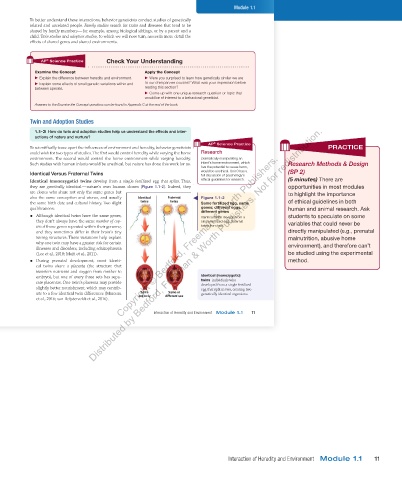
                   Identical  (monozygotic)  twins  develop from a single fertilized egg that splits. Thus,   ethical guidelines for research.     (5 minutes) There are


                 they  are  genetically  identical — nature’s  own human  clones  ( Figure 1.1-2 ). Indeed,  they   opportunities in most modules


                 are clones who share not only the same genes but      & Worth Publishers. Not for redistribution.
                                                                                                      to highlight the importance
                 also the same conception and uterus, and usually   Identical  Fraternal            Figure   1.1-2
                 the same birth date and cultural history. Two slight   twins  twins      Same fertilized egg, same   of ethical guidelines in both
                 qualifications:                                         genes; different eggs,       human and animal research. Ask
                                                                         different genes


                 •   Although identical twins have the same genes,       Identical twins develop from a   students to speculate on some
                    they don’t always have the same  number of cop-      single fertilized egg, fraternal   variables that could never be
                    ies  of those genes repeated within their genome,    twins from two.
                    and they sometimes differ in their brain’s tiny                                   directly manipulated (e.g., prenatal
                    wiring structures. These variations help explain                                  malnutrition, abusive home
                    why one twin may have a greater risk for certain   Bedford, Freeman &             environment), and therefore can’t
                    illnesses and disorders, including schizophrenia
                    ( Lee et al., 2018 ;  Maiti et al., 2011 ).                                       be studied using the experimental
                                      Distributed by Bedford, Freeman         Module 1.1   11

                 •   During prenatal development, most identi-                                        method.
                    cal twins share a  placenta  (the structure that
                    transfers nutrients and oxygen from mother to
                    embryo), but one of every three sets has sepa-             identical (monozygotic)
                    rate placentas. One twin’s placenta may provide      twins       individuals who
                                                                         developed from a single fertilized
                    slightly better nourishment, which may contrib-      egg that split in two, creating two
                    ute to a few identical twin differences ( Marceau   sex only  different sex  genetically identical organisms.
                                                               Same or
                                                      Same
                    et al., 2016 ; van  Beijsterveldt et al., 2016 ).        Copyright ©
                                                          Interaction of Heredity and Environment
         03_myersAPpsychology4e_28116_ch01_002_163.indd   11                              15/12/23   9:21 AM


                                                                                  Interaction of Heredity and Environment Module 1.1   11


          03_HammerTE4e_47547_ch01_2a_163_4pp.indd   11                                                                         07/02/24   5:16 PM

