


Page 20 - 2024-bfw-MyersAP4e-TE
P. 20
Yet we aren’t really all that different from our chimpanzee cousins. At a genetic level,
                                                                             humans and chimpanzees are 96 percent identical (Mikkelsen et al., 2005). At “functionally
                                                                             important” DNA sites, this proportion reaches 99.4 percent (Wildman et al., 2003)! Yet that
                                                                             wee 0.6 percent difference matters. It took a human, Shakespeare, to do what a chimpanzee
                                                                             cannot — weave 17,677 words into literary masterpieces.
                                                                               Small differences matter among other species, too. Common chimpanzees and bono-
                                                                             bos resemble each other in many ways. They should — their genomes differ by much less
                                                                             than 1 percent. But they display markedly differing behaviors. Chimpanzees are aggressive
                                                                             and their family groups are male dominated; bonobos are peaceable and live in female-
                                                                             led groups.
                                                                               The occasional variations found at particular gene sites in human DNA fascinate genet-
                                                                             icists and psychologists. Slight person-to-person variations from the common pattern give
                                                                             clues to our uniqueness — why one person is more susceptible than another to Covid,
                                                                             why one is tall and another short, why one is anxious and another calm (Ellinghaus et al.,
                                                                             2020). Taking advantage of these distinctions, some scientists are now developing gene ther-
               TEACH 1.1-2                                                   apies, which use gene-editing technology to prevent or treat diseases with a genetic basis
                                                                             (Coller, 2019).
               Active Learning                                                 Most of our traits have complex genetic roots. How tall you are, for example, reflects
               (30 minutes) After discussing genes,                          the size of your face, vertebrae, leg bones, and so forth — each of which may be influenced
                                                                             by different genes interacting with your specific environment. Traits such as intelligence,
                                                                       & Worth Publishers. Not for redistribution.
               ask student pairs to write a slogan-like                      happiness,  and  aggressiveness  are  similarly  influenced  by  a  whole  orchestra  of genes
               bumper sticker to illustrate the con-                         (Holden, 2008). Indeed, one of the big take-home findings of today’s behavior genetics
               cept of polygenetics. Tell them to be                         is that there is no single gene that predicts your smarts, sexual orientation, or personal-
                                                                             ity. Gene analyses of more than 800,000 people have, for example, identified 269 genes
               creative and have fun, but to be sure                         associated with depression (Howard et al., 2019). Another study of 1.1 million people
                                                                                 Worth Publishers.
               they get the main point across. Have                          identified 1271 gene variations that together predicted about 12 percent of the differences
               them share their slogans with the class                       in people’s years of schooling (Lee et al., 2018). The bottom line: Our differing traits are
                                                                             polygenetic — they are influenced by “many genes of small effect” (Lee et al., 2018; Matoba
               and look for themes that emerge.                              et al., 2019; Plomin, 2018a).


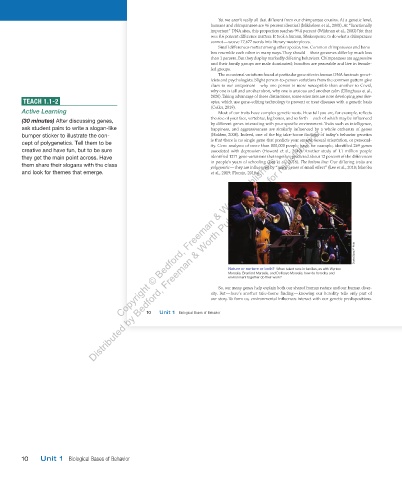
                                                            Bedford, Freeman &    Nature or nurture or both?  When talent runs in families, as with Wynton   Charles Sykes/AP Photo


                                      Distributed by Bedford, Freeman        sity.  But — here’s  another take-home  finding — knowing  our heredity tells only  part  of   15/12/23   9:21 AM

                                                                                  Marsalis, Branford Marsalis, and Delfeayo Marsalis, how do heredity and
                                               Copyright ©
                                                                                  environment together do their work?
                                                                               So, our many genes help explain both our shared human nature and our human diver-
                                                                             our story. To form us, environmental influences interact with our genetic predispositions.

                                                        10   Unit 1  Biological Bases of Behavior


                                                  03_myersAPpsychology4e_28116_ch01_002_163.indd   10


               10   Unit 1  Biological Bases of Behavior


          03_HammerTE4e_47547_ch01_2a_163_4pp.indd   10                                                                         07/02/24   5:16 PM

