


Page 18 - 2024-bfw-MyersAP4e-TE
P. 18
of junk foods and often inactive lifestyles. The stress response that helped our ancestors
                                                         AP  Exam Tip
                                                           ®
                                                                             escape temporary, mortal threats (That’s a tiger in the grass!) now threatens our health, as
                                                                             we experience the long-term stressors of modern living (That exam is tomorrow! The traffic is
                                   ®
                 TEACHING THE AP  TIP                    Memory research reveals a testing
                                                         effect: We retain information much   making me late!).
                                                         better if we actively retrieve it by
                                                         self-testing and rehearsing. To   Evolutionary Psychology Today
                The testing effect is robust—            bolster your learning and memory,
                self-testing and rehearsing over         take advantage of the self-testing    Darwin’s theory of evolution has become one of biology’s fundamental organizing princi-
                                                                             ples and lives on in the second Darwinian revolution: the application of evolutionary princi-
                                                         opportunities you will find through-
                time lead to better retention. Ensure    out this text. These Check Your   ples to psychology. In concluding On the Origin of Species, Darwin (1859, p. 346) anticipated
                                                         Understanding sections will  appear
                that students take advantage of the      periodically throughout each mod-  this development, foreseeing “open fields for far more important researches. Psychology
                                                         ule. You can check your answers   will be based on a new foundation.”
                Check Your Understanding features        to the Examine the  Concept review   In modules to come, we address questions that intrigue evolutionary psychologists:
                throughout the text. You can also        questions in  Appendix C.  Why do infants start to fear strangers about the time they become mobile? Why do more
                utilize the assessment suggestions                           people develop a specific phobia in response to spiders, snakes, and heights than to modern
                provided throughout the text.                                threats, such as guns? And why do women tend to be choosier than men when selecting
                                                                             sexual partners?
                                                                       & Worth Publishers. Not for redistribution.
                                                             ®
                                                           AP  Science Practice  Check Your Understanding
                                                         Examine the Concept                 Apply the Concept
                                                         ▶ ▶Explain the principle of natural selection.  ▶ ▶Imagine that a futuristic scientist wanted to breed humans
                                                                                 Worth Publishers.
                                                                                             to favor particular behavioral traits. How would the scientist go
                                                                                             about it? Why might this prove a greater challenge than breeding
                                                                                             less complex mammals?
                                                         Answers to the Examine the Concept questions can be found in Appendix C at the end of the book.

                                                                             Behavior Genetics: Predicting Individual Differences

                                                                              1.1-2 How do behavior geneticists explain our individual differences?
               TEACH 1.1-2                                                   While evolutionary psychologists tend to focus on human similarities, behavior genet-

               Dig Deeper                                                    icists explore the genetic and environmental roots of human differences. Our shared
                                                                             brain architecture predisposes all of us humans to some common behavioral tendencies.
               You will notice that DNA and            A Thousand Words Photography by Erica Comer  Whether we live in the Arctic or in the tropics, we sense the world, develop language,
                                                                             and feel hunger through identical mechanisms. We prefer sweet tastes to sour. We divide
                 occasionally chromosomes come up           Bedford, Freeman &
                                                                             the color spectrum into similar colors. And we feel drawn to behaviors that produce and
               at several points in this module. These                       protect offspring.
                                                                               Our human family shares not only a common biological heritage — cut us and we
               concepts are important in  explaining                         bleed — but also common social behaviors. Whether we’re named Gonzales, Nkomo,
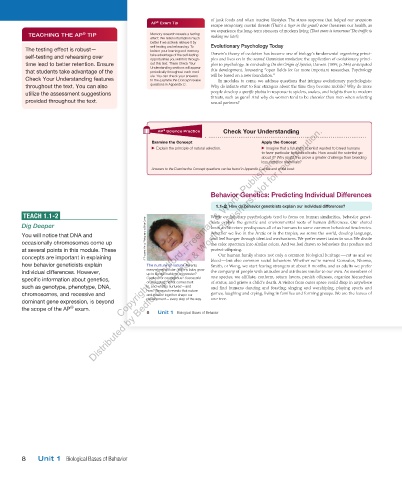
               how behavior geneticists explain         The nurture of nature  Parents   Smith, or Wong, we start fearing strangers at about 8 months, and as adults we prefer
                 individual differences. However,       everywhere wonder: Will my baby grow   the company of people with attitudes and attributes similar to our own. As members of
                                                        up to be agreeable or aggressive?
               specific information about genetics,     Cautious or courageous? Successful   one species, we affiliate, conform, return favors, punish offenses, organize hierarchies
                                                        or struggling? What comes built
                                                                             of status, and grieve a child’s death. A visitor from outer space could drop in anywhere
               such as genotype, phenotype, DNA,        in, and what is nurtured — and   and find humans dancing and feasting, singing and worshiping, playing sports and
                                                        how? Research reveals that nature
               chromosomes, and recessive and   Copyright ©                  games, laughing and crying, living in families and forming groups. We are the leaves of
                                                        and nurture together shape our
               dominant gene expression, is beyond      development — every step of the way.  one tree.
                               ®
               the scope of the AP  exam. Distributed by Bedford, Freeman                                                           15/12/23   9:20 AM
                                                        8   Unit 1  Biological Bases of Behavior
                                                  03_myersAPpsychology4e_28116_ch01_002_163.indd   8


               8   Unit 1  Biological Bases of Behavior


          03_HammerTE4e_47547_ch01_2a_163_4pp.indd   8                                                                          07/02/24   5:16 PM

