


Page 25 - 2024-bfw-MyersAP4e-TE
P. 25
Module 1.1

                 infants ( Loehlin et al., 200 7;  van IJzendoorn & Juffer, 2006 ;  Wierzbicki, 1993 ). Seven in eight
                                                                              ®
                 adopted children have reported feeling strongly attached to one or both adoptive parents.   AP  Science Practice
                 As children of self-giving parents, they grow up to be more self-giving and unselfish than         Research
                 average ( Sharma et al., 1998 ). Many score higher than their biological parents and raised-    Results such as “seven in eight
                 apart biological siblings on intelligence tests, and most grow into happier and more stable   adopted children have reported
                 adults ( Kendler et al., 2015b ; van  IJzendoorn et al., 2005 ). In one Swedish study, children   feeling strongly attached to one or
                 adopted as infants grew up with fewer problems than were experienced by children whose   both adoptive parents” indicate the
                 biological mothers initially registered them for adoption but then decided to raise the chil-  descriptive research method. The
                                                                         purpose of the descriptive method
                 dren themselves ( Bohman & Sigvardsson, 1990 ).  The bottom line:  Most adopted children   is to observe and record behavior.
                 benefit from adoption.                                  You can revisit  Unit 0  to review
                                                                         basic research methods.
                     AP  Science Practice          Check Your Understanding
                       ®
                         Examine the Concept        Apply the Concept
                   ▶  Explain how researchers use twin   ▶  Do you know biological siblings who,
                   and adoption studies to learn about   despite having been raised together, have
                   psychological principles.    very different personalities? (Are  you  one   The New Yorker Collection, 2003, Michael Shaw
                                             of these siblings, perhaps?) Knowing            from cartoonbank.com. All Rights Reserved
                                             what you do of their lives and upbringing,
                                             what do you think contributed to these
                                             differences?
                       Answers to the Examine the Concept questions can be found in  Appendix C  at the end of the book.               “The title of my science project is


                                                                        ‘My Little Brother: Nature or Nurture.’”
                                 Gene–Environment Interaction

                               1.1-4   How do heredity and environment work together?
                               1.1-4   How do her edity and envir onment work together?                   TEACH 1.1-4


                   Among our similarities, the most important — the behavioral hallmark of our species — is  as heredity).   Worth Publishers.   Active Learning
                 our enormous adaptive capacity. Some human traits develop the same way in virtually every   (10 minutes) To understand the
                                                                               interaction       the interplay that
                 environment. But other traits are expressed only in particular environments. Go barefoot  & Worth Publishers. Not for redistribution.
                 for a summer and you will develop toughened, callused feet — a biological adaptation to   occurs when the effect of one   gene–environment interaction,
                 friction. Meanwhile, your neighbor who wears shoes will remain a tenderfoot. The differ-  factor (such as environment)     students must be able to differentiate
                                                                         depends on another factor (such
                 ence between the two of you is an effect of environment. But it is the product of a biological   between genetic traits and learned
                 mechanism —  adaptation. To say that genes and experience are  both  important is true. But

                 more precisely, they    interact  .                                                 behaviors. In writing or in pairs, have
                              Just   how  our genes and our experiences interact to form us as unique individuals   students identify the following as
                 is one of the hottest topics in psychology today. Gene– environment  interaction stud-  either genetic trait or learned behavior,
                 ies are revealing, for example, who
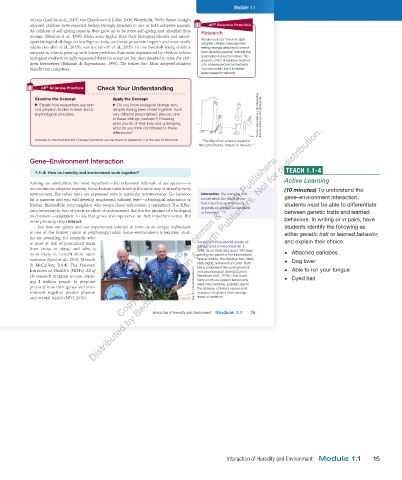
                                                                        An out-of-this-world study of
                 is most at risk of permanent harm          Bedford, Freeman &                       and explain their choice.
                 from  stress or  abuse  and who  is                    genes and environments   In
                                                                        2015, Scott Kelly (left) spent 340 days
                 most likely to benefit from inter-                     orbiting the planet in the International   •  Attached earlobes
                                      Distributed by Bedford, Freeman         Module 1.1   15
                 ventions ( Byrd et al., 2019 ;  Manuck                 Space Station. His identical twin, Mark   •  Dog lover
                 & McCaffery, 2014 ).  The National                     Kelly (right), remained on Earth. Both
                                                                        twins underwent the same physical
                 Institutes of Health’s (NIH’s)  All of                 and psychological testing ( Garrett-  •  Able to roll your tongue
                 Us  research program is now study-                     Bakelman et al., 2019 . Only Scott   •  Dyed hair
                                                                                  )
                 ing 1 million people to pinpoint                      Derek Storm/Splash News/Newscom  Kelly’s immune system temporarily
                                                                        went into overdrive, possibly due to
                 precisely how their genes and envi-                    the stresses of living in space and
                 ronment together predict physical                      exposure to greater-than-average
                 and mental health ( NIH, 2019 ).   Copyright ©         levels of radiation.
                                                          Interaction of Heredity and Environment
         03_myersAPpsychology4e_28116_ch01_002_163.indd   15                              15/12/23   9:21 AM


                                                                                  Interaction of Heredity and Environment Module 1.1   15


          03_HammerTE4e_47547_ch01_2a_163_4pp.indd   15                                                                         07/02/24   5:17 PM

