


Page 41 - 2024-bfw-MyersAP4e-TE
P. 41
Module 1.3a
How Neurons Communicate AP Exam Tip
®
1.3-2
1.3-2 How do nerve cells communicate with other nerve cells?
How do nerve cells communicate with other nerve cells?
®
Note the important shift here. So TEACHING THE AP TIP
far, you have been learning about
Neurons are interweaved so intricately that even with a microscope, you would struggle to see how just one neuron operates. The
where one neuron ends and another begins. Scientists once believed that the axon of one cell action potential is the mechanism
fused with the dendrites of another in an uninterrupted fabric. Then British physiologist Sir for communication within a single The material in this module can
Charles Sherrington (1857–1952) noticed that neural impulses were taking an unexpectedly neuron. Now you are moving on be complex for students, but it
to a discussion of two neurons
long time to travel a neural pathway. Inferring that there must be a brief interruption in the and how communication occurs is foundational to psychology.
transmission, Sherrington called the meeting point between neurons a synapse . between them — very different, but
We now know that the axon terminal of one neuron is, in fact, separated from the equally important. Both ideas are Take a moment to note an
®
important for the AP exam.
receiving neuron by a tiny synaptic gap (or synaptic cleft ). Spanish anatomist Santiago Ramón important shift in focus here. Up
y Cajal (1852 –1934) marveled at these near-unions of neurons, calling them “protoplasmic to this point, the text has been
kisses.” “Like elegant ladies air-kissing so as not to muss their makeup, dendrites and axons synapse [SIN-aps] the junction
don’t quite touch,” noted poet Diane Ackerman (2004 , p. 37 ). How do the neurons execute between the axon tip of the describing how just one neuron
this protoplasmic kiss, sending information across the synaptic gap? The answer is one of sending neuron and the dendrite operates. Now it moves on to a
or cell body of the receiving
the important scientific discoveries of our age. neuron. The tiny gap at this discussion of two neurons and
Neuroscientist Solomon Snyder (1984) captured your brain’s information processing in junction is called the synaptic gap
simple words: It’s “neurons ‘talking to’ each other at synapses.” When an action potential or synaptic cleft. how communication occurs
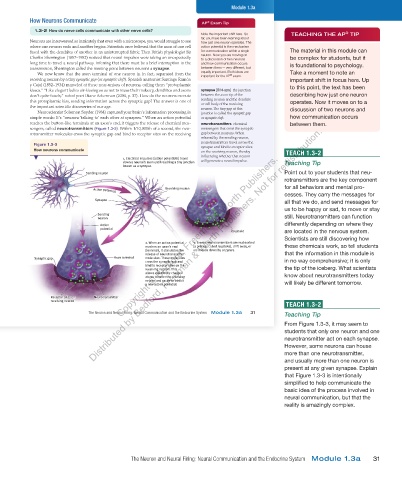
reaches the button-like terminals at an axon’s end, it triggers the release of chemical mes- neurotransmitters chemical between them.
Distributed by Bedford, Freeman & Worth Publishers. Not for redistribution.
sengers, called neurotransmitters ( Figure 1.3-3 ). Within 1/10,000th of a second, the neu- messengers that cross the synaptic
rotransmitter molecules cross the synaptic gap and bind to receptor sites on the receiving gap between neurons. When
released by the sending neuron,
neurotransmitters travel across the
Figure 1.3-3 synapse and bind to receptor sites
How neurons communicate on the receiving neuron, thereby TEACH 1.3-2
Copyright © Bedford, Freeman & Worth Publishers.
influencing whether that neuron
1. Electrical impulses (action potentials) travel
down a neuron’s axon until reaching a tiny junction will generate a neural impulse. Teaching Tip
known as a synapse.
Sending neuron Point out to your students that neu-
rotransmitters are the key component
Receiving neuron for all behaviors and mental pro-
Action potential
cesses. They carry the messages for
Synapse
all that we do, and send messages for
us to be happy or sad, to move or stay
Sending still. Neurotransmitters can function
neuron
Action differently depending on where they
potential
Reuptake are located in the nervous system.
Scientists are still discovering how
2. When an action potential 3. Excess neurotransmitters are reabsorbed
reaches an axon’s end (a process called reuptake), drift away, or these chemicals work, so tell students
(terminal), it stimulates the are broken down by enzymes.
release of neurotransmitter that the information in this module is
Synaptic gap Axon terminal molecules. These molecules
cross the synaptic gap and in no way comprehensive; it is only
bind to receptor sites on the
receiving neuron. This the tip of the iceberg. What scientists
allows electrically charged
atoms to enter the receiving know about neurotransmitters today
neuron and excite or inhibit will likely be different tomorrow.
a new action potential.
Receptor sites on Neurotransmitter
receiving neuron
TEACH 1.3-2
The Neuron and Neural Firing: Neural Communication and the Endocrine System Module 1.3a 31 Teaching Tip
From Figure 1.3-3, it may seem to
students that only one neuron and one
03_myersAPpsychology4e_28116_ch01_002_163.indd 31 15/12/23 9:21 AM neurotransmitter act on each synapse.
However, some neurons can house
more than one neurotransmitter,
and usually more than one neuron is
present at any given synapse. Explain
that Figure 1.3-3 is intentionally
simplified to help communicate the
basic idea of the process involved in
neural communication, but that the
reality is amazingly complex.
The Neuron and Neural Firing: Neural Communication and the Endocrine System Module 1.3a 31
03_HammerTE4e_47547_ch01_2a_163_4pp.indd 31 07/02/24 5:18 PM

