


Page 38 - 2024-bfw-MyersAP4e-TE
P. 38
Module 1.3a          The Neuron and Neural Firing:
               INTRODUCE THE MODULE
               Make It Meaningful                                               Neural Communication and


                (10 minutes) Ask students the                                   the Endocrine System
                following questions:
                •  What do you already know
                  about neurons and neural                                          LEARNING TARGETS
                  transmission?                                                    1.3-1        Describe  neurons,  and explain how they transmit information.
                                                                                  1.3-2         Explain how nerve cells communicate with other nerve cells.
                •  Where did you learn this                                       1.3-3           Explain how neurotransmitters influence behavior, and explain how drugs
                  information?                                                      and other chemicals affect neurotransmission.
                •  What questions do you have                                     1.3-4          Explain how the endocrine system transmits information and interacts with
                  about neurons and neural                                          the nervous system.
                  transmission?
                                      Distributed by Bedford, Freeman & Worth Publishers. Not for redistribution.
                Use their responses as a way to                                    Neural Communication
                begin the discussion of the neuron                             For scientists, it is a happy fact of nature that the information systems of humans and other
                and neural communication.                                    animals operate similarly. This similarity allows researchers to study relatively simple animals
                                                                             to discover how our own neural systems operate. Cars differ, but all have engines, accelera-
                                                                             tors, steering wheels, and brakes. A space alien could study any one of them and grasp the
                                                                             operating principles. Likewise, animals differ, yet their nervous systems operate similarly.
               INTRODUCE THE MODULE                                             Neurons
               Activate Prior Knowledge                                                   1.3-1   What are  neurons,  and how do they transmit information?
                                                                                       e
                                                                                  What ar
                                                                                       e
                                                                                        neurons,
                                                                                        neurons,
                                                                                       e

                                                                                  What ar
                                                                                          1.3-1


                                                                                  What ar
                                                                                               and how do they transmit information?

                (10 minutes) Begin class with                                  Our body’s neural information system comprises a complexity built from simplicity. Its build-

                                                                                          ,
                this activity, which asks students                           ing blocks are    neurons    or nerve cells. Throughout life, new neurons are born and unused


                                                               neuron    a nerve cell; the basic   neurons wither away ( O’Leary et al., 2014 ;  Shors, 2014 ). To fathom our thoughts and actions,
                to decide if statements are              building block of the nervous   our memories and moods, we must first understand how neurons work and communicate.
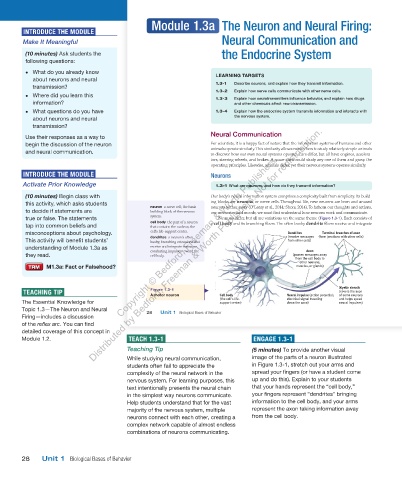
                true or false. The statements            system.                     Neurons differ, but all are variations on the same theme (  Figure 1.3-1 ). Each consists of


                                                            cell body    the part of a neuron
                tap into common beliefs and              that contains the nucleus; the   a    cell body   and its branching fibers. The often bushy   dendrite   fibers receive and integrate
                                                         cell’s life-support center.

                misconceptions about psychology.  Copyright © Bedford, Freeman & Worth Publishers.    Dendrites  Terminal branches of axon
                                                            dendrites       a neuron’s often          (receive messages  (form junctions with other cells)
                This activity will benefit students’     bushy, branching extensions that             from other cells)
                understanding of Module 1.3a as          receive and integrate messages,                    Axon
                                                         conducting impulses toward the
                they read.                               cell body.                                    (passes messages away
                                                                                                        from the cell body to
                                                                                                          other neurons,
                       M1.3a: Fact or Falsehood?                                                        muscles, or glands)
                                                                                                                      Myelin sheath
               TEACHING TIP                                        Figure   1.3-1    Cell body       Neural impulse (action potential;   (covers the axon
                                                                                                                      of some neurons
                                                          A motor neuron
               The Essential Knowledge for                                     (the cell’s life-     electrical signal traveling  and helps speed
                                                                                                     down the axon)
                                                                                                                      neural impulses)
                                                                               support center)
               Topic 1.3—The Neuron and Neural          28   Unit 1  Biological Bases of Behavior
               Firing—includes a discussion
               of the reflex arc. You can find
               detailed coverage of this concept in
               Module 1.2.                        TEACH 1.3-1                              ENGAGE 1.3-1                             15/12/23   9:21 AM
                                                  03_myersAPpsychology4e_28116_ch01_002_163.indd   28
                                                 Teaching Tip                             (5 minutes) To provide another visual
                                                 While studying neural communication,     image of the parts of a neuron illustrated
                                                 students often fail to appreciate the    in Figure 1.3-1, stretch out your arms and
                                                 complexity of the neural network in the   spread your fingers (or have a student come
                                                 nervous system. For learning purposes, this   up and do this). Explain to your students
                                                 text intentionally presents the neural chain   that your hands represent the “cell body,”
                                                 in the simplest way neurons communicate.   your fingers  represent “dendrites” bringing
                                                 Help students understand that for the vast   information to the cell body, and your arms
                                                 majority of the nervous system, multiple   represent the axon taking information away
                                                 neurons connect with each other, creating a   from the cell body.
                                                 complex network capable of almost endless
                                                 combinations of neurons communicating.
               28   Unit 1  Biological Bases of Behavior
          03_HammerTE4e_47547_ch01_2a_163_4pp.indd   28                                                                         07/02/24   5:18 PM

