


Page 71 - 2021-bfw-SPA-4e-TE-sample.indd
P. 71
152    CHAPTER 2   •  Modeling One-Variable Quantitative Data

                                                     7.   The figure shows a density curve that models the dis-  (c)  2019, because the standardized score is greater than
                7. d                                    tribution of a quantitative variable. Seven  values are   in 1965
                8. a                                    marked on the density curve. Which of the following   (d)  2019, because $34,000 is greater than $2300
                                                        statements is true?
                9. c                                                                     10.  The distribution of the time it takes for different peo-
                                                                                           ple  to  solve  a  certain  crossword  puzzle  is  strongly
                10. d                                                                      skewed to the right with a mean of 30 minutes and a
                                                                                           standard deviation of 15 minutes. The distribution of
                11.  (a) Because there are 130 values in                                   z-scores for those times is
                this data set, the 10th percentile will be                               (a)  normally distributed with mean 30 and SD 15.
                                                                                         (b)  skewed to the right with mean 30 and SD 15.
                                    =
                the value that has (130)(0.1) 13 values                                  (c)  normally distributed with mean 0 and SD 1.
                below it. Counting from the minimum,                                     (d)  skewed to the right with mean 0 and SD 1.
                the 14th value in this data set is 36.3 °C.
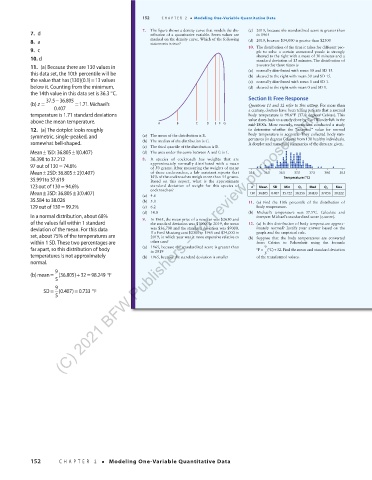
                     37.5 −36.805                                                        Section II: Free Response
                (b) z =        =1.71. Michael’s                                          Questions 11 and 12 refer to this setting. For more than
                           (C) 2021 BFW Publishers -- for review purposes only.
                        0.407                                                            a century, doctors have been telling patients that a normal
                temperature is 1.71 standard deviations                                  body  temperature  is 98.6F°   (37.0  degrees  Celsius).  This
                above the mean temperature.                A     B     C   D  E  F  G    value dates back to a study done by Carl Wunderlich in the
                                                                                         mid-1800s. More recently, researchers conducted a study
                12.  (a) The dotplot looks roughly                                       to  determine  whether  the  “accepted”  value  for  normal
                symmetric, single-peaked, and        (a)  The mean of the distribution is E.  body  temperature  is  accurate. They  collected  body  tem-
                                                                                         peratures (in degrees Celsius) from 130 healthy individuals.
                somewhat bell-shaped.                (b)  The median of the distribution is C.  A  dotplot and numerical summaries of the data are given.
                                                     (c)  The third quartile of the distribution is D.
                    ±
                              ±
                Mean 1SD: 36.805 1(0.407)            (d)  The area under the curve between A and G is 1.
                36.398 to 37.212                     8.  A  species  of  cockroach  has  weights  that  are
                          =
                97out of 130 74.6%                      approximately normally distributed with a mean
                                                        of 50 grams. After measuring the weights of many
                              ±
                Mean 2SD: 36.805 2(0.407)               of these cockroaches, a lab assistant reports that   35.5  36.0  36.5  37.0  37.5  38.0  38.5
                    ±
                35.991to 37.619                         14% of the cockroaches weigh more than 55 grams.   Temperature (°C)
                                                        Based  on  this  report,  what  is  the  approximate
                123outof 130 94.6%                      standard  deviation  of  weight  for  this  species  of    n  Mean  SD  Min  Q 1  Med  Q 3  Max
                          =
                                                        cockroaches?
                Mean 3SD: 36.805 3(0.407)            (a)  4.6                            130  36.805  0.407  35.722 36.556 36.833  37.056  38.222
                    ±
                              ±
                35.584 to 38.026                     (b)  5.0                            11.  (a)  Find  the  10th  percentile  of  the  distribution  of
                129 outof 130 99.2%                  (c)  6.2                              body temperature.
                          =
                                                     (d)  14.0                           (b)  Michael’s  temperature  was  37.5C° .  Calculate  and
                In a normal distribution, about 68%                                        interpret Michael’s standardized score (z-score).
                of the values fall within 1 standard   9.   In 1965, the mean price of a new car was $2650 and   12.  (a)  Is this distribution of body temperature approx-
                                                        the standard deviation was $1000. In 2019, the mean
                deviation of the mean. For this data    was $36,700 and the standard deviation was $9000.   imately  normal?  Justify  your  answer  based  on  the
                                                                                           graph and the empirical rule.
                set, about 75% of the temperatures are   If a Ford Mustang cost $2300 in 1965 and $34,000 in   (b)  Suppose  that  the  body  temperatures  are  converted
                                                        2019, in which year was it more expensive relative to
                within 1 SD. These two percentages are   other cars?                       from  Celsius  to  Fahrenheit  using  the  formula
                far apart, so this distribution of body   (a)  1965, because the standardized score is greater than   ° =  9  ° (C)32. Find the mean and standard deviation
                                                                                                 +
                                                                                            F
                                                        in 2019
                                                                                              5
                temperatures is not approximately    (b)  1965, because the standard deviation is smaller  of the transformed values.
                normal.
                        9
                (b) mean =  (36.805)32 98.249 F
                                   =
                               +
                                          °
                        5
                        9
                               =
                                     °
                    SD =  (0.407)0.733 F
                        5
                                                  03_StarnesSPA4e_24432_ch02_088_153.indd   152                            07/09/20   1:59 PM


                152       CHAPTER 2   •   Modeling One-Variable Quantitative Data


          03_TysonTEspa4e_25177_ch02_088_153_4pp.indd   152                                                            10/11/20   7:49 PM

