


Page 68 - 2021-bfw-SPA-4e-TE-sample.indd
P. 68
Chapter 2  Main Points  149


                  Normal Distributions                entry for each z-score is the area under the curve
                  ■  Some  distributions  of  quantitative  data  can  be   to the left of z.
                    modeled by symmetric, single-peaked, bell-shaped   ■  You can use Table A or technology to determine
                    density curves called normal curves.  area for given values of the variable or the value
                                                      that corresponds to a given percentile in any nor-
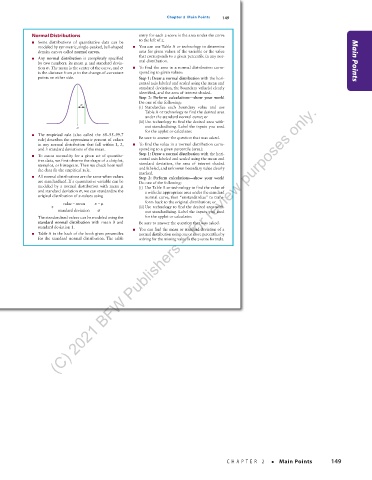
                  ■  Any  normal  distribution  is  completely  specified
                    by two numbers: its mean µ and standard devia-  mal distribution.                                        Main Points
                    tion σ . The mean is the center of the curve, and σ    ■  To find the area in a normal distribution corre-
                    is the distance from µ to the change-of-curvature   sponding to given values:
                    points on either side.            Step 1: Draw a normal distribution with the hori-
                                                      zontal axis labeled and scaled using the mean and
                                                      standard deviation, the boundary value(s) clearly
                                                      identified, and the area of interest shaded.
                                                      Step  2:  Perform  calculations—show  your  work!
                                                      Do one of the following:
                           (C) 2021 BFW Publishers -- for review purposes only.
                                  σ
                                                      (i)  Standardize  each  boundary  value  and  use
                                                        Table A or technology to find the desired area
                                                        under the standard normal curve; or
                                                      (ii) Use technology to find the desired area with-
                                                        out standardizing. Label the inputs you used
                                                        for the applet or calculator.
                  ■  The  empirical  rule  (also  called  the  68–95–99.7
                    rule) describes the approximate percent of values   Be sure to answer the question that was asked.
                    in any normal distribution that fall within 1, 2,   ■  To find the value in a normal distribution corre-
                    and 3 standard deviations of the mean.  sponding to a given percentile (area):
                  ■  To assess normality for a given set of quantita-  Step 1: Draw a normal distribution with the hori-
                    tive data, we first observe the shape of a dotplot,   zontal axis labeled and scaled using the mean and
                    stemplot, or histogram. Then we check how well   standard  deviation,  the  area  of  interest  shaded
                    the data fit the empirical rule.  and labeled, and unknown boundary value clearly
                                                      marked.
                  ■  All normal distributions are the same when values   Step  2:  Perform  calculations—show  your  work!
                    are standardized. If a quantitative variable can be   Do one of the following:
                    modeled by a normal distribution with mean  µ   (i)  Use Table A or technology to find the value of
                    and standard deviation σ, we can standardize the   z with the appropriate area under the standard
                    original distribution of x-values using  normal curve, then “unstandardize” to trans-
                             value −  mean  x  −  µ     form back to the original distribution; or
                         z  =         =               (ii) Use technology to find the desired area with-
                           standard deviation  σ        out standardizing. Label the inputs you used
                    The standardized values can be modeled using the   for the applet or calculator.
                    standard  normal  distribution  with  mean  0  and   Be sure to answer the question that was asked.
                    standard deviation 1.           ■  You can find the mean or standard deviation of a
                  ■  Table A in the back of the book gives percentiles   normal distribution using one or more percentiles by
                    for  the  standard  normal  distribution. The  table   solving for the missing value in the z-score formula.


        03_StarnesSPA4e_24432_ch02_088_153.indd   149                             07/09/20   1:59 PM


                                                                                   CHAPTER 2   •  Main Points         149


          03_TysonTEspa4e_25177_ch02_088_153_4pp.indd   149                                                            10/11/20   7:49 PM

