


Page 38 - 2021-bfw-SPA-4e-TE-sample.indd
P. 38
LESSON 2.4   •   The Empirical Rule and Assessing Normality  119

                   Calculating the shaded area isn’t as easy as multiplying  baseheight×  , but it’s
                 not as hard as you might think. The following activity will shed some light on how
                 to do it.


                                             ACTIVITY                                            ACTIVITY OVERVIEW           Lesson 2.4
                                                                                            Time: 8–10 min
                    What’s so special about normal distributions?
                                                                                            Materials: One Internet-connected
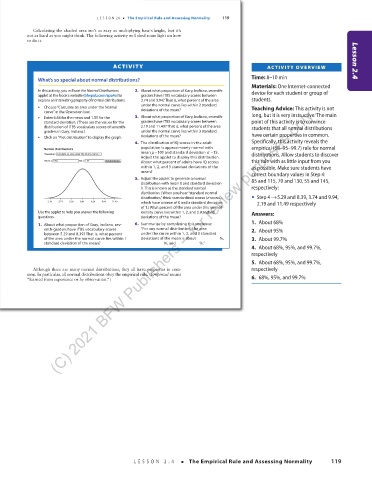
                    In this activity, you will use the Normal Distributions   2.  About what proportion of Gary, Indiana, seventh-  device for each student or group of
                    applet at the book’s website (bfwpub.com/spa4e) to   graders have ITBS vocabulary scores between
                    explore an interesting property of normal distributions.  3.74 and 9.94? That is, what percent of the area   students.
                           (C) 2021 BFW Publishers -- for review purposes only.
                    •  Choose “Calculate an area under the Normal   under the normal curve lies within 2 standard   Teaching Advice: This activity is not
                                                       deviations of the mean?
                      curve” in the Operation box.                                          long, but it is very instructive. The main
                    •  Enter 6.84 for the mean and 1.55 for the   3.  About what proportion of Gary, Indiana, seventh-
                      standard deviation. (These are the values for the   graders have ITBS vocabulary scores between   point of this activity is to convince
                      distribution of ITBS vocabulary scores of seventh-  2.19 and 11.49? That is, what percent of the area   students that all normal distributions
                      graders in Gary, Indiana.)       under the normal curve lies within 3 standard   have certain properties in common.
                    •  Click on “Plot distribution” to display the graph.  deviations of the mean?
                                                     4.  The distribution of IQ scores in the adult   Specifically, this activity reveals the
                      Normal Distributions             population is approximately normal with   empirical (68–95–99.7) rule for normal
                      Operation:  Calculate an area under the Normal curve  mean µ = 100 and standard deviation σ =15.    distributions. Allow students to discover
                                                       Adjust the applet to display this distribution.
                      Mean = 6.84  SD = 1.55  Plot distribution  About what percent of adults have IQ scores   this rule with as little input from you
                                                       within 1, 2, and 3 standard deviations of the   as possible. Make sure students have
                                                       mean?                                correct boundary values in Step 4:
                                                     5.  Adjust the applet to generate a normal   85 and 115, 70 and 130, 55 and 145,
                                                       distribution with mean 0 and standard deviation
                                                       1. This is known as the standard normal   respectively:
                                                       distribution. (When you hear “standard normal
                                                       distribution,” think standardized scores (z-scores),   •   Step 4  S5.29 and 8.39, 3.74 and 9.94,
                        2.19  3.74  5.29  6.84  8.39  9.94  11.49  which have a mean of 0 and a standard deviation   2.19 and 11.49 respectively
                                                       of 1.) What percent of the area under this normal
                    Use the applet to help you answer the following   density curve lies within 1, 2, and 3 standard   Answers:
                    questions.                         deviations of the mean?
                    1.  About what proportion of Gary, Indiana, sev-  6.  Summarize by completing this sentence:   1.  About 68%
                      enth-graders have ITBS vocabulary scores   “For any normal distribution, the area   2.  About 95%
                      between 5.29 and 8.39? That is, what percent   under the curve within 1, 2, and 3 standard
                      of the area under the normal curve lies within 1   deviations of the mean is about   %,    3.  About 99.7%
                      standard deviation of the mean?         %, and      %.”
                                                                                            4.  About 68%, 95%, and 99.7%,
                                                                                            respectively
                                                                                            5.  About 68%, 95%, and 99.7%,
                   Although there are many normal distributions, they all have properties in com-  respectively
                 mon. In particular, all normal distributions obey the empirical rule. (Empirical means   6.  68%, 95%, and 99.7%
                 “learned from experience or by observation.”)


        03_StarnesSPA4e_24432_ch02_088_153.indd   119                             07/09/20   1:55 PM


                                                    LESSON 2.4   •  The Empirical Rule and Assessing Normality        119


          03_TysonTEspa4e_25177_ch02_088_153_4pp.indd   119                                                            10/11/20   7:45 PM

