


Page 43 - 2021-bfw-SPA-4e-TE-sample.indd
P. 43
124    CHAPTER 2   •  Modeling One-Variable Quantitative Data

                                                                         The example shows that the distribution of amount of cream in Ryan and Allie’s
                        TEACHING TIP                                 random sample of 45 Double Stuf Oreo cookies is approximately normal. As you will
                                                                                 ,
                                                                     learn in  Chapter 4  random sampling allows us to generalize results from a sample
                Assessing normality is important for                 to the larger population. It is therefore reasonable to believe that the distribution of
                many techniques learned later in                     amount of cream in the population of Double Stuf Oreo cookies is approximately
                                                                     normal. Assessing the normality of a population distribution is an important part of
                this book, but not all distributions                 several inference methods that you will encounter in  Chapters 8 – 11   .
                are approximately normal. There are
                alternate techniques for many of
                those other distributions, but they’re                         LESSON   APP     2 . 4
                not covered in this textbook. Just like     How big is your fridge?
                people, some of the most interesting
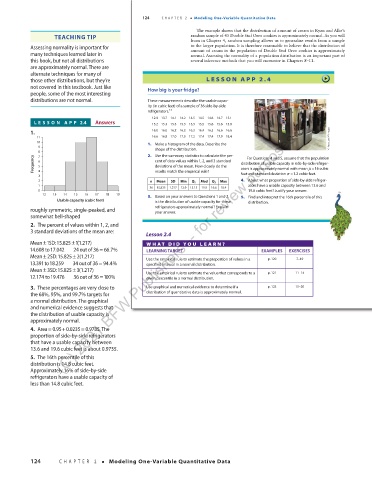
                distributions are not normal.                These measurements describe the usable capac-
                           (C) 2021 BFW Publishers -- for review purposes only.
                                                       ity (in cubic feet) of a sample of 36 side-by-side
                                                              13
                                                       refrigerators.
                                                            12.9       13.7       14.1       14.2       14.5       14.5       14.6       14.7       15.1
                 LESSON   APP  2.4    Answers               15.2       15.3       15.3       15.3       15.3       15.5       15.6       15.6       15.8
                1.                                          16.0       16.0       16.2       16.2       16.3       16.4       16.5       16.6       16.6
                  11                                        16.6       16.8       17.0       17.0       17.2       17.4       17.4       17.9       18.4     Wilfredo Lee/AP Images
                  10                                      1.   Make a histogram of the data. Describe the

                   9                                      shape of the distribution.
                   8 7                                   2.   Use the summary statistics to calculate the per-

                 Frequency  6 5                           cent of data values within 1, 2, and 3 standard   distribution of usable capacity in side-by-side refriger-
                                                                                          For  Questions 4  and  5 , assume that the population
                                                          deviations of the mean. How closely do the

                                                                                      ators is approximately normal with mean  µ =16   cubic

                   3 4                                    results match the empirical rule?  feet and standard deviation  σ =1.2   cubic feet.


                   2                                            n        Mean        SD        Min           Q 1               Med         Q 3      Max       4.   About what proportion of side-by-side refriger-


                   1                                       36       15.825        1.217        12.9       15.15        15.9        16.6        18.4     ators have a usable capacity between 13.6 and
                   0                                                                     19.6 cubic feet? Justify your answer.
                    12  13  14  15  16  17  18  19       3.   Based on your answers to  Questions 1  and  2 ,      5.   Find and interpret the 16th percentile of this

                         Usable capacity (cubic feet)     is the distribution of usable capacity for these   distribution.
                roughly symmetric, single-peaked, and     refrigerators approximately normal? Explain
                                                          your answer.
                somewhat bell-shaped
                2.  The percent of values within 1, 2, and
                3 standard deviations of the mean are:
                                                            Lesson   2.4
                              ±
                Mean ±1SD:15.825 1(1.217)                WHA T  DID   Y OU  LEARN ?
                                       =
                14.608 to17.042        24 outof3666.7%    LEARNING TARGET                     EXAMPLES    EXERCISES
                              ±
                Mean ± 2SD:15.825 2(1.217)               Use the empirical rule to estimate the proportion of values in a     p. 120     7–10
                13.391to18.259        34 outof3694.4%  specified interval in a normal distribution.
                                       =
                              ±
                Mean ± 3SD:15.825 3(1.217)                                                       p. 121     11–14
                                       =
                12.174 to19.476        36 outof36100%    Use the empirical rule to estimate the value that corresponds to a
                                                       given percentile in a normal distribution.
                3.  These percentages are very close to     Use graphical and numerical evidence to determine if a     p. 123     15–20
                the 68%, 95%, and 99.7% targets for    distribution of quantitative data is approximately normal.
                a normal distribution. The graphical
                and numerical evidence suggests that
                the distribution of usable capacity is
                approximately normal.
                4.  Area 0.95 0.0235 0.9735. The   03_StarnesSPA4e_24432_ch02_088_153.indd   124                           07/09/20   1:56 PM
                                 =
                      =
                           +
                proportion of side-by-side refrigerators
                that have a usable capacity between
                13.6 and 19.6 cubic feet is about 0.9735.
                5.  The 16th percentile of this
                distribution is 14.8 cubic feet.
                Approximately 16% of side-by-side
                refrigerators have a usable capacity of
                less than 14.8 cubic feet.


                124       CHAPTER 2   •   Modeling One-Variable Quantitative Data


          03_TysonTEspa4e_25177_ch02_088_153_4pp.indd   124                                                            10/11/20   7:46 PM

