


Page 41 - 2021-bfw-SPA-4e-TE-sample.indd
P. 41
122    CHAPTER 2   •  Modeling One-Variable Quantitative Data

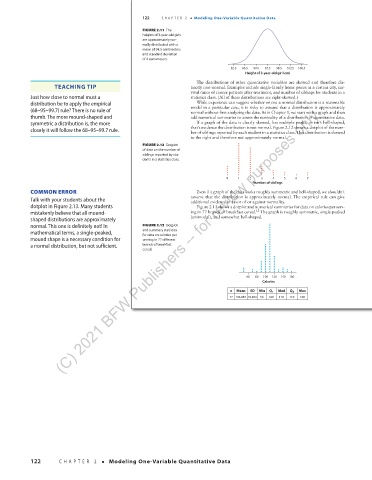
                                                     FIGURE 2.11  The
                                                     heights of 3-year-old girls
                                                     are approximately nor-
                                                     mally distributed with a
                                                     mean of 94.5 centimeters
                                                     and standard deviation
                                                     of 4 centimeters.
                                                                                   82.5  86.5  90.5  94.5  98.5  102.5  106.5
                                                                                        Height of 3-year-old girl (cm)
                                                                       The  distributions  of  other  quantitative  variables  are  skewed  and  therefore  dis-
                        TEACHING TIP                                 tinctly non-normal. Examples include single-family home prices in a certain city, sur-
                                                                     vival times of cancer patients after treatment, and number of siblings for students in a
                Just how close to normal must a                      statistics class. (All of these distributions are right-skewed.)
                distribution be to apply the empirical                 While experience can suggest whether or not a normal distribution is a reasonable
                           (C) 2021 BFW Publishers -- for review purposes only.
                (68–95–99.7) rule? There is no rule of               model in a particular case, it is risky to assume that a distribution is approximately
                                                                     normal without first analyzing the data. As in Chapter 1, we start with a graph and then
                thumb. The more mound-shaped and                     add numerical summaries to assess the normality of a distribution of quantitative data.
                symmetric a distribution is, the more                  If a graph of the data is clearly skewed, has multiple peaks, or isn’t bell-shaped,
                closely it will follow the 68–95–99.7 rule.          that’s evidence the distribution is not normal. Figure 2.12 shows a dotplot of the num-
                                                                     ber of siblings reported by each student in a statistics class. This distribution is skewed
                                                                     to the right and therefore not approximately normal.
                                                     FIGURE 2.12  Dotplot
                                                     of data on the number of
                                                     siblings reported by stu-
                                                     dents in a statistics class.


                                                                                 0   1   2   3   4   5  6   7
                                                                                          Number of siblings
                COMMON ERROR                                           Even if a graph of the data looks roughly symmetric and bell-shaped, we shouldn’t
                Talk with your students about the                    assume that the distribution is approximately normal. The empirical rule can give
                                                                     additional evidence in favor of or against normality.
                dotplot in Figure 2.13. Many students                  Figure 2.13 shows a dotplot and numerical summaries for data on calories per serv-
                                                                                           12
                mistakenly believe that all mound-                   ing in 77 brands of breakfast cereal.  The graph is roughly symmetric, single-peaked
                shaped distributions are approximately               (unimodal), and somewhat bell-shaped.
                normal. This one is definitely not! In   FIGURE 2.13  Dotplot
                mathematical terms, a single-peaked,   and summary statistics
                                                     for data on calories per
                mound shape is a necessary condition for   serving in 77 different
                a normal distribution, but not sufficient.  brands of breakfast
                                                     cereal.


                                                                                        60  80  100  120  140  160
                                                                                             Calories
                                                                                   n  Mean  SD  Min  Q 1  Med  Q 3  Max
                                                                                  77 106.883 19.484  50  100  110  110  160


                                                  03_StarnesSPA4e_24432_ch02_088_153.indd   122                            07/09/20   1:56 PM


                122       CHAPTER 2   •   Modeling One-Variable Quantitative Data


          03_TysonTEspa4e_25177_ch02_088_153_4pp.indd   122                                                            10/11/20   7:45 PM

