


Page 47 - 2021-bfw-SPA-4e-TE-sample.indd
P. 47
Lesson   2.5
                                                                     Normal Distributions:

                                                                     Finding Areas from Values

                 LEARNING  T AR GET   KEY                                               L E AR N I N G   TAR G E T S
                 The problems in the test bank are                     •   Find the proportion of values to the left of a boundary in a normal distribution.

                 keyed to the learning targets using                   •   Find the proportion of values to the right of a boundary in a normal distribution.

                 these numbers:                                        •   Find the proportion of values between two boundaries in a normal

                                                                         distribution.
                 •   2.5.1
                           (C) 2021 BFW Publishers -- for review purposes only.
                 •   2.5.2
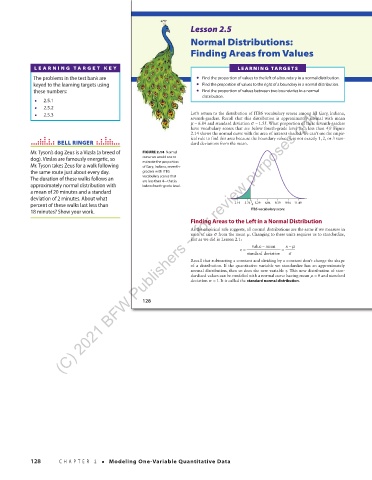
                 •   2.5.3                                             Let’s return to the distribution of ITBS vocabulary scores among all Gary, Indiana,
                                                                     seventh-graders.  Recall  that  this  distribution  is  approximately  normal  with  mean


                                                                      µ =  6.84 and standard deviation  σ =  1.55  What proportion of these seventh-graders
                                                                                               .

                                                                     have vocabulary scores that are below fourth-grade level (i.e., less than 4)?  Figure
                                                                     2.14 shows the normal curve with the area of interest shaded. We can’t use the empir-


                                                                     ical rule to find this area because the boundary value, 4, is not exactly 1, 2, or 3 stan-
                          BELL RINGER                                dard deviations from the mean.
                Mr. Tyson’s dog Zeus is a Vizsla (a breed of   FIGURE   2.14     Normal
                dog). Vizslas are famously energetic, so   curve we would use to
                Mr. Tyson takes Zeus for a walk following   estimate the proportion
                                                     of Gary, Indiana, seventh-
                the same route just about every day.   graders with ITBS
                The duration of these walks follows an   vocabulary scores that
                                                     are less than 4—that is,
                approximately normal distribution with   below fourth-grade level.
                a mean of 20 minutes and a standard
                deviation of 2 minutes. About what
                percent of these walks last less than                               2.19  3.74  4  5.29  6.84  8.39  9.94  11.49
                18 minutes? Show your work.                                               ITBS vocabulary score
                                                                               Finding Areas to the Left in a Normal Distribution
                                                                       As the empirical rule suggests, all normal distributions are the same if we measure in

                                                                                         .
                                                                     units of size   σ from the mean  µ  Changing to these units requires us to standardize,
                                                                     just as we did in  Lesson 2.1 :
                                                                                             −
                                                                                          value mean  x  −  µ
                                                                                      z  =          =
                                                                                        standard deviation  σ
                                                                       Recall that subtracting a constant and dividing by a constant don’t change the shape
                                                                     of a distribution. If the quantitative variable we standardize has an approximately
                                                                     normal distribution, then so does the new variable  z  This new distribution of stan-
                                                                                                      .

                                                                     dardized values can be modeled with a normal curve having mean   µ =  0 and standard


                                                                     deviation   σ = 1  It is called the  standard normal distribution

                                                                                                          .


                                                                               .
                                                     128
                                                  03_StarnesSPA4e_24432_ch02_088_153.indd   128                            07/09/20   1:56 PM


                128       CHAPTER 2   •   Modeling One-Variable Quantitative Data


          03_TysonTEspa4e_25177_ch02_088_153_4pp.indd   128                                                            10/11/20   7:46 PM

