


Page 50 - 2021-bfw-SPA-4e-TE-sample.indd
P. 50
LESSON 2.5   •   Normal Distributions: Finding Areas from Values  131


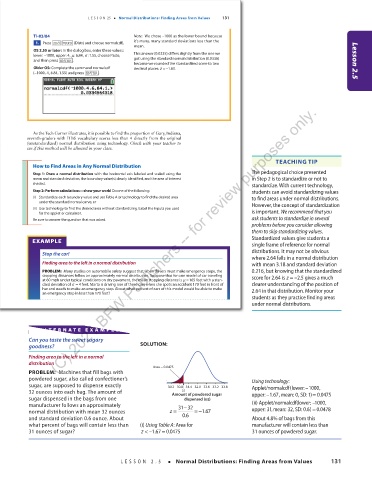
                   TI-83/84                         Note:  We chose  1000 as the lower bound because
                                                              −
                     1.    Press  2nd   VARS  (Distr) and choose normalcdf(.  it’s many, many standard deviations less than the
                                                    mean.
                   OS 2.55 or later: In the dialog box, enter these values:
                   lower:  −1000, upper: 4, µ:6.84, σ :1.55, choose Paste,   This answer (0.0335) differs slightly from the one we
                   and then press  ENTER .          got using the standard normal distribution (0.0336)                      Lesson 2.5
                                                    because we rounded the standardized score to two
                   Older OS: Complete the command normalcdf   decimal places: z =− 1.83.
                   −
                   ( 1000,4,6.84, 1.55) and press  ENTER .


                           (C) 2021 BFW Publishers -- for review purposes only.


                   As the Tech Corner illustrates, it is possible to find the proportion of Gary, Indiana,
                 seventh-graders with ITBS vocabulary scores less than 4 directly from the original
                 (unstandardized) normal distribution using technology. Check with your teacher to
                 see if this method will be allowed in your class.

                                                                                                    TEACHING TIP
                   How to Find Areas in Any Normal Distribution
                                                                                            The pedagogical choice presented
                   Step 1: Draw a normal distribution with the horizontal axis labeled and scaled using the
                   mean and standard deviation, the boundary value(s) clearly identified, and the area of interest   in Step 2 is to standardize or not to
                   shaded.                                                                  standardize. With current technology,
                   Step 2: Perform calculations—show your work! Do one of the following:    students can avoid standardizing values
                   (i)  Standardize each boundary value and use Table A or technology to find the desired area   to find areas under normal distributions.
                     under the standard normal curve; or                                    However, the concept of standardization
                   (ii)  Use technology to find the desired area without standardizing. Label the inputs you used   is important. We recommend that you
                     for the applet or calculator.
                   Be sure to answer the question that was asked.                           ask students to standardize in several
                                                                                            problems before you consider allowing
                                                                                            them to skip standardizing values.
                                                                                            Standardized values give students a
                  EXAMPLE
                                                                                            single frame of reference for normal
                                                                                            distributions. It may not be obvious
                      Stop the car!
                                                                                            where 2.64 falls in a normal distribution
                      Finding area to the left in a normal distribution                     with mean 3.18 and standard deviation
                      PROBLEM:  Many studies on automobile safety suggest that when drivers must make emergency stops, the   0.216, but knowing that the standardized
                      stopping distances follow an approximately normal distribution. Suppose that for one model of car traveling   score for 2.64 is z = –2.5 gives a much
                      at 60 mph under typical conditions on dry pavement, the mean stopping distance is µ =165 feet with a stan-
                      dard deviation of σ = 4 feet. Marta is driving one of these cars when she spots an accident 170 feet in front of   clearer understanding of the position of
                      her and needs to make an emergency stop. About what percent of cars of this model would be able to make   2.64 in that distribution. Monitor your
                      an emergency stop in less than 170 feet?
                                                                                            students as they practice finding areas
                                                                                            under normal distributions.


        03_StarnesSPA4e_24432_ch02_088_153.indd   131                             07/09/20   1:56 PM
                     AL TERNA TE  EX AMPLE
                 Can you taste the sweet sugary
                 goodness?                            SOLUTION:

                 Finding area to the left in a normal
                 distribution
                                                           Area = 0.0475
                 PROBLEM:  Machines that fill bags with
                 powdered sugar, also called confectioner’s                                 Using technology:
                 sugar, are supposed to dispense exactly        30.2 30.8 31.4 32.0 32.6 33.2 33.8  Applet/normalcdf(lower:–1000,
                 32 ounces into each bag. The amount of          Amount of powdered sugar   upper:–1.67, mean:0,SD:1) 0.0475
                                                                    31
                                                                                                                =
                 sugar dispensed in the bags from one                dispensed (oz)
                 manufacturer follows an approximately             31 −32                   (ii) Applet/normalcdf(lower:–1000,
                                                                                                                =
                 normal distribution with mean 32 ounces        z =      =−1.67             upper: 31,mean: 32,SD: 0.6) 0.0478
                 and standard deviation 0.6 ounce. About             0.6                    About 4.8% of bags from this
                 what percent of bags will contain less than   (i) Using Table A: Area for  manufacturer will contain less than
                                                              =
                 31 ounces of sugar?                   z < –1.670.0475                      31 ounces of powdered sugar.


                                                LESSON 2.5   •  Normal Distributions: Finding Areas from Values       131


          03_TysonTEspa4e_25177_ch02_088_153_4pp.indd   131                                                            10/11/20   7:46 PM

