


Page 53 - 2021-bfw-SPA-4e-TE-sample.indd
P. 53
134    CHAPTER 2   •  Modeling One-Variable Quantitative Data

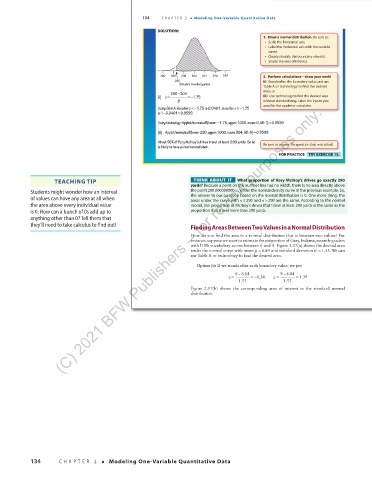
                                                                 SOLUTION:
                                                                                                    1.     Draw a normal distribution.  Be sure to:
                                                                                              •     Scale the horizontal axis.

                                                                                              •   Label the horizontal axis with the variable
                                                                                               name.
                                                                                              •   Clearly identify the boundary value(s).

                                                                                              •    Shade the area of interest.
                                                           280  288  296  304  312  320  328        2.     Perform calculations—show your work!
                                                                290                              (i)   Standardize the boundary value and use

                                                                  Distance traveled (yards)       Table A  or technology to find the desired
                                                                                              area; or
                                                               290 −304

                                                             z
                                                              (i)       =  =−1.75              ( ii)   Use technology to find the desired area
                                                                 8                            without standardizing. Label the inputs you
                           (C) 2021 BFW Publishers -- for review purposes only.
                                                                                              used for the applet or calculator.

                                                             Using  Table A :  Area for   <−z    1.75  is 0.0401. Area for  z ≥−1.75

                                                                 =
                                                           is    −1 0.0401 0.9599 .
                                                                                                =
                                                                              −
                                                             Using technology:  Applet/normalcdf(lower:1.75,upper:1000,mean:0,SD:1)0.9599

                                                                                          =
                                                             (ii)     Applet/normalcdf(lower:290,upper:1000,mean:304,SD:8) 0.9599

                                                            About    96%  of Rory McIlroy’s drives travel at least 290 yards. So he       Be sure to answer the question that was asked.
                                                           is likely to have a clear second shot.
                                                                                                       FOR PRACTICE     TRY EXERCISE 13.
                        TEACHING TIP                                      THINK  ABOUT  IT           What proportion of Rory McIlroy’s drives go exactly 290

                                                                     yards?      Because a point on the number line has no width, there is no area directly above
                Students might wonder how an interval                the point 290.000000000. . . under the normal density curve in the previous example. So,
                of values can have any area at all when              the answer to our question based on the normal distribution is 0. One more thing: the
                                                                                        290   and   x >
                                                                     areas under the curve with   x ≥
                                                                                               290  are the same. According to the normal


                the area above every individual value                model, the proportion of McIlroy’s drives that travel at least 290 yards is the same as the
                is 0. How can a bunch of 0s add up to                proportion that travel more than 290 yards.
                anything other than 0? Tell them that
                they’ll need to take calculus to find out!                 Finding Areas Between Two Values in a Normal Distribution
                                                                       How do you find the area in a normal distribution that is between two values? For
                                                                     instance, suppose we want to estimate the proportion of Gary, Indiana, seventh- graders

                                                                     with ITBS vocabulary scores between 6 and 9.  Figure 2.17(a) shows the desired area

                                                                                                                    .


                                                                     under the normal curve with mean   µ =  6.84 and standard deviation  σ = 1.55  We can

                                                                     use  Table A  or technology to find the desired area.
                                                                       Option (i):  If we standardize each boundary value, we get:
                                                                                    66.84          96.84
                                                                                                    −
                                                                                     −
                                                                                  z  =    =− 0.54  z  =  =  1.39
                                                                                     1.55           1.55

                                                                         Figure  2.17(b)  shows  the  corresponding  area  of  interest  in  the  standard  normal
                                                                     distribution.
                                                  03_StarnesSPA4e_24432_ch02_088_153.indd   134                            07/09/20   1:57 PM


                134       CHAPTER 2   •   Modeling One-Variable Quantitative Data


          03_TysonTEspa4e_25177_ch02_088_153_4pp.indd   134                                                            10/11/20   7:47 PM

