


Page 48 - 2021-bfw-SPA-4e-TE-sample.indd
P. 48
LESSON 2.5   •   Normal Distributions: Finding Areas from Values  129

                  DEFINITION  Standard normal distribution
                  The standard normal distribution is the normal distribution with mean 0 and standard   TEACHING TIP
                  deviation 1.
                                                                                            Unifying calculations by converting
                                                                                            to z-scores is a powerful tool that is
                                                                                            frequently used in advanced statistics.  Lesson 2.5
                                                                                            Repeatedly remind students that the
                                                                                            “standard normal” distribution has mean
                                –3  –2  –1  0  1  2  3                                      µ = 0 and standard deviation σ =1.
                                         z-score

                   Because all normal distributions are the same when we standardize, we can find
                 areas under any normal curve using the standard normal distribution. Table A in the
                           (C) 2021 BFW Publishers -- for review purposes only.
                 back of the book gives areas under the standard normal curve. The table entry for
                 each z-score is the area under the curve to the left of z.
                   For the ITBS test score data, we want to find the area to the left of 4 under the
                 normal curve with mean 6.84 and standard deviation 1.55. See Figure 2.15(a). We
                 start by standardizing the boundary value  =x  4:
                                              −
                                     −
                                  value mean  46.84
                              z  =          =     =− 1.83
                                standard deviation  1.55
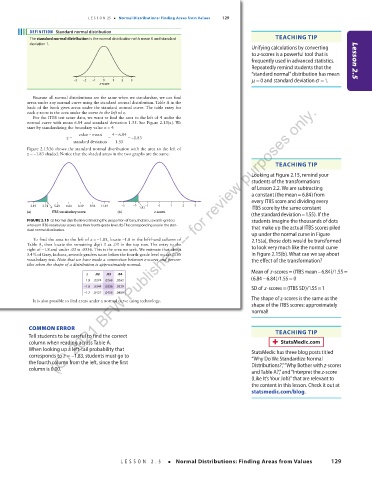
                 Figure 2.15(b) shows the standard normal distribution with the area to the left of
                 z  =− 1.83 shaded. Notice that the shaded areas in the two graphs are the same.
                                                                                                    TEACHING TIP
                                                                                            Looking at Figure 2.15, remind your
                                                                                            students of the transformations
                                                                                            of Lesson 2.2. We are subtracting
                                                                                                           =
                                                                                            a constant (themean 6.84) from
                                                                                            every ITBS score and dividing every
                  2.19  3.74  4  5.29  6.84  8.39  9.94  11.49  –3  –2  –1.83 –1  0  1  2  3  ITBS score by the same constant
                 (a)     ITBS vocabulary score  (b)        z-score
                                                                                                            =
                                                                                           (the standarddeviation1.55). If the
                 FIGURE 2.15  (a) Normal distribution estimating the proportion of Gary, Indiana, seventh-graders   students imagine the thousands of dots
                 who earn ITBS vocabulary scores less than fourth-grade level. (b) The corresponding area in the stan-  that make up the actual ITBS scores piled
                 dard normal distribution.
                                                                                            up under the normal curve in Figure
                                      z
                                                −
                   To find the area to the left of  =− 1.83, locate  1.8 in the left-hand column of   2.15(a), those dots would be transformed
                 Table A, then locate the remaining digit 3 as .03 in the top row. The entry to the   to look very much like the normal curve
                 right of  1.8−   and under .03 is .0336. This is the area we seek. We estimate that about
                 3.4% of Gary, Indiana, seventh-graders score below the fourth-grade level on the ITBS   in Figure 2.15(b). What can we say about
                 vocabulary test. Note that we have made a connection between z-scores and percen-  the effect of the transformation?
                 tiles when the shape of a distribution is approximately normal.
                                                                                            Meanof  z-scores(ITBS mean–6.84)/1.55  =
                                                                                                        =
                                     z  .02  .03  .04
                                    −1.9  .0274  .0268  .0262                              (6.84– 6.84)/1.55  = 0
                                                                                                      =
                                    −1.8  .0344  .0336  .0329                               SD of  z-scores(ITBS SD)/1.55  =1
                                    −1.7  .0427  .0418  .0409
                                                                                            The shape of z-scores is the same as the
                   It is also possible to find areas under a normal curve using technology.
                                                                                            shape of the ITBS scores: approximately
                                                                                            normal!
                 COMMON ERROR
        03_StarnesSPA4e_24432_ch02_088_153.indd   129                             07/09/20   1:56 PM
                 Tell students to be careful to find the correct                                    TEACHING TIP
                 column when reading across Table A.                                                 StatsMedic.com
                 When looking up a left-tail probability that                               StatsMedic has three blog posts titled
                 corresponds to z = –1.83, students must go to                              “Why Do We Standardize Normal
                 the fourth column from the left, since the first                           Distributions?,” “Why Bother with z-scores
                 column is 0.00.
                                                                                            and Table A?,” and “Interpret the z-score
                                                                                            (Like It’s Your Job)” that are relevant to
                                                                                            the content in this lesson. Check it out at
                                                                                            statsmedic.com/blog.


                                                LESSON 2.5   •  Normal Distributions: Finding Areas from Values       129


          03_TysonTEspa4e_25177_ch02_088_153_4pp.indd   129                                                            10/11/20   7:46 PM

