


- Content Hub
- Discipline
Discipline
back- Anatomy & Physiology Astronomy Biochemistry Biology Business Chemistry College Success Communication Economics Electrical Engineering English Environmental Science Geography Geology History Mathematics Music & Theater Nutrition and Health Philosophy & Religion Physics Psychology Sociology Statistics
- Digital
- Solutions
- News & Media
- Our Story
- Contact Us
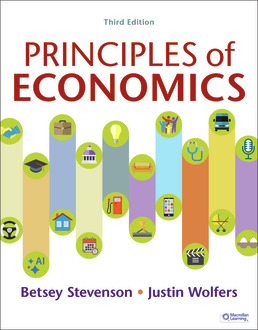
Principles of Economics
Third Edition ©2026 Betsey Stevenson; Justin Wolfers Formats: Achieve, E-book, Print
As low as $88.99
As low as $88.99
- Product Overview
- Content Material
- Assessment
- Reports and Insights
- Teaching Resources
- Support and Services

Authors
-

Betsey Stevenson
Betsey Stevenson is a professor of economics and public policy at the University of Michigan. Her research focuses on the impact of public policies on the labor market, and explores women’s labor market experiences, the economic forces shaping the modern family, and the role of subjective well-being data for public policy. She serves on the Executive Committee of the American Economic Association, and is also a research associate with the National Bureau of Economic Research, a fellow of the Institute for Economic Research in Munich, a visiting associate professor of economics at the University of Sydney, and a research Fellow with the Centre for Economic Policy Research in London. She served as a member of the Council of Economic Advisers from 2013 to 2015, where she advised President Obama on social policy, labor market, and trade issues. She also served as the chief economist of the U.S. Department of Labor from 2010 to 2011. Betsey is an occasional editorialist for Bloomberg, and a trusted presence in the public debate about economics and public policy. She earned a BA in economics and mathematics from Wellesley College and an AM and PhD in economics from Harvard University.

-

Justin Wolfers
Justin Wolfers is a professor of economics and public policy at the University of Michigan. He does research in both macroeconomics and applied microeconomics topics, and has explored unemployment and inflation, the power of prediction markets, the economic forces shaping the modern family, discrimination, and happiness. He is a research associate with the National Bureau for Economic Research, a fellow of the Brookings Institution, a fellow of the Peterson Institute for International Economics, a research fellow with the Centre for Economic Policy Research in London, a fellow of the Institute for Economic Research in Munich, a visiting professor of economics at the University of Sydney, and an international research fellow at the Kiel Institute for the World Economy in Germany. He has been an editor of the Brookings Papers on Economic Activity, a board member on the Committee on the Status of Women in Economics, a member of the Panel of Advisors of the U.S. Congressional Budget Office, among many other board and advisory positions. He is currently a contributing columnist for the New York Times, and has written about economic issues in numerous other outlets. He is frequently quoted in the media on economic policy and relied upon to provide unbiased assessments of the current state of the macroeconomy. Justin earned a BA in economics from the University of Sydney and an AM and PhD in economics from Harvard University.

Table of Contents
Discover What's Inside! Click here to review a sample chapter, Chapter 11: Unemployment, from Stevenson and Wolfer's Principles of Macroeconomics, Third Edition.
Preface
A Quick Review of Graphs
PART I Foundations of Economics
Chapter 1 The Four Core Principles of Economics
Chapter 2 Demand and Consumer Choice
Chapter 3 Supply and Producer Choice
Chapter 4 Equilibrium: Where Supply Meets Demand
PART II Analyzing Markets
Chapter 5 Elasticity: Measuring Responsiveness
Chapter 6 Taxes, Price Controls, and Quantity Regulations
Chapter 7 Welfare Economics: Evaluating Market Efficiency and Market Failure
Chapter 8 Comparative Advantage and Gains from Trade
PART III Applications and Policy Issues
Chapter 9 International Trade
Chapter 10 Externalities and Public Goods
Chapter 11 The Labor Market
Chapter 12 Why Wages Vary: Workers, Jobs, Institutions, and Discrimination
Chapter 13 Inequality, Poverty, and Social Insurance
PART IV Industrial Organization and Business Strategy
Chapter 14 Market Structure and Market Power
Chapter 15 Entry, Exit, and Long-Run Profitability
Chapter 16 Price Discrimination and Sophisticated Pricing Strategies
Chapter 17 Economics of Strategic Management
PART V Advanced Decisions
Chapter 18 Game Theory and Strategic Choices
Chapter 19 Decisions Involving Uncertainty
Chapter 20 Decisions Involving Private Information
PART VI Macroeconomic Foundations and the Long Run
Chapter 21 Sizing Up the Economy Using GDP
Chapter 22 Economic Growth
Chapter 23 Unemployment
Chapter 24 Inflation and Money
PART VII Micro Foundations of Macroeconomics
Chapter 25 Consumption and Saving
Chapter 26 Investment
Chapter 27 The Financial Sector: Banks, Bonds, and Stocks
Chapter 28 International Finance and the Exchange Rate
PART VIII The Business Cycle
Chapter 29 Tracking the Business Cycle
Chapter 30 Linking Interest Rates and Output Using IS-MP Analysis
Chapter 31 The Phillips Curve and Inflation
Chapter 32 The Fed Model: Putting it All Together
Chapter 33 Aggregate Demand and Aggregate Supply
PART IX Macroeconomic Policy
Chapter 34 Monetary Policy
Chapter 35 Government Spending, Taxes, and Fiscal Policy
Appendix: A Closer Look at Aggregate Expenditure and the Multiplier
Appendix: A Deeper Dive Into Consumer Choice: Budget Constraints and Indifference Curves
Glossary
Index
Product Updates
- NEW Appendix on Consumer Choice: A Deeper Dive into Consumer Choice: Budget constraints and Indifference Curves
- Updated examples and data on International Trade
- Updated examples and data on Elasticity
- Updated examples and data on the Labor Market
- Updated examples and data on Market Structures
- New and updated end of chapter questions, adaptive quiz content, and instructor presentation materials
- New Decision Points, Math & Graphing Tutorials and Interactive Graphs
- Updates to GDP, Unemployment, Inflation, and Investment chapters including both up to date data and new examples and coverage
- New and updated end of chapter questions, adaptive quiz content, and instructor presentation materials
Authors
-
Betsey Stevenson
Betsey Stevenson is a professor of economics and public policy at the University of Michigan. Her research focuses on the impact of public policies on the labor market, and explores women’s labor market experiences, the economic forces shaping the modern family, and the role of subjective well-being data for public policy. She serves on the Executive Committee of the American Economic Association, and is also a research associate with the National Bureau of Economic Research, a fellow of the Institute for Economic Research in Munich, a visiting associate professor of economics at the University of Sydney, and a research Fellow with the Centre for Economic Policy Research in London. She served as a member of the Council of Economic Advisers from 2013 to 2015, where she advised President Obama on social policy, labor market, and trade issues. She also served as the chief economist of the U.S. Department of Labor from 2010 to 2011. Betsey is an occasional editorialist for Bloomberg, and a trusted presence in the public debate about economics and public policy. She earned a BA in economics and mathematics from Wellesley College and an AM and PhD in economics from Harvard University.
-
Justin Wolfers
Justin Wolfers is a professor of economics and public policy at the University of Michigan. He does research in both macroeconomics and applied microeconomics topics, and has explored unemployment and inflation, the power of prediction markets, the economic forces shaping the modern family, discrimination, and happiness. He is a research associate with the National Bureau for Economic Research, a fellow of the Brookings Institution, a fellow of the Peterson Institute for International Economics, a research fellow with the Centre for Economic Policy Research in London, a fellow of the Institute for Economic Research in Munich, a visiting professor of economics at the University of Sydney, and an international research fellow at the Kiel Institute for the World Economy in Germany. He has been an editor of the Brookings Papers on Economic Activity, a board member on the Committee on the Status of Women in Economics, a member of the Panel of Advisors of the U.S. Congressional Budget Office, among many other board and advisory positions. He is currently a contributing columnist for the New York Times, and has written about economic issues in numerous other outlets. He is frequently quoted in the media on economic policy and relied upon to provide unbiased assessments of the current state of the macroeconomy. Justin earned a BA in economics from the University of Sydney and an AM and PhD in economics from Harvard University.
Table of Contents
Discover What's Inside! Click here to review a sample chapter, Chapter 11: Unemployment, from Stevenson and Wolfer's Principles of Macroeconomics, Third Edition.
Preface
A Quick Review of Graphs
PART I Foundations of Economics
Chapter 1 The Four Core Principles of Economics
Chapter 2 Demand and Consumer Choice
Chapter 3 Supply and Producer Choice
Chapter 4 Equilibrium: Where Supply Meets Demand
PART II Analyzing Markets
Chapter 5 Elasticity: Measuring Responsiveness
Chapter 6 Taxes, Price Controls, and Quantity Regulations
Chapter 7 Welfare Economics: Evaluating Market Efficiency and Market Failure
Chapter 8 Comparative Advantage and Gains from Trade
PART III Applications and Policy Issues
Chapter 9 International Trade
Chapter 10 Externalities and Public Goods
Chapter 11 The Labor Market
Chapter 12 Why Wages Vary: Workers, Jobs, Institutions, and Discrimination
Chapter 13 Inequality, Poverty, and Social Insurance
PART IV Industrial Organization and Business Strategy
Chapter 14 Market Structure and Market Power
Chapter 15 Entry, Exit, and Long-Run Profitability
Chapter 16 Price Discrimination and Sophisticated Pricing Strategies
Chapter 17 Economics of Strategic Management
PART V Advanced Decisions
Chapter 18 Game Theory and Strategic Choices
Chapter 19 Decisions Involving Uncertainty
Chapter 20 Decisions Involving Private Information
PART VI Macroeconomic Foundations and the Long Run
Chapter 21 Sizing Up the Economy Using GDP
Chapter 22 Economic Growth
Chapter 23 Unemployment
Chapter 24 Inflation and Money
PART VII Micro Foundations of Macroeconomics
Chapter 25 Consumption and Saving
Chapter 26 Investment
Chapter 27 The Financial Sector: Banks, Bonds, and Stocks
Chapter 28 International Finance and the Exchange Rate
PART VIII The Business Cycle
Chapter 29 Tracking the Business Cycle
Chapter 30 Linking Interest Rates and Output Using IS-MP Analysis
Chapter 31 The Phillips Curve and Inflation
Chapter 32 The Fed Model: Putting it All Together
Chapter 33 Aggregate Demand and Aggregate Supply
PART IX Macroeconomic Policy
Chapter 34 Monetary Policy
Chapter 35 Government Spending, Taxes, and Fiscal Policy
Appendix: A Closer Look at Aggregate Expenditure and the Multiplier
Appendix: A Deeper Dive Into Consumer Choice: Budget Constraints and Indifference Curves
Glossary
Index
Product Updates
- NEW Appendix on Consumer Choice: A Deeper Dive into Consumer Choice: Budget constraints and Indifference Curves
- Updated examples and data on International Trade
- Updated examples and data on Elasticity
- Updated examples and data on the Labor Market
- Updated examples and data on Market Structures
- New and updated end of chapter questions, adaptive quiz content, and instructor presentation materials
- New Decision Points, Math & Graphing Tutorials and Interactive Graphs
- Updates to GDP, Unemployment, Inflation, and Investment chapters including both up to date data and new examples and coverage
- New and updated end of chapter questions, adaptive quiz content, and instructor presentation materials
Every Decision is an Economic Decision
In macroeconomics, the authors take a policy-focused perspective, with clear coverage of inflation, unemployment, and monetary policy—including a more accurate view of central banking, as highlighted in a 2020 Federal Reserve study.
In microeconomics, foundational topics are reimagined for clarity and relevance. Supply, demand, and equilibrium are introduced across multiple chapters, while market structures are framed as a spectrum of pricing and strategic decisions—making economic theory more intuitive and applicable.
Success Stories
Here are a few examples of how Achieve has helped instructors like you improve student preparedness, enhance their sense of belonging, and achieve course goals they set for themselves.
Prof. Kiandra Johnson, Spelman College
See how the resources in Achieve help you engage students before, during, and after class.
Prof. Jennifer Duncan
Use diagnostics in Achieve for a snapshot into cognitive and non-cognitive factors that may impact your students’ preparedness.
Prof. Ryan Elsenpeter
Here’s why educators who use Achieve would recommend it to their peers.
Related Titles

Instructor Resources
Instructor Resources
Access Test Bank
You need to sign in as a verified instructor to access the Test Bank.

Test Bank for Principles of Economics
Betsey Stevenson; Justin Wolfers | Third Edition | ©2026 | ISBN:9781319419936
Download Resources
You need to sign in to unlock your resources.

Clicker Slides
Image Slides for Principles of Economics (Online Only; Accessible)
Betsey Stevenson; Justin Wolfers | Third Edition | ©2026 | ISBN:9781319419950
Instructor's Resource Manual for Principles of Economics (Online Only)
Betsey Stevenson; Justin Wolfers | Third Edition | ©2026 | ISBN:9781319419912
Lecture Slides for Principles of Economics (Online Only; Accessible)
Betsey Stevenson; Justin Wolfers | Third Edition | ©2026 | ISBN:9781319419929
Solutions Manual for Principles of Economics (Online Only)
Betsey Stevenson; Justin Wolfers | Third Edition | ©2026 | ISBN:9781319421335You've selected:
Click the E-mail Download Link button and we'll send you an e-mail at with links to download your instructor resources. You will also be able to download your resources anytime from within your account once ready. Please note there may be a delay in delivering your e-mail depending on the size of the files.
Warning! These materials are owned by Macmillan Learning or its licensors and are protected by copyright laws in the United States and other jurisdictions. Such materials may include a digital watermark that is linked to your name and email address in your Macmillan Learning account to identify the source of any materials used in an unauthorised way and prevent online piracy. These materials are being provided solely for instructional use by instructors who have adopted Macmillan Learning’s accompanying textbooks or online products for use by students in their courses. These materials may not be copied, distributed, sold, shared, posted online, or used, in print or electronic format, except in the limited circumstances set forth in the Macmillan Learning Terms of Use and any other reproduction or distribution is illegal. These materials may not be made publicly available under any circumstances. All other rights reserved. For more information about the use of your personal data including for the purposes of anti-piracy enforcement, please refer to Macmillan Learning's.Privacy Notice
Thank you!
Your download request has been received and your download link will be sent to .
Please note you could wait up to 30 to 60 minutes to receive your download e-mail depending on the number and size of the files. You will also be able to download your resources anytime from within your account once ready. We appreciate your patience while we process your request.
Check your inbox, trash, and spam folders for an e-mail from InstructorResources@macmillan.com.
If you do not receive your e-mail, please visit macmillanlearning.com/support.
FAQs
-
-
Are you a campus bookstore looking for ordering information?
MPS Order Search Tool (MOST) is a web-based purchase order tracking program that allows customers to view and track their purchases. No registration or special codes needed! Just enter your BILL-TO ACCT # and your ZIP CODE to track orders.
Canadian Stores: Please use only the first five digits/letters in your zip code on MOST.
Visit MOST, our online ordering system for booksellers: https://tracking.mpsvirginia.com/Login.aspx
Learn more about our Bookstore programs here: https://www.macmillanlearning.com/college/us/contact-us/booksellers
-
-
-
Our courses currently integrate with Canvas, Blackboard (Learn and Ultra), Brightspace, D2L, and Moodle. Click on the support documentation below to find out more details about the integration with each LMS.
Integrate Macmillan courses with Blackboard
Integrate Macmillan courses with Canvas
-
-
-
If you’re a verified instructor, you can request a free sample of our courseware, e-book, or print textbook to consider for use in your courses. Only registered and verified instructors can receive free print and digital samples, and they should not be sold to bookstores or book resellers. If you don't yet have an existing account with Macmillan Learning, it can take up to two business days to verify your status as an instructor. You can request a free sample from the right side of this product page by clicking on the "Request Instructor Sample" button or by contacting your rep. Learn more.
-
-
-
Sometimes also referred to as a spiral-bound or binder-ready textbook, loose-leaf textbooks are available to purchase. This three-hole punched, unbound version of the book costs less than a hardcover or paperback book.
-
-
-
Achieve (full course) includes our complete e-book, as well as online quizzing tools, multimedia assets, and iClicker active classroom manager.
Most Achieve Essentials courses do not include our e-books and adaptive quizzing.
Visit our comparison table for details: https://www.macmillanlearning.com/college/us/digital/achieve/compare
-
-
-
Achieve (full course) includes our complete e-book, as well as online quizzing tools, multimedia assets, and iClicker active classroom manager.
Achieve Read & Practice only includes our e-book and adaptive quizzing, and does not include instructor resources and assignable assessments. Read & Practice does integrate with LMS.
Visit our comparison table for details: https://www.macmillanlearning.com/college/us/digital/achieve/compare
-
-
-
We can help! Contact your representative to discuss your specific needs for your course. If our off-the-shelf course materials don’t quite hit the mark, we also offer custom solutions made to fit your needs.
-
ISBN:9781319574413
Access all your course tools in one place!
ISBN:9781319579029
Take notes, add highlights, and download our mobile-friendly e-books.
ISBN:9781319574420
Save money with our hole-punched, loose-leaf textbook.
ISBN:9781319617585
This package includes Achieve and Loose-Leaf.
FAQs
-
-
Are you a campus bookstore looking for ordering information?
MPS Order Search Tool (MOST) is a web-based purchase order tracking program that allows customers to view and track their purchases. No registration or special codes needed! Just enter your BILL-TO ACCT # and your ZIP CODE to track orders.
Canadian Stores: Please use only the first five digits/letters in your zip code on MOST.
Visit MOST, our online ordering system for booksellers: https://tracking.mpsvirginia.com/Login.aspx
Learn more about our Bookstore programs here: https://www.macmillanlearning.com/college/us/contact-us/booksellers
-
-
-
Our courses currently integrate with Canvas, Blackboard (Learn and Ultra), Brightspace, D2L, and Moodle. Click on the support documentation below to find out more details about the integration with each LMS.
Integrate Macmillan courses with Blackboard
Integrate Macmillan courses with Canvas
-
-
-
If you’re a verified instructor, you can request a free sample of our courseware, e-book, or print textbook to consider for use in your courses. Only registered and verified instructors can receive free print and digital samples, and they should not be sold to bookstores or book resellers. If you don't yet have an existing account with Macmillan Learning, it can take up to two business days to verify your status as an instructor. You can request a free sample from the right side of this product page by clicking on the "Request Instructor Sample" button or by contacting your rep. Learn more.
-
-
-
Sometimes also referred to as a spiral-bound or binder-ready textbook, loose-leaf textbooks are available to purchase. This three-hole punched, unbound version of the book costs less than a hardcover or paperback book.
-
-
-
Achieve (full course) includes our complete e-book, as well as online quizzing tools, multimedia assets, and iClicker active classroom manager.
Most Achieve Essentials courses do not include our e-books and adaptive quizzing.
Visit our comparison table for details: https://www.macmillanlearning.com/college/us/digital/achieve/compare
-
-
-
Achieve (full course) includes our complete e-book, as well as online quizzing tools, multimedia assets, and iClicker active classroom manager.
Achieve Read & Practice only includes our e-book and adaptive quizzing, and does not include instructor resources and assignable assessments. Read & Practice does integrate with LMS.
Visit our comparison table for details: https://www.macmillanlearning.com/college/us/digital/achieve/compare
-
-
-
We can help! Contact your representative to discuss your specific needs for your course. If our off-the-shelf course materials don’t quite hit the mark, we also offer custom solutions made to fit your needs.
-
Principles of Economics
In macroeconomics, the authors take a policy-focused perspective, with clear coverage of inflation, unemployment, and monetary policy—including a more accurate view of central banking, as highlighted in a 2020 Federal Reserve study.
In microeconomics, foundational topics are reimagined for clarity and relevance. Supply, demand, and equilibrium are introduced across multiple chapters, while market structures are framed as a spectrum of pricing and strategic decisions—making economic theory more intuitive and applicable.
Select a demo to view:
 Sample Achieve